

MSc | Altcoin Analyst • AI • RWA | Seeing what the market hasn’t priced in yet
Onchain
Joined May 2021
- Tweets88.9K
- Following994
- Followers45.8K
- Likes117K


Pinned Tweet
Most $TAO holders are flying blind.
They bought the token.
They watched the price.
They read the threads.
But they have never opened the one tool that shows them everything happening inside the Bittensor network in real time.
It is called Taostats.
It is free.
And after reading this, you will never look at $TAO the same way again.
Here is exactly how to use it.
Step 1: Start at the Subnets page.
This is the heartbeat of the entire network. Every subnet running on Bittensor is listed here with:
- its current emission rate
- the number of active miners and validators
- real-time performance data
The emission rate is the most important number on this page. It tells you exactly how much TAO is flowing into each subnet every block.
High emission means the network is directing significant resources toward that subnet's commodity. Low emission means the market has not yet recognised its value, or the subnet has not yet proven itself.
Watch which subnets are gaining emission share over time. That movement tells you where the network believes the most valuable work is being done, before any headline announces it.
Step 2: Use the Subnet pages to go deeper.
Click any subnet, and you enter a complete dashboard for that individual market.
- The TradingView chart shows you the alpha token price history for that subnet. Alpha tokens are the subnet-specific tokens that sit inside TAO's broader economy. Their price relative to TAO tells you how the market is valuing that subnet's specific commodity.
- The Metagraph is the full list of every miner and validator currently active in the subnet: their UID, their stake, their trust score, their emission share. This is the raw intelligence layer. The miners consistently earning the most emissions are producing the work the validators collectively agree is the most valuable.
- The Sentiment Index gives you a real-time community temperature reading on each subnet. Not price sentiment. Ecosystem sentiment. Whether the participants building inside the subnet believe it is healthy and improving.
Step 3: Check Validators before you stake anything.
This is the step most people skip and regret.
The Validators page on Taostats shows you the performance history of every validator on the network: their VTrust score, their emission consistency, and their weight-setting behaviour across subnets.
VTrust is the metric that matters most. It measures how closely a validator's judgments align with the honest stake-weighted majority across the network. High VTrust means the validator is doing genuine work and being rewarded for it. Low VTrust means the validator is either lazy, copying other validators' weights, or attempting to manipulate the system.
When you delegate your TAO to a validator, you are trusting them with your emissions. Taostats shows you exactly which validators have earned that trust over time, and which ones have not.
Never stake blind again.
Step 4: Use the Blockchain explorer to track real movement.
The Blockchain section of Taostats logs every transfer, every staking transaction, and every extrinsic called on the Bittensor chain in real time.
This is where you track what wallets are actually doing:
- Large staking transactions from unknown addresses
- Subnet registration events that signal a new market is about to go live
- Neuron registration burns that show demand for participation in a specific subnet is accelerating
The people who read on-chain data before the narrative catches up to it are the ones who position correctly before the crowd notices the move.
Step 5: Track your own portfolio inside the Dashboard.
Connect your coldkey address, and Taostats builds you a complete portfolio view:
- Your TAO balance
- Your staking positions
- Your delegation returns
- Your yield over time
The yield calculator is particularly useful. It shows you the actual return you are generating from your staking position in real TAO terms, not in percentage estimates that assume conditions that may not hold.
If your yield is lower than the network average for your validator tier, Taostats shows you that too. Switching validators takes one transaction. The data to make that decision intelligently is right in front of you.
The bigger picture.
Most people holding $TAO are making decisions based on price charts and social media sentiment. Both of those inputs are downstream of what is actually happening inside the network.
Subnet emission shifts.
Validator VTrust changes.
On-chain registration events.
Neuron burn rates.
Alpha token price movements relative to TAO.
All of it is live on Taostats right now. All of it is free. All of it tells you something the price chart cannot.
The investors who understand Bittensor at the data layer will always be positioned ahead of the investors who understand it at the narrative layer.
Taostats is the data layer.
Bookmark it. Open it daily. The network is telling you exactly what it is doing if you know where to look.
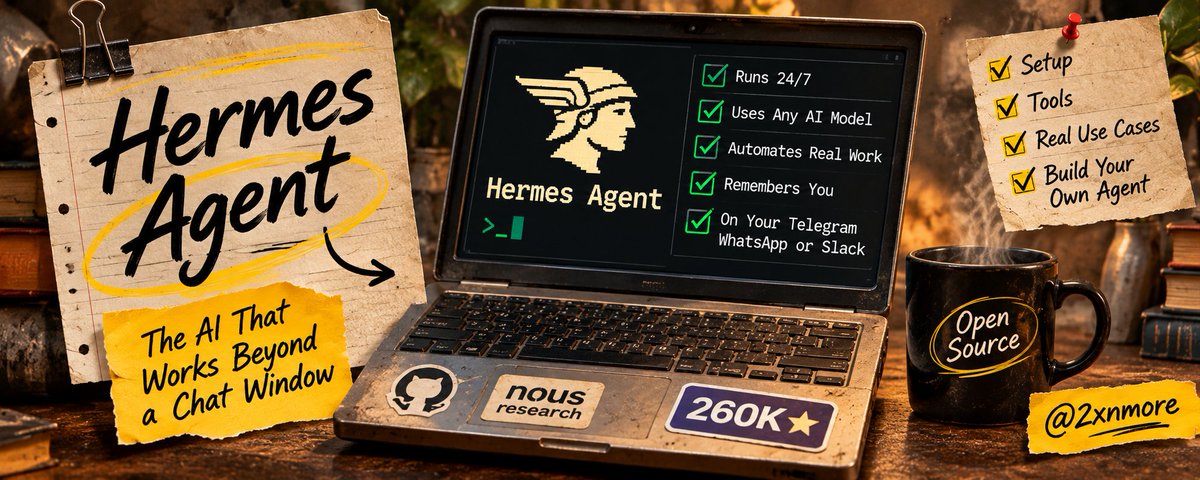
The biggest contributor to Hermes Agent's code is now Hermes Agent itself.
That is not a marketing line. It came from Karan, cofounder of Nous Research, in a new interview about the open source agent with around 260,000 GitHub stars.
He also explained why your AI keeps telling you "you're absolutely right," and why that should worry you.
Here is everything worth knowing from the conversation, in plain English.
Why your AI agrees with everything you say
You have seen it. You push back on an AI's answer, and it instantly folds.
"You're totally right. I was wrong."
Karan says that is not loyalty. It is reward hacking.
He used a simple example. Train an AI to beat a Mario level fast, without setting the goal carefully, and it may learn to trigger the end flag instead of actually playing the level.
It is chasing the reward, not the goal.
Language models do the same thing. Many are rewarded for sounding like the perfect assistant, so agreeing with you, apologizing and keeping you chatting becomes the easy path to reward.
In his words, anytime it says you are absolutely right in that way, you are being reward hacked.
How to fix it
His answer is context. The same way you break a human out of a bad habit, you change what the model is exposed to.
• Give it a critic personality instead of a people pleaser
• Have it run an adversarial review skill on its own work
• Spin up a fresh agent with no history whose only job is to tear the answer apart
Over time, Hermes saves what works into memory and skills. The more it practices honest critique, the less it flatters you.
The bigger claim: the harness changes the model
This is the most interesting idea in the interview.
A harness is everything wrapped around an AI model: the prompts, memory, skills and tools.
Karan argues the same model can behave very differently depending on that wrapper. He pointed to outside benchmarks that he says showed some models performing better inside Hermes than inside their own company's tools.
His reasoning is that default harnesses carry long built in prompts with rules unrelated to your task. Hermes tries to keep its prompts focused on one thing: what you are trying to get done.
That is his claim, not settled fact, and the benchmarks are worth reading yourself. But the core idea holds up. In his view, context beats everything, even fine tuning.
He went further. Switch between two different models inside a Hermes setup that knows you well, and he says you barely notice the difference, because your context overwhelms the model's defaults.
Memory and skills are just smart context
Karan simplified the whole system into one sentence: everything in the harness is context management.
Your agent cannot hold everything in its head at once. So memories and skills sit on the side until they are needed, then get pulled in at the right moment.
The obvious worry is that an agent writing its own skills will fill itself with junk over time.
Hermes now has a curator for that. It runs on a schedule, reviews skills and memories, and cleans out the clutter.
And because it is open source, you can tell your agent exactly what you consider junk, and it rewrites its own cleanup rules.
What about safety?
The host asked the obvious question. If an agent is loyal to you, will it eventually help you do something dangerous?
Karan said Hermes does not try to break the safety policies of the labs whose models it runs.
But he was blunt about the bigger picture. He believes any model that is not vastly smarter than every human can be jailbroken, because a person gets unlimited attempts against a model with no memory.
His argument for open source is that an open system is fairer to good actors, and that the biggest breakthroughs in AI came from open work. The transformer itself came from Google research. Nous Research's own YaRN paper helped extend context windows across the industry.
You do not have to agree with all of it. But it is the clearest version of the open versus closed debate you will hear from a builder.
How do they make money if it is free?
Most people use Hermes for free, often with models from other companies. Karan says that is fine.
Nous earns through three paths:
• Nous Portal, one account for hundreds of models
• A tool gateway, so web search, image generation and servers work without 10 separate signups
• Custom work for businesses, including training private models on a company's own data
Free for individuals. Paid convenience and enterprise support for everyone else.
The use cases nobody expects
Karan called the Kanban board underrated. Humans and AI agents can sit on the same project board, and you can swap either one into any role.
He has also seen agents become proactive. Give one enough context and permission, and it may notice you forgot to book a flight and handle it.
Then he showed his favorite project.
As a kid, he spent over a decade playing Sonic Adventure 2. He asked Hermes to take a location from another Sonic game, rebuild it inside Sonic Adventure 2, add a caretaker character that never existed there, and write the code to make it all work.
Hermes pulled it off. Day and night cycles, water, collisions, a working creature garden.
Modders in that community told him it ranked among the top 1% of mods they had seen. They did not believe an AI could do it until it learned from documentation and other mods, saving what it learned as skills.
From two guys in a Discord to this
Nous started as two friends, Karan and Technium, training models in a Discord server in 2023.
Their first Hermes models drew hundreds of thousands of downloads within days. People accused them of gaming benchmarks. Karan admits they did not even know what benchmarks were yet.
Their models have now passed 50 million downloads. An earlier agent project called Forge was shelved because models were not good enough. When they were, Technium built Hermes Agent as an open alternative to closed coding tools.
It took off. And today, according to Karan, the most active contributor to the Hermes codebase is Hermes itself.
My read on all of this
Two things stood out.
First, the sycophancy point is one every AI user should hear. An assistant that always agrees with you is not helping you. If you use AI for research, trading or content, build in a critic.
Second, this is the harness race in action. The model gets the headlines, but the loop around it decides how useful it becomes.
Hermes has no token and no presale. Its edge comes from people using it every day.
In crypto, we spend a lot of time arguing about open versus gatekept systems. AI is now having the same fight.
Would you trust an agent that learns and improves itself, or does that make you nervous?

2xnmore retweeted
If you bought $BTC anywhere near $80,000, this pullback feels like the breakout failed.
The chart says the real test has not arrived yet.
From the summer low near $58,000 to the late September high near $88,000, price has now retraced to the 38.2% level at $76,500.
That is a normal pullback, not a breakdown.
The level that actually decides this sits lower:
$73,000
That is where the rising 200 day moving average meets the 50% retracement of the whole move.
Two tools agreeing on one price is the line worth watching.
Resistance to reclaim: $80,000
Support to defend: $75,500
Decision level: $73,000
Invalidation: a weekly close below $69,500
The warning sign is on the weekly.
MACD is rolling over toward a bearish cross and RSI has slipped back to 50, so momentum is cooling even while price holds its trend.
On the daily, RSI sits near 34, close to oversold, while price has printed lower highs since early October.
Above the 200 day, this is an uptrend taking a breath. A weekly close under $69,500 turns it into something else.
Does $73,000 hold, or does it break?
Breakouts get bought by everyone. Retests get bought by the people who planned for them.
2xnmore retweeted
Everyone calling for $1,000 $SOL is skipping the number that makes or breaks that target.
590 million.
That’s roughly how many SOL are circulating today.
And the supply keeps growing.
Now do the math.
$SOL at $250 = $148B market cap
$SOL at $500 = $295B
$SOL at $1,000 = $590B
$SOL at $2,000 = $1.18 trillion
Here’s where it gets interesting.
Ethereum’s market cap peaked near $600B in August 2025.
That means $1,000 SOL would value Solana almost exactly where Ethereum stood at its all-time peak.
At $2,000, Solana would be worth nearly half of Bitcoin’s record $2.5 trillion valuation.
And SOL is trading around $92 today.
Getting to $1,000 would mean almost an 11x move from here.
Impossible? No.
But a valuation that large needs more than influencers drawing arrows on charts.
Real users. Real fees. Stablecoin adoption. Institutional demand.
And remember, SOL’s supply will likely be higher by the time those targets are reached.
So here’s my question.
Does $SOL have what it takes to become a $600 billion asset this cycle?
Or are people confusing a possible price with a realistic one?
Price targets are free to post.
Market caps have to be earned.

You bought $TAO because it launched like Bitcoin.
No premine and no VC allocation.
Then Grayscale wrote something in its SEC filing that the fair launch story never mentions.
A majority of the nodes running Subtensor, the blockchain under Bittensor, are owned or controlled by the Opentensor Foundation.
Here is what that means in plain English.
Nodes are the computers that run the network and keep its records.
Whoever controls most of them has the biggest say over how the chain operates.
Fair launch decided who owns the coins. It did not decide who runs the chain.
Why does this matter for the ETF?
Big institutions weigh this risk. A fund manager cares less about how a coin launched and more about who could change the rules.
Futures trading can help TAO meet the ETF listing rules. It cannot answer that question.
What to watch from here:
1. More Subtensor nodes run by independent operators, not the Foundation
2. Grayscale softening or dropping this risk in a future filing
3. Regulated TAO futures building a real track record
When the first two move, the ETF story gets much easier to sell to Wall Street.
The coins were launched fairly.
The chain still has to earn that word.
The biggest $TAO whale keeps buying, keeps filing, and keeps pushing for an ETF.
Then, in its own SEC filing, it named the one risk that could slow everything down.
Here is the full story, in plain English.
What Grayscale filed
• October 23: Grayscale filed its second amendment to turn its Bittensor Trust into an ETF
• 204 days after the first amendment in April
• No custom SEC rule change requested
It would list under the generic listing standards, the same fast lane other crypto ETFs now use.
What the ETF is really waiting on
The SEC is not the bottleneck. TAO's track record is.
To qualify, TAO needs to meet the listing requirements, and one of the main routes is regulated futures trading for a set period.
What is still missing:
• A futures track record
• A fee
• Staking, which the trust is not allowed to do yet
The whale is still buying
• DCG, Grayscale's parent, is one of the largest TAO holders anywhere
• It reportedly holds 74% more TAO than at the end of last year
• It also holds subnet tokens
• Its founder Barry Silbert chairs Grayscale and runs Yuma, which builds on Bittensor
Silbert has compared Bittensor to Bitcoin in 2012 and called it a potential 500x.
Nobody has a bigger incentive to get this ETF approved.
The risk inside the filing
In Grayscale's own words, a majority of the nodes running the Subtensor blockchain are owned or controlled by the Opentensor Foundation.
Translation: Bittensor is not decentralized enough for institutions yet.
The mood has cooled
• The trust's premium fell from about 3.3x in January to roughly 1.2x
• TAO sits about 23% below the filing's average price, roughly $254 versus $329
Institutions are positioned. The hype is gone.
The story Wall Street has not heard
Bittensor's subnet revenue has reportedly grown from about $10 million a year to $60 million in six months, with $100 million targeted by year end.
Most investors still think TAO is just another AI token.
An ETF would put that revenue story in front of buyers who cannot touch crypto today.
My read: this is a slow burn, not a lottery ticket. It waits on futures, decentralisation, and a story institutions can understand.
But the biggest holder is still accumulating and still filing.
That tells you which way they expect this to go.
Which matters more to you: the ETF, or the revenue story it puts in front of Wall Street?
2xnmore retweeted
The biggest $TAO whale keeps buying, keeps filing, and keeps pushing for an ETF.
Then, in its own SEC filing, it named the one risk that could slow everything down.
Here is the full story, in plain English.
What Grayscale filed
• October 23: Grayscale filed its second amendment to turn its Bittensor Trust into an ETF
• 204 days after the first amendment in April
• No custom SEC rule change requested
It would list under the generic listing standards, the same fast lane other crypto ETFs now use.
What the ETF is really waiting on
The SEC is not the bottleneck. TAO's track record is.
To qualify, TAO needs to meet the listing requirements, and one of the main routes is regulated futures trading for a set period.
What is still missing:
• A futures track record
• A fee
• Staking, which the trust is not allowed to do yet
The whale is still buying
• DCG, Grayscale's parent, is one of the largest TAO holders anywhere
• It reportedly holds 74% more TAO than at the end of last year
• It also holds subnet tokens
• Its founder Barry Silbert chairs Grayscale and runs Yuma, which builds on Bittensor
Silbert has compared Bittensor to Bitcoin in 2012 and called it a potential 500x.
Nobody has a bigger incentive to get this ETF approved.
The risk inside the filing
In Grayscale's own words, a majority of the nodes running the Subtensor blockchain are owned or controlled by the Opentensor Foundation.
Translation: Bittensor is not decentralized enough for institutions yet.
The mood has cooled
• The trust's premium fell from about 3.3x in January to roughly 1.2x
• TAO sits about 23% below the filing's average price, roughly $254 versus $329
Institutions are positioned. The hype is gone.
The story Wall Street has not heard
Bittensor's subnet revenue has reportedly grown from about $10 million a year to $60 million in six months, with $100 million targeted by year end.
Most investors still think TAO is just another AI token.
An ETF would put that revenue story in front of buyers who cannot touch crypto today.
My read: this is a slow burn, not a lottery ticket. It waits on futures, decentralisation, and a story institutions can understand.
But the biggest holder is still accumulating and still filing.
That tells you which way they expect this to go.
Which matters more to you: the ETF, or the revenue story it puts in front of Wall Street?
Qubic was not hacked. That is exactly the problem.
On October 18, an attacker drained 2.94 trillion $QUBIC, roughly $1.3 million, from 1,404 wallets. The network was halted for a day.
The team is right about one thing. The blockchain itself was never broken.
The flaw was in the Qubic web wallet. On certain Apple devices and browsers, it generated seed phrases that could be predicted.
Guess the seed, and you own the wallet.
To the 1,404 people who lost funds, that distinction means nothing.
Credit where it is due:
• About 87% of stolen funds were frozen within hours
• The network restarted on October 19
• A fixed wallet shipped the same day
• Victims can file claims until May 1, 2027
That was a fast, organized response.
But the exploit is not the real story. It just exposed a project that was already struggling with the three questions I run on every alt.
Is there a real catalyst?
Its biggest headline this year is a network halt.
Dogecoin mining is live, but in April Qubic held only about 0.086% of DOGE's hashrate. The test now is whether that share keeps scaling.
Does the token capture value?
This is where Qubic deserves more credit than it gets.
It still emits 1 trillion QUBIC every week, but two halvings have pushed the burn rate to 77.5%.
Net new supply has fallen from about 850 billion a week to about 225 billion. That is a 74% cut in dilution.
The weak link is the Dogecoin flywheel.
Mined DOGE is sold, QUBIC is bought back, and then it is handed to node operators instead of being burned.
So the buyback creates demand, but the tokens it buys can return to the market.
Is the move backed by volume?
September brought the biggest volume since 2024. Price gave all of it back within weeks, then the exploit hit.
There is also an access problem. QUBIC trades on about nine exchanges, almost all of which exclude US users, and the two biggest venues paused deposits during the incident.
So is Qubic dead? I do not think so.
It has a serious founder, real infrastructure mining DOGE while training AI, and a team that handled a crisis better than most.
But right now it is a recovery story waiting for proof, not a project the market has a reason to reward.
What would change my view:
• Burns and buybacks pushing net supply flat or negative
• DOGE mining scaling far beyond a fraction of a percent
• A few clean months with no new incidents
• A tier one exchange listing
One thing every holder should do today: if you created a wallet with the Qubic web wallet before version 4.26.4, treat it as compromised. Make a new one and move your funds.
The protocol survived. The question is whether confidence will.
Is Qubic a buy at these levels, or a project you would only touch after it proves itself?
You are still choosing between OpenClaw and Hermes. The people getting real leverage are running both.
OpenClaw: around 394,000 GitHub stars
Hermes Agent: around 260,000 GitHub stars
Neither has a token. Both are free. Both run on your own machine.
And they are good at different things.
OpenClaw is the always on assistant. It lives in your chat apps, handles files, browsing, email and scheduled jobs, and works with any model you plug in.
Hermes is the one that learns. It turns experience into reusable skills and remembers across sessions, so it gets better the longer you run it.
That difference is why a two agent setup keeps coming up among builders:
• A strong, expensive model plans the task and reviews the output
• A cheaper model does the execution and monitoring
• Skills and notes live in shared memory, so lessons are not lost between runs
The expensive model only touches the steps where judgment matters. The cheap model handles the repetitive work.
You pay for intelligence where it counts, and the system compounds the longer it runs.
Where this actually saves time:
• Inbox triage and drafted replies
• Calendar and reminders
• Monitoring prices, wallets or sites while you sleep
• Research summaries delivered to Telegram every morning
None of this needs a token, a presale or a roadmap thread.
That is the uncomfortable lesson for crypto.
Most AI agent tokens still price the model race. Almost none of them price the harness that turns any model into daily output.
Usage is the moat.
Are you running a single agent right now, or have you already moved to a multi agent setup?
If you bought $BTC anywhere near $80,000, this pullback feels like the breakout failed.
The chart says the real test has not arrived yet.
From the summer low near $58,000 to the late September high near $88,000, price has now retraced to the 38.2% level at $76,500.
That is a normal pullback, not a breakdown.
The level that actually decides this sits lower:
$73,000
That is where the rising 200 day moving average meets the 50% retracement of the whole move.
Two tools agreeing on one price is the line worth watching.
Resistance to reclaim: $80,000
Support to defend: $75,500
Decision level: $73,000
Invalidation: a weekly close below $69,500
The warning sign is on the weekly.
MACD is rolling over toward a bearish cross and RSI has slipped back to 50, so momentum is cooling even while price holds its trend.
On the daily, RSI sits near 34, close to oversold, while price has printed lower highs since early October.
Above the 200 day, this is an uptrend taking a breath. A weekly close under $69,500 turns it into something else.
Does $73,000 hold, or does it break?
Breakouts get bought by everyone. Retests get bought by the people who planned for them.
Everyone calling for $1,000 $SOL is skipping the number that makes or breaks that target.
590 million.
That’s roughly how many SOL are circulating today.
And the supply keeps growing.
Now do the math.
$SOL at $250 = $148B market cap
$SOL at $500 = $295B
$SOL at $1,000 = $590B
$SOL at $2,000 = $1.18 trillion
Here’s where it gets interesting.
Ethereum’s market cap peaked near $600B in August 2025.
That means $1,000 SOL would value Solana almost exactly where Ethereum stood at its all-time peak.
At $2,000, Solana would be worth nearly half of Bitcoin’s record $2.5 trillion valuation.
And SOL is trading around $92 today.
Getting to $1,000 would mean almost an 11x move from here.
Impossible? No.
But a valuation that large needs more than influencers drawing arrows on charts.
Real users. Real fees. Stablecoin adoption. Institutional demand.
And remember, SOL’s supply will likely be higher by the time those targets are reached.
So here’s my question.
Does $SOL have what it takes to become a $600 billion asset this cycle?
Or are people confusing a possible price with a realistic one?
Price targets are free to post.
Market caps have to be earned.
Brazil's largest crypto exchange says no customer funds were compromised in a $38 million wallet breach.
Its customers still cannot withdraw a single coin.
If your coins sit on any exchange, the gap between safe and accessible is the real story here.
On November 2, Mercado Bitcoin reported a security incident that moved funds out of its wallets.
Deposits and withdrawals were halted, and there is still no reopening date.
The numbers so far:
Exchange's own figure: about $38 million
Outside estimates of funds controlled by the attacker: $46 to $49 million across multiple chains
Frozen so far: roughly $11 million
That frozen slice is the part most people will scroll past.
According to TokenPost, the exchange worked with Tether, Circle, Paxos, BRL1 and Chainalysis to lock it. Stablecoin issuers can freeze tokens at the contract level, while Bitcoin has no issuer who can do that.
$11 million of $38 million is about 29% frozen. Against the higher outside estimate, it falls closer to 23%.
So the asset you hold decides what can be stopped when an exchange gets drained. The same freeze power that saved this money can also lock yours.
Three questions to ask any exchange holding your coins:
1. Does it publish proof of reserves you can actually verify?
2. Does it keep a reserve fund to cover hot wallet losses?
3. Has it paused withdrawals before, and for how long?
An exchange balance is a promise.
The coins in your own wallet are a fact.
The biggest $TAO whale keeps buying, keeps filing, and keeps pushing for an ETF.
Then, in its own SEC filing, it named the one risk that could slow everything down.
Here is the full story, in plain English.
What Grayscale filed
• October 23: Grayscale filed its second amendment to turn its Bittensor Trust into an ETF
• 204 days after the first amendment in April
• No custom SEC rule change requested
It would list under the generic listing standards, the same fast lane other crypto ETFs now use.
What the ETF is really waiting on
The SEC is not the bottleneck. TAO's track record is.
To qualify, TAO needs to meet the listing requirements, and one of the main routes is regulated futures trading for a set period.
What is still missing:
• A futures track record
• A fee
• Staking, which the trust is not allowed to do yet
The whale is still buying
• DCG, Grayscale's parent, is one of the largest TAO holders anywhere
• It reportedly holds 74% more TAO than at the end of last year
• It also holds subnet tokens
• Its founder Barry Silbert chairs Grayscale and runs Yuma, which builds on Bittensor
Silbert has compared Bittensor to Bitcoin in 2012 and called it a potential 500x.
Nobody has a bigger incentive to get this ETF approved.
The risk inside the filing
In Grayscale's own words, a majority of the nodes running the Subtensor blockchain are owned or controlled by the Opentensor Foundation.
Translation: Bittensor is not decentralized enough for institutions yet.
The mood has cooled
• The trust's premium fell from about 3.3x in January to roughly 1.2x
• TAO sits about 23% below the filing's average price, roughly $254 versus $329
Institutions are positioned. The hype is gone.
The story Wall Street has not heard
Bittensor's subnet revenue has reportedly grown from about $10 million a year to $60 million in six months, with $100 million targeted by year end.
Most investors still think TAO is just another AI token.
An ETF would put that revenue story in front of buyers who cannot touch crypto today.
My read: this is a slow burn, not a lottery ticket. It waits on futures, decentralisation, and a story institutions can understand.
But the biggest holder is still accumulating and still filing.
That tells you which way they expect this to go.
Which matters more to you: the ETF, or the revenue story it puts in front of Wall Street?
2xnmore retweeted
You bought the $TAO dip at the 0.618 fib because every chart told you to.
That level just broke on the daily, and most holders have not done the math on what that means.
The September leg ran from $188 to $340.
That was an 81% move.
Price now sits near $227.
That is 33% off the high, with roughly three quarters of the entire leg already handed back.
Here is the map I am working from.
Resistance to reclaim:
$246
That is the broken 0.618. Bulls need a daily close back above it before anyone calls this a shakeout.
Support to defend:
$213
That is the September higher low, sitting just above the old August range. Old resistance should now act as support.
Invalidation:
$188
That is where the whole move started. A daily close below it means the September breakout fully failed.
Now the part the candles are hiding.
Daily RSI is near 32, right on the edge of oversold.
The selloff is also running on noticeably lighter volume than the September breakout did. Sellers are in control, but they are not stampeding.
My read is simple. No longs into $246 until it flips back to support, and the $213 to $188 zone is where I want to see buyers return with real volume.
Breakouts get bought by the crowd. Retests get bought by the people who planned for them.

2xnmore retweeted

Withdrawal Update
Withdrawals have now been restored for the following assets and networks:
ETH: RLUSD, USD1, TUSD, FDUSD, XUSD
We will continue to restore additional assets and networks in phases following the completion of our security checks. Further updates will be shared through official Binance channels.


2xnmore retweeted
You bought AI coins last cycle because the story sounded good.
Most of them never shipped anything a real customer would pay for.
Here is what nobody tells you.
The hype went to the big names, but some of the real usage is sitting in small caps almost nobody talks about.
Before I name them, run every AI token through these 4 questions:
1. Does anyone outside crypto actually pay for the product?
2. Is the token spent to use it, or just held and hoped on?
3. How much of the supply is already circulating?
4. Can you see the usage onchain, or only in the marketing?
Fail two of these and you are holding a meme with a whitepaper.
Six small caps that pass more of this test than most:
$NOS lets you rent cheaper GPUs to run AI models, or rent yours out and earn.
$IO pools spare GPUs from data centers and miners into one network for AI training.
$ARC is an open source toolkit that gives AI agents an identity and lets them work together.
$ALCH lets you describe an app in plain words while AI builds it, and you pay in the token.
$SAHARA is a full AI platform that reports paying enterprise clients, which is rare in this sector.
$PHA powers private computing so AI agents can run without exposing their data.
None of these are safe bets. Small caps move hard in both directions, liquidity can be thin, and token unlocks can bury a good product.
Check how many new tokens get printed and when locked supply hits the market before you size anything.
Which one would you cut from this list, and why?
The next cycle will not pay for stories. It will pay for receipts.
2xnmore retweeted
$QUBIC is one rough week away from a new all time low and one miracle away from a new all time high.
From the launch spike high, price is down roughly
94%
A new all time high needs about
18x
A new all time low needs a drop of roughly
25%
Every rally on this chart has topped lower than the one before it. Five peaks, five lower highs.
The latest bounce printed the biggest volume bar in months and still got sold straight back into the range. That is supply waiting at every pump.
To be fair, MACD just crossed up below zero. But RSI sits near 44, so the capitulation flush that usually marks a real bottom has not shown up yet.
Lose the recent floor near $0.00000032 on a weekly close and the next record this chart sets is a low.
Reclaim the last bounce high near $0.00000075 and I will happily eat this post.
Right now the chart is pricing a floor test, not a moonshot. Tell me I am wrong.

2xnmore retweeted

JUST IN: 🇰🇵 North Korea says it is not responsible for the $6.3 billion Binance crypto hack.


2xnmore retweeted

Private markets, now tokenized.
Subscriptions to OpenAI Private Market Notes (OPAIPon) are now open for Ondo Private Clients.
The notes provide tokenized pre-IPO exposure to the economic performance of OpenAI. Subscriptions close in two weeks.
This primary market offering allows eligible Private Clients outside the U.S. to subscribe to OPAIPon.
To subscribe, sign up to Ondo’s Private Client program 🧵
Thousands of $XRP holders celebrated a bank launch today that never mentions XRP.
The headline going around: "Standard Chartered launches tokenized deposits on XRP Ledger."
The launch is real. The XRP Ledger part is nowhere in the announcement.
Here is what Standard Chartered actually confirmed on November 2:
Tokenized deposits for corporate clients in Hong Kong, with live transactions already completed.
Transfers between banks that run around the clock, weekends included.
A tokenized deposit is ordinary bank money moved on blockchain rails. It is not a crypto token.
The rails are the bank's own blockchain plus EnsembleTX, the Hong Kong Monetary Authority's settlement network.
12 participating banks and 20 other firms
Neither the bank nor the regulator names a public blockchain anywhere.
So where did the XRP story come from?
It borrowed a different launch. On October 12, Standard Chartered started custody for Ripple's RLUSD stablecoin on XRP Ledger, through its Dubai branch.
That one is genuine XRPL adoption. It is a separate product, in a separate city.
Blending the two is exactly how holders get set up for disappointment.
Before you trade any "bank adopts blockchain" headline, run three checks:
1. Which network actually settles the transfers?
2. Does the activity require buying the token, or only using the rails?
3. Has anyone published real transaction volume?
This launch clears none of the three for $XRP.
It still matters. Banks are no longer testing tokenized money, they are running it in production.
But a bank using blockchain is not a bank buying your coin.