Entrepreneur | Advisor | Author #ArtificialOrganizations #Unlearn #LeanEnterprise | Cofounder AI Venture Studio @NobodyCrowd | Faculty @singularityu
Singapore
Joined June 2010
- Tweets20.1K
- Following1K
- Followers7.2K
- Likes2.4K






Pinned Tweet
I’m excited to share that my new book, Artificial Organizations, is coming out in mid-March!
I’ve been working on this over the past number of months, driven by a simple question I keep hearing from executives:
How do we pair human intuition with machine insight to actually get better outcomes, not just more activity?
This book is for leaders navigating that shift in how we work in high-paced environments.
Not AI as a tool. Not AI as automation.
But AI as a thinking partner that helps you make better decisions, faster without losing judgment, context, or humanity.
Sign up at artificialorganizations.com/ to be notified of the official book release!
How you behave as a leader shapes what your teams feel able to do with AI.
Asking people to experiment carries more weight when they can see you trying it yourself, working through difficulties, and sharing what you’re learning.
In the latest Unlearn Podcast, Cassandra Pratt, CHRO at @Progyny, and John Marcante, former Global CIO of @Vanguard_Group, join me to discuss the leadership behaviors that help govern AI.
Cass shares what it takes to build employee confidence while changing how work gets done. John explores the accountability leaders need to establish and the judgment they must continue to exercise themselves.
We talk about how those responsibilities show up in everyday decisions, especially when progress is slower and the answers less certain than expected.
Listen to “The Leadership Behaviors to Best Govern AI” below.
🔗 barryoreilly.com/explore/pod…

“We’ve learned a lot” should lead to a decision about what happens next.
An AI review can surface useful findings and still leave teams waiting for someone to act on them. The leadership responsibility continues after the discussion ends.
A useful review should give people direction: a change to test, someone responsible for it, and a way to assess whether it helped.
That link between learning and action is central to what John Marcante @Jtmarcante and I describe as behavioral governance.
Read more on “From Software Governance to Behavioral Governance”:
barryoreilly.com/explore/blo…
1/2


A faster task does not always create a better-performing organization.
AI can increase output while review time, rework, decision speed, and customer outcomes remain unchanged. That’s why leaders need to follow the work further before calling an AI initiative successful.
In this video, I share four questions that can help distinguish increased activity from genuine improvement.
Where can your organization point to a measurable outcome created by AI?
Take the 10-minute AI Outcomes Survey and establish your baseline:
artificialorganizations.com/…
What happens when AI activation starts at the top? And leaders are given the space to put it into practice?
Over the past few months, nearly 2,000 @Rabobank leaders have participated in our Leadership AI Activation Labs, from the Managing Board to senior leaders across the organization.
The journey began in May in London, working with the Board on what it means to role-model AI leadership in their daily work. Not simply by using new tools, but by applying AI to improve judgment, accelerate decisions, and achieve better outcomes.
Since then, we’ve worked with Rabobank’s top 100 and broader senior leadership community to bring those ideas into the everyday realities of leading a major organization.
What struck me most was the energy in every room, the curiosity, thoughtful challenge, practical experimentation, and a genuine willingness to learn.
Each participant received a copy of Artificial Organizations and explored how its principles could apply to their own decisions, workflows, teams, and leadership practices.
Now the experiments are multiplying. Confidence is growing. New possibilities are emerging across the bank.
The next step is the one that matters most, translating that momentum into measurable improvements in decision quality, speed, and business results.
Thank you to everyone at Rabobank who made these labs possible, and to every leader who showed up ready to question, experiment, and lead.
We’re only getting started. And will be measuring their AI outcomes!

The day you deploy AI is the beginning of a new governance responsibility.
You can establish guardrails, approve the tools, and grant people access. Then someone starts using AI to make a recommendation that a colleague would previously have questioned.
Does anyone still challenge it? Who checks whether the decision was better?
Leaders need to pay attention to these things as people start working differently.
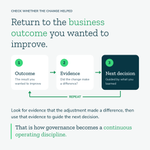
If a team gets answers faster but spends more time correcting mistakes, that should change the conversation. If AI keeps surfacing the same confusion about a policy, someone needs to examine the policy.
That’s why John Marcante and I encourage executive teams to keep returning to the three questions illustrated here.
Bring examples from the work. Look at what people are doing, where they need support, and whether the results justify continuing the approach.
Then use what you learn to change it.
We explore this in “From Software Governance to Behavioral Governance,” the second article in The Adaptive Enterprise series.
🔗 Read more: barryoreilly.com/explore/blo…

Your AI can pass every technical check while leaving the way your business works unchanged.
For the past forty years, governance has focused primarily on technology. As AI increasingly influences human decisions, leaders need to examine how people work with it and whether that work produces better outcomes.
That shift starts with leadership’s own behavior.
When John Marcante @Jtmarcante took Vanguard’s executive team to Silicon Valley, they expected to discover better technology. They came home recognizing that their own leadership behaviors needed to change first.
John and I explore that responsibility in our second article in The Adaptive Enterprise series.
We call it behavioral governance: how leaders guide the way people use AI, learn from what happens, and assess whether the business is improving.
Read more: barryoreilly.com/explore/blo…

AI use is easy to count. Its impact on business outcomes is harder to measure.
That raises a bigger question, where is AI improving organizational performance, and where is AI investment failing to create a return?
The research that helped inspire my book, Artificial Organizations, showed me the value of understanding how AI changes work for leaders, teams, and entire organizations.
Automating a task may help you work faster, but if decision-making or customer response times remain unchanged, organizational performance has not improved. To understand AI’s impact, we need to look beyond usage and examine the outcomes it produces.
These are the questions the Artificial Organizations Research Program is seeking to answer.
Establish a baseline for yourself and your organization in 10 minutes, and see where you stand relative to the market:
👉 geni.us/measuring-ai-outcome…

The only thing I love more than signing stacks of Artificial Organizations books is leaders, teams and organizations taking 10 minutes to baseline their AI outcomes against the market at artificialorganizations.com/…
Learn what human behaviors that leverage machine intelligence drive business outcomes.
What does it take to translate a book about AI while using AI as part of the process?
I recently sat down with Ignaz Furger, who translated Artificial Organizations into German as KI als Denkpartner.
In our conversation, we discussed how he approached the translation, where AI supported the process, and why human judgment remained essential to ensure the ideas worked for German-speaking readers.
Watch our conversation on YouTube: youtu.be/9-sMp7M375E
#ArtificialOrganizations #KIalsDenkpartner #ai #leadership

Where does AI value get lost between a leadership decision and the teams responsible for making it happen?
On October 27, I'll be joining Jeremy Vianna @jvianna, VP of Strategic Growth at @nearform, for an Impact Talks webinar on how leadership decisions shape the results organizations get from AI.
We'll dig into a few important questions:
- Where is AI value getting lost in key decisions?
- How can we use AI to strengthen our judgment rather than replace it?
- How do we know if an AI pilot is worth pursuing in the first place?
Peri Kadaster, Chief Communications Officer at Nearform, will be moderating the conversation.
🗓️ Save your seat for Oct 27: watch.getcontrast.io/registe…
#aileadership #artificialorganizations #enterpriseai #nearform

The work people are proudest of can be the hardest to let go.
At @Vanguard_Group, financial advisors had built their expertise around activities such as portfolio construction and asset allocation. As those activities became automated, they faced a personal question about where their value came from.
Leaders introducing automation need to take that question seriously. A plan for greater efficiency gives people little direction about how to use the expertise they have spent years developing.
This week on the Unlearn Podcast, John Marcante @Jtmarcante shares how they approached that transition and helped advisors focus their attention on the decisions that mattered most to clients.
His experience makes the human side of work redesign very concrete.
Listen now on Unlearn:
- Website: barryoreilly.com/explore/pod…
- YouTube: youtu.be/OpKmVuJdH1I?si=2Z8I…
An AI experiment can appear successful because people produced more or completed a task faster.
The harder question is whether the work actually make your situation better.
Without a baseline, teams struggle to show whether AI reduced rework, protected quality, accelerated decisions, negatively impacted or improved a meaningful outcome.
The Artificial Organizations Research Program, and Measuring AI Outcomes study can help you understand where AI is contributing to performance and what may be holding progress back.
Take the survey: artificialorganizations.com/…
10 minutes of your time, could unlock hours of capacity to reinvest in the work that really moves your desired outcomes.


Barry O'Reilly retweeted

How well is AI working in your own decisions?
Join @barryoreilly and Jeremy Vianna to hear how leading executives use AI to build the judgement infrastructure that better decisions depend on.
🗓️ 27th October
📌 Register to join >> nf.ie/Impact-talks

How much of your technology progress can the business actually absorb?
At Vanguard, John Marcante’s @Jtmarcante team made IT faster through its cloud journey. But the business struggled to adopt the changes, leaving clients with only incremental improvements.
For executives under pressure to show results from AI investment, that experience raises an uncomfortable possibility: the technology team can deliver what was asked for while the organization remains unable to benefit fully.
In the latest episode of the Unlearn Podcast, John shares what they had to reconsider and why business and technology teams needed a shared definition of success.
It’s a useful lesson to revisit as leaders set expectations for AI.
Listen to the full episode with John:
- Website: barryoreilly.com/explore/pod…
- YouTube: youtu.be/OpKmVuJdH1I?si=2Z8I…
An AI rollout can meet its adoption targets and still leave leaders struggling to explain the return.
John Marcante @Jtmarcante and I explore the leadership choices behind that gap in our first podcast for The Adaptive Enterprise series.
At @Vanguard_Group, John saw technology delivery accelerate while the business struggled to absorb the changes. His experience offers a useful starting point for leaders facing pressure to turn AI investment into better business performance.
We discuss what needs to change in how teams work together, where human expertise creates value, and how executives lead while learning themselves.
Listen to the latest episode of the Unlearn Podcast: “Why AI Adoption Alone Won’t Create Business Value” 👇
barryoreilly.com/explore/pod…

A team can produce more with AI and still be unsure whether the work has improved.
More output is one signal. Less rework, better decisions, greater capacity, or shorter customer waits tell us more about what has changed across the organization.
The Artificial Organizations AI Executive Research Program 2026 is gathering evidence from people experiencing these changes at work. If AI has created progress, friction, or uncertainty for your team, we’d value your perspective.
Take the survey: artificialorganizations.com/…
Allow about 10–15 minutes to complete it.

Measure AI Outcomes: Is AI Making Your Organization Better? xitter.cf/i/broadcasts/1qGoNYRAE…