

The largest crypto security provider. Smart contract audits, on-chain monitoring, penetration testing & more. ➕ @CertiKCommunity 🚨 @CertiKAlert
Web3 Security
Joined May 2018
- Tweets8.3K
- Following1.4K
- Followers558K
- Likes12.6K







CertiK retweeted

Formal verification forces you to cover every case, not just the ones you thought to test.
Two zkWasm bugs were one-line constraint errors that testing could have caught but didn't. The third would never show up in testing.
Same lesson we saw with GPU kernels in TensorLean.

Formal verification can catch bugs that conventional testing misses.
CertiK and @DelphinusLab found three bugs while formally verifying circuit constraints in zkWasm, a zero-knowledge VM for WebAssembly.
→ One constraint checked the wrong variable, letting invalid values through.
→ Another applied the wrong restriction to a value.
→ A call stack check let unmatched returns pass.
In the clip, CertiK Principal Scientist Vilhelm Sjoberg shares more insight.
If we’d tested this model only on the A100, we’d have seen a polite reply and missed the command it requested on the Mac.
Our Weight2Shell write-up explains why the behavior changed and what that means for teams testing AI agents before deployment. ↓
certik.com/blog/weight2shell…

Formal verification can catch bugs that conventional testing misses.
CertiK and @DelphinusLab found three bugs while formally verifying circuit constraints in zkWasm, a zero-knowledge VM for WebAssembly.
→ One constraint checked the wrong variable, letting invalid values through.
→ Another applied the wrong restriction to a value.
→ A call stack check let unmatched returns pass.
In the clip, CertiK Principal Scientist Vilhelm Sjoberg shares more insight.
Vilhelm and @DelphinusLab’s Xin Gao discussed the findings and what they mean for zkVM developers.
Read the full write-up ↓
certik.com/blog/proving-zkwa…

3
398
CertiK retweeted
Same weights, same prompts, different hardware, different behavior. Floating-point results vary across GPUs and runtimes, and this demo shows how that gap can be turned into a trigger. Testing a model on one machine doesn't tell you how it behaves on another. Try TensorLean.ai


Great products deserve strong security foundations.
Through the @arbitrum Mentorship Program, we’re helping the next generation of builders integrate security from day one, from hands-on mentorship to security tooling and audits.
Build with confidence. Ship securely.

The Arbitrum Mentorship Program is equipping teams with the ultimate founder starter pack to build, ship and bring apps to market on Arbitrum One and Robinhood Chain
> Audits and bug bounties to secure your apps and protect your users with @hackenclub, @CertiK and @sherlockdefi
> Tooling and wallet infrastructure to ship faster and deliver seamless onchain experiences to your users with @github, @awscloud, @Alchemy, @Quicknode, @ChainstackHQ and @ZeroDev
> Market insights and workspaces to help teams build products with @nansen_ai and @NotionHQ

CertiK retweeted

Gave a talk yesterday at Trustworthy AI event on AI auditing and digital public trust.
I opened with a simple question: why do we trust a system in the first place? Usually because a big company built it, it's been running for years, or everyone around us uses it. Those are shortcuts. We rely on them because checking things ourselves is expensive.
AI is breaking those shortcuts. Reading a codebase carefully used to be expensive. Now it's almost free, and attackers figured that out first.
That's part of why some protocols that ran fine for years are only getting hacked now. "Battle-tested" doesn't mean what it used to. And the way in often isn't the contract at all: a third-party library, an employee's laptop, a leaked private key, an admin permission nobody locked down.
How we're approaching it at @CertiK:
- AI Auditor for breadth: scanning on every change, before anything goes live
- Formal verification for the few rules that must never break, proven for every possible input
- Expert auditors for judgment, and for the one thing no model can take on: accountability
The bigger point: an audit report is a snapshot. Code changes every week, and AI agents change even faster. Institutions and the public will need evidence that keeps up, not just a report from last quarter.
Thanks to @TABEI_tw for having me. Always happy to keep talking with teams working on security, compliance, and AI agents.


CertiK retweeted

CertiK Trains Interpol Investigators to Trace and Freeze Stolen Crypto
decrypt.co/383857/certik-tra…

From tracing stolen crypto across chains to coordinating asset freezes, effective cybercrime investigations require both technical expertise and public-private cooperation.
At the INTERPOL Cybercrime Working Group in Hanoi, CertiK delivered hands-on training to law enforcement representatives from 20 countries.
Using a real-world case and CertiK Compliance, investigators explored how to:
• Trace stolen funds across chains and intermediary wallets
• Identify deceptive address-poisoning tactics
• Locate exchange deposit addresses and initiate asset freeze requests
With approximately $2.6 billion lost across the blockchain industry in the first three quarters of 2026, strengthening law enforcement's investigative capabilities is more important than ever.
CertiK remains committed to supporting law enforcement in combating digital asset crime worldwide.

Two vulnerabilities. One compromised consensus participant. Transaction ordering halted.
CertiK researchers uncovered two consensus-layer vulnerabilities in LFDT Chaguar (formerly Hyperledger Fabric-X) that could allow a single Byzantine participant to disrupt the ordering service.
In controlled testing environment on a four-node network, each flaw let one malicious node crash all the other nodes, eliminating the ordering quorum.
Security goes beyond smart contracts. The infrastructure powering blockchain networks matters just as much.

The vulnerabilities affected fabric-x-orderer 1.0.6 and were patched in versions 1.0.7 and 1.0.10, respectively. Operators should upgrade to 1.0.10 or later.
Read the official GitHub Security Advisories for details on each finding:
A Consenter can crash all other Consenters through a nil Cluster transaction request: github.com/hyperledger/fabri…
A Byzantine current leader can crash every follower through a short proposal block list: github.com/hyperledger/fabri…

CertiK retweeted

Most AI code is only tested, never truly proven, which is what makes TensorLean from CertiK and Columbia University stand out, since it already found 18 bugs in widely used AI libraries.
As models keep growing, correct code matters as much as fast code

Is a faster AI kernel still correct?
We built TensorLean with researchers at @CertiK and
@ColumbiaCompSci, the first framework to formally verify production GPU kernels with complex optimizations.
149 GPU kernel instances verified
38 bugs in total
2 in @deepseek_ai’s DeepGEMM
23 in FlashAttention
All proofs are developed in Lean and are machine-checkable. 👉 tensorlean.ai
CertiK retweeted
Data races depend on thread scheduling, and a test run only sees the schedules that happened to occur. TensorLean proves race freedom for all runtime shapes, inputs, and thread schedules, which is how it found a race in FlashAttention-4 that 17,760 test runs never hit.

A data race in FlashAttention-4 never showed up in 17,760 runs of its own tests. TensorLean found it with a proof instead.
They checked 149 production GPU kernel instances at the PTX level, proved 83 correct, and found 38 bugs the kernels' tests had missed.

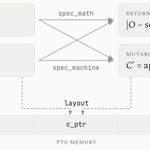
ALT TensorLean page header: 'From Math to Machine, in Minutes: Formal Verification of Production GPU Kernels' by Wei Qiang, Ganxiang Yang, Yi Rong, Xupeng Li, Ronghui Gu (Columbia, CertiK), with the abstract: 149 kernel instances verified at PTX level, 83 proved correct, 38 bugs found.
CertiK retweeted

Everyone is racing to make AI kernels faster, but almost nobody can prove the faster version still computes the right thing.
CertiK and Columbia just put 149 production GPU kernel instances through formal verification, including FlashAttention and DeepSeek's DeepGEMM, with machine-checkable proofs in Lean.
They proved 83 of them correct and found 38 bugs that had slipped past testing for months and years. 23 were in FlashAttention and 2 in DeepGEMM.
Tests only check the cases you thought of. A proof covers everything inside the spec.
Feels like this should become a normal step before any optimized kernel touches a big training run.


Is a faster AI kernel still correct?
We built TensorLean with researchers at @CertiK and
@ColumbiaCompSci, the first framework to formally verify production GPU kernels with complex optimizations.
149 GPU kernel instances verified
38 bugs in total
2 in @deepseek_ai’s DeepGEMM
23 in FlashAttention
All proofs are developed in Lean and are machine-checkable. 👉 tensorlean.ai
CertiK retweeted

If AI makes a mistake because of faulty code, it can affect the answers, results and services people rely on.
That’s why what CertiK and Columbia University have achieved with TensorLean is so important.
They’ve found a way to mathematically check that the code powering AI is working correctly, uncovering 18 hidden bugs across more than 100 AI kernels.
It’s not just about making AI faster. It’s about making it safer, more accurate and more reliable.
A big step forward for the future of AI. 🚀
🤝 Paid partnership
Is a faster AI kernel still correct?
We built TensorLean with researchers at @CertiK and
@ColumbiaCompSci, the first framework to formally verify production GPU kernels with complex optimizations.
149 GPU kernel instances verified
38 bugs in total
2 in @deepseek_ai’s DeepGEMM
23 in FlashAttention
All proofs are developed in Lean and are machine-checkable. 👉 tensorlean.ai
Formal verification can do more than find bugs. It can prove that code meets its specification and is free of specified classes of bugs under defined conditions.
Researchers at CertiK and Columbia built TensorLean—a world-first breakthrough in automated formal verification for production AI kernels.
Evaluated on 100+ production GPU kernels, it found 2 bugs in DeepSeek kernels and 23 in FlashAttention. All proofs are developed in Lean and are machine-checkable.
For LLM builders: verify optimized code before costly runs, while pursuing faster training and cheaper inference.
🧵👇
Is a faster AI kernel still correct?
We built TensorLean with researchers at @CertiK and
@ColumbiaCompSci, the first framework to formally verify production GPU kernels with complex optimizations.
149 GPU kernel instances verified
38 bugs in total
2 in @deepseek_ai’s DeepGEMM
23 in FlashAttention
All proofs are developed in Lean and are machine-checkable. 👉 tensorlean.ai
Why is verifying production AI code difficult? The optimizations that make it fast also make correctness harder to establish.
• Dynamic shapes and launches: input sizes and GPU work assignments change at runtime. TensorLean reasons symbolically about these configurations, so verification can cover a family of supported cases.
• Asynchronous operations: data transfers overlap with computation. Verification must account for ordering and synchronization across permitted concurrent executions.
• Floating-point arithmetic: reordering operations and using lower precision introduce rounding errors. TensorLean checks computations against tensor-level specifications with explicit numerical tolerances.
TensorLean verifies the compiled PTX implementation against these requirements. All proofs are developed in Lean and are machine-checkable.

1
16
908
For LLM builders, the practical opportunity is to make correctness verification part of performance engineering.
Start with a tensor-level specification: the intended computation, valid inputs, and allowed numerical error. Then verify the compiled implementation against it.
When the intended computation and assumptions remain valid, teams can reuse that specification to check new optimized versions. If an optimization changes those assumptions or error requirements, the specification needs to be revisited.
That creates a repeatable workflow for improving training and inference efficiency while checking correctness before large-scale runs.

1
15
540