

Non-custodial passive income tool in $USDT up to 30% APY, powered by 7 years in crypto and 18 in finance. Low-risk: no trading or volatile assets.
Web3
Joined December 2022
- Tweets7.2K
- Following1.9K
- Followers4.7K
- Likes40.9K





Pinned Tweet
💸 Is your money just sitting there?
DSF Invest helps anyone grow wealth with stablecoins! Perfect for entrepreneurs, advisors, freelancers, or anyone seeking passive income.
💸 Earn 17% annually, safely and effortlessly. No DeFi expertise needed.
👉Start now at DSF Invest and research on why our tool is safe.
#summersonic2025 #DeFi
🔔 Incident Update
We continue to work on the DSF Finance incident. Today, we'd like to share several important steps we've taken together with independent experts and specialized organizations.
Independent specialists have joined our efforts, helping us track asset movements on-chain, analyze transactions, and prepare technical materials for the investigation.
We would also like to extend our thanks to @SEAL_911 , a Security Alliance initiative dedicated to responding to security incidents in the crypto industry. Their team is providing support on a voluntary basis.
We are also working with law enforcement authorities through these specialists. Addresses associated with the unauthorized withdrawal of assets have already been flagged and are being monitored. This enables crypto services participating in monitoring efforts to identify funds linked to the incident and may make it more difficult for the perpetrators to move or use them.
To protect the integrity of the investigation, certain technical and procedural details are not being disclosed at this stage.
We understand how important it is for our users to stay informed, and we will continue sharing verified updates as significant developments emerge.
Thank you for your patience and support. We remain committed to our work and will keep you informed.
🔔 DSF Security Incident — Investigation Update
Our team continues working to establish the full circumstances of the incident and support the ongoing investigation.
Medical samples have been collected for analysis, and we are working with law enforcement authorities to document the incident and establish the facts.
We will share the official case number and additional verified details as soon as they become available and can be disclosed.
We remain committed to keeping our community informed as the situation develops.
🔔 DSF — Status Update
The DSF team remains active and continues working through the aftermath of the recent incident.
We remain fully committed to our community and will continue sharing updates through our official channels.
A comprehensive incident report will be published in due course. We will share further updates as more verified information becomes available.
The DSF smart contract remains temporarily paused while we investigate the incident and assess its implications.
Thank you for your patience, and continued support.


🔔 Important Security Notice
Please stop interacting with the DSF smart contract until further official notice from the team. Do not deposit funds or carry out any transactions through it.
Following an armed assault on DSF’s CTO, attackers obtained administrative access to the smart contract by threatening his life. The team is currently no longer in control of the service. Preliminary information indicates that the attackers withdrew funds; the details are still being established.
We have contacted blockchain specialists and are working to establish the circumstances of the incident. We will publish verified information and further instructions in this channel.



💼 Diversification is no longer just an investment principle - it is a key layer of capital protection
In calmer, more predictable markets, investors could afford to take more risk in search of higher returns.
But today markets are shaped by too many variables at once: inflation, rates, liquidity, geopolitics, regulation, investor sentiment, hidden dependencies, and sudden stress events.
When a strategy depends on one asset, one platform, one instrument, or one market scenario, it may look stable — until the first real shock.
That is why professional capital management treats diversification not as an optional feature, but as a structural requirement.👇

3/4
In other words, even major institutional players now recognize the same thing:
when inflation, rates, geopolitics, liquidity, and regulation can all affect markets at the same time, capital cannot depend on one familiar model or one version of the future.
👉 When traditional portfolios offer less protection exactly when investors need it most, capital has to be managed differently. Portfolios must be built for multiple scenarios.
4/4
🔭 And this is where crypto becomes more complicated
🧐In crypto, diversification does not simply mean buying several different tokens.
A portfolio can hold 10 assets and still be exposed to the same market mood, the same liquidity cycle, the same exchange, the same risk appetite, or the same exit problem.
The real question is: “What risks is my portfolio actually diversified against?”
How to add a layer of stability to a portfolio without taking on unnecessary risk — we’ll break that down in future threads.
👉How do you currently diversify your capital? Especially the crypto part?🤩
📈 DSF Leads an Expert Session on Web3 Capital Management
Over the past few weeks, we have held several sessions for financial advisors — both online and offline. The topic proved to be even more relevant than we expected.
While the retail market often talks about crypto in terms of “where can I put money to get the highest return?”, professionals ask a different set of questions: Where is the capital held? Who controls withdrawals? Where does the yield come from? What risks are not visible from the landing page? And what happens to the product under stress?
🔭 What we covered
▶️ how capital management models in Web3 actually work;
▶️ which risks are often overlooked;
▶️ why the same APY can mean completely different levels of resilience;
▶️ how capital management itself is changing in the new financial environment.
A large part of the discussion focused on the difference between “yield on the screen” and the actual architecture behind the product.
Because 20%, 50%, or even 500% APY says very little on its own about the quality of a strategy.
🎯 Who this is especially relevant for
These conversations are especially important for people who work with capital at different levels:
fund founders and managers, financial advisors, multi-family offices, private investors, entrepreneurs, and anyone being offered crypto products for a portfolio — but who wants to understand Web3 at the level of architecture, not marketing claims.
👉 This is especially important now👈
After scams, hacks, withdrawal freezes, and aggressive yield promises, the market has become much more cautious. And rightly so. The next stage of Web3 will require much more transparency around how financial products are structured, how they work under the hood, and where the yield actually comes from.
For us, these sessions are not just speaking engagements. They are a way to help a Web2 audience build a more accurate understanding of an industry that is still surrounded by generalizations and misconceptions. They are also an opportunity to give practical risk-assessment tools to people who make capital decisions every day, are accountable to their clients, and cannot afford to choose a product based on a polished landing page. And each time, we see the same reaction: when Web3 is explained as a new financial infrastructure, the fear around it goes down — and serious interest goes up.
🌊If you'd like to go deeper in topics, drop like or comment, and we’ll make a separate post with the key insights covered during these sessions.

🧠The biggest mistake when choosing where to earn yield
The last few years made one thing clear: perfect market conditions are not a strategy.
Macro shocks, geopolitical tension, inflation pressure, liquidity stress, banking crises, market crashes, and sudden changes in risk appetite have all become part of the environment capital has to operate in.
And still most people look at yield as a number.
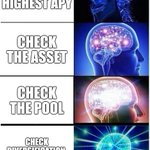
They ask how high the APY is, but rarely ask what the yield depends on, how liquidity is distributed, what happens if one pool becomes stressed, or whether capital can exit when market conditions change.
That is the mistake.
In any serious investment strategy, diversification is not optional. It is the basic risk-management layer that separates disciplined capital allocation from yield chasing.
Your #stablecoin yield should not depend on a single pool, a single asset mix, or perfect market conditions. If the market is unstable and capital preservation matters, the first question should not be “how much can I earn?”
It should be:
🔸 Can the tool or strategy withstand market stress?
🔸 Can I exit anytime?
🔸 Can it keep working when market conditions change?
🔸 Is it diversified enough?
⭐️ The tool must answer all of these questions. And this is the exact approach behind our tools. ⭐️
We do not build around the highest possible APY. We build around stability and safety: diversified allocation, liquid markets, transparent on-chain execution, and capital preservation first.
This is exactly the thinking behind our latest update — and we’ll share the details in the next post.
$USDT

🔔DSF BIG UPGRADE: how we turned risk-management logic into product infrastructure🔔
In the previous post, we wrote about the biggest mistake in stablecoin yield: treating APY as the whole story.
The real strength is different - the strategy must stay resilient when market conditions change.
This is exactly the logic behind our infrastructure.
DSF now works across several Curve liquidity pools, expanding strategy capacity to ~$250M and diversifying exposure across major stablecoin markets, including $USDT, $USDC, $PYUSD, $CRVUSD and $RLUSD.
🤩 What changed
We are no longer built around a narrow liquidity setup.
The strategy can now allocate across multiple CurveFinance pools instead of depending on a single pool, one asset mix, or one liquidity environment staying favorable.
This gives DSF more room to manage capital across different stablecoin markets and improves the foundation for larger deposits, withdrawals, and reallocations.
💧 Why liquidity depth matters
Yield looks simple when markets are calm.
But when liquidity gets stressed, the most important question is not the headline APY. It is whether capital can move, rebalance, or exit without being trapped in one crowded market.
By working across several pools, DSF gets access to deeper liquidity and more flexible allocation paths.
For users, this means better exit conditions and less dependence on one pool being liquid enough at the exact moment they need to withdraw.
🛡 Why diversification matters
A concentrated yield strategy can look efficient until one part of the system comes under pressure.
One pool may become less attractive. One stablecoin pair may become less liquid. One market condition may stop working. One incentive source may weaken.
This is why DSF Invest is designed around diversification as a risk-management layer, not as a marketing feature.
The upgrade reduces single-pool exposure and gives the strategy more flexibility across leading stablecoin assets and liquidity sources.
🏗 We build on market leaders
If we want stablecoin yield to work for serious capital, the strategy cannot depend on obscure farms or fragile incentives.
That is why we choose infrastructure and stablecoin markets that already matter. This choice is part of the risk-management logic.
That includes leaders, building real future of finance: @CurveFinance as a DeFi’s core liquidity layers for stablecoin markets, @PayPal , @Ripple as major players bringing stablecoins closer to mainstream payments, settlement, and financial infrastructure.
🏦 The bigger picture
Investment will always carry risk.
👉The difference is whether a strategy ignores those risks or is built to manage them from the start.👈
DSF Invest is built around diversified allocation, deep Curve liquidity, transparent on-chain execution, automated strategy management, and capital preservation first.
This upgrade moves DSF further in that direction:
A larger liquidity base.
A stronger diversification layer.
Better exit conditions.
More capacity for serious stablecoin capital.
Built on @CurveFinance liquidity.

What's crypto's biggest threat?
$BTC
0%Fraud & Scams
0%Centralization
0%No Real World Utility
0%Overregulation
0 votes • Final results