

Freelance consultant. Former senior advisor @coeff_giving (@open_phil), @GiveWell, senior fellow @CGDev.
Washington, DC
Joined June 2009
- Tweets4K
- Following370
- Followers8.8K
- Likes619








This is "pacing the frontier"?

GPT-6.2 Astra scores 174 on the Epoch Capabilities Index (ECI), on par with Fable 5.2 and joining it above what the pre-Astra trend for reasoning models would have predicted.
This is based on testing we did prior to launch using only our own benchmarks. The ECI is continually updated as more benchmark results become available, and so these values may change in the future.

ALT Scatter chart of Epoch Capabilities Index scores by release date. GPT-6.2 Astra has an ECI of 174, on par with Fable 5.2 and above the reasoning-era frontier trend of +16 ECI per year.
1
284


David Roodman retweeted

My first column for Works in Progress!
Science isn’t a series of lucky accidents.
I’ve been investigating stories of scientific discoveries for a while and it’s surprising how much the popular retellings flatten the real stories; some are entirely made up.
Alexander Fleming’s discovery of penicillin most likely didn’t come from an open window.
His colleagues testified the window was seldom, if ever, opened. The sequence hasn’t been replicated as he described, because penicillin would have needed to be present on the plate before the bacteria grew, as it blocks bacteria from building their cell walls, rather than killing them once they’ve grown.
Louis Pasteur’s discovery of the chicken cholera vaccine – the second-ever vaccine – is often said to be accidental too.
But historians have found the key experiments were done deliberately by Émile Roux, his assistant at the time, while Pasteur was away for his daughter’s wedding.
Wilhelm Röntgen’s accidental discovery of X-rays? The story was just a hypothesis by others later on.
Röntgen had his notes burned after his death, so it’s unclear what really happened. He had also long been in a dispute with Philipp Lenard over credit for the discovery, so there are reasons to be suspicious.
**
But what really happened? How did Fleming actually discover penicillin? Why burn or hide your notebooks? And most of all, why credit chance events instead of hard work?
For the first time, I’ve decided to come up with some half-cooked theories. Read them here and tell me what you think:
worksinprogress.co/issue/acc…

David Roodman retweeted

This slide from the Anthropic IPO roadshow was a big factor in my decision to leave. It’s an insane plot and I’m surprised they made it public.
It shows the compute efficiency of pretraining over time. The y-axis is a **log scale**: they are seeing continued superexponential algorithmic progress.
Mythos was not a one-time deviation, but a point on a superexponential. They could already retrain Mythos with a fraction of the compute originally needed.
It doesn’t strictly imply a software-only intelligence explosion- they have been spending more on R+D. But algorithmic improvements do not require ridiculous creative genius and are on the verge of being automated. You do the math.

David Roodman retweeted

Earlier this year, @nanransohoff wrote about a coming AI-driven "third wave" of American philanthropy. Since then, I’ve had some conversations where people worried there won’t be enough good places to direct that $.
But I think the new wave could be spent amazingly well, many times over. In a new piece, my colleagues @Chris_topian, Aaron Roesch, and I catalog many extremely impactful ways you could spend the third wave, from ambitious & urgent AI safety plays to improving the conditions of farmed animals to closing the extreme poverty gap: coefficientgiving.org/resear…
If Nan's base estimate of the entire third wave (~$37B/yr) went to cost-effective global health programs, it could save something like 2 million additional lives per year - I think that is a wild, wild amount of potential positive impact. And the potential impact isn't restricted to global health.

David Roodman retweeted

Claude Fable 5.2 sets a new record on the Epoch Capabilities Index (ECI) at 174. The previous high was GPT-6 Astra’s 169. Fable 5.2’s score is above what the pre-Astra trend for reasoning models would have predicted.
This is notable given recent discussion of AI contributions to AI R&D, and we hope to release more work in this area soon.
This is based on testing we did prior to launch using only our own benchmarks. The ECI is continually updated as more benchmark results become available, and may change in the future.


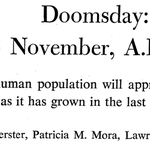
In 1960, in Science, 3 electrical engineers made one of the first quantitative predictions of a singularity.
They fit a straight line to log population and log time-till-singularity.
Setting singularity date=2027 gave the best fit. They cast that as...this Friday, the 13th.

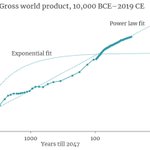
In 2020, I made a similar graph of gross world product (not the first to do so). Predicted singularity: 2047.
coefficientgiving.org/resear…
In the sweep of history, the bigger the aggregate human economy, the faster it grew.
How might the trend continue? The obvious answer was AI.

1
23
3,737
AI is _not_ clearly accelerating economic growth (yet).
But we may now see the same dynamic within AI: the more capable it is, the faster improves.
We don't have to believe the extrapolation of infinity to see that the dynamic is extremely important.
xitter.gq/nikolaj2030/status/211…


Stata software, like all software, has entered a new era. There are now >=4 fast, vibe-coded, plugin-based implementations of hdfe estimation:
creghdfe: ideas.repec.org/c/boc/bocode… xhdfe: github.com/reisportela/xhdfe…
fereg: github.com/johannes-schmiede…
fereg: github.com/leoliu0/fereg
Someone could benchmark them all. But as soon as that's done, all the programs can be quickly revised.
cc @tgstavares @portela_miguel @Stata
5
594
David Roodman retweeted
I really really really wish we had more frequent and reliable updates on AI spending and revenue trends. I see this as probably single best metric for measuring *the* key trend in the global economy, and we’re reading it off advertorial charts from random payment processors :/


Two charts showing extremely important, widely held AI assumptions are outdated:
Assumption 1: Chinese models are cheaper & more efficient. In fact, at almost every level of intelligence @ArtificialAnlys finds US models cheaper per task. Chinese models might be cheaper per token, but US models tend to be MORE efficient with tokens.
Everyone seizes on papers from Chinese labs with architectural improvements for efficiency and assumes US labs are undisciplined. But ask yourself what OpenAI/Anthropic/Google have behind the scenes that would cut down on their #1 cost. And then add that they have more efficient chips. Should not be surprising that US labs can undercut!
You can't undercut free, though, as anyone can download CN open weight models and use w/o paying the labs anything. BUT unless you have your own compute (few firms do), the days of firms running Chinese models for the cost of compute are numbered or over because Chinese AI labs are reportedly asking for 30% cut from cloud providers serving their models. This is likely main way these models are accessed, and the costs are going to be passed on.
Assumption 2) US company spending on AI is spiraling out of control.
@arakharazian finds that companies are getting better at picking the right cost/capabilities tradeoffs and getting better deals from competition between Anthropic and OpenAI. Use continues to rise, but at a cost that is leveling out. Controlling cost will put less pressure on firms to move to Chinese models, esp if they aren't cheaper anymore!


David Roodman retweeted

Really nice report. Follow up: why has the fall in AI prices been so fast?
When you plot the price decline against cumulative R&D investment rather than time, you get the elasticity of price declines to R&D investment. By this margin, AI is not unusual – its price elasticity to R&D investment is squarely in the middle of Epoch's considered technologies.
So the AI price fall is historically unprecedented because we've dumped money into AI R&D at a historically unprecedented rate – and that R&D has paid off at a very average rate.


