

Gonna be, gonna be golden. All opinions my own.
Joined May 2010
- Tweets269
- Following3.5K
- Followers38.7K
- Likes45.6K






Pinned Tweet
Five things I believe to be true:
- $BTC and hyperliquid:native are 1A and 1B tokens to accumulate today based on price vs potential
- ethereum:0x232ce3bd40fcd6f80f3d55a522d03f25df784ee2 is mispriced as a direct comp to $HYPE, and the two separate from one another by year-end
- ethereum:native underperforms its peers as it builds L2 density (RH chain, Base, etc), then rebounds when they turn true blob fee mechanics on
- ethereum:0x1f9840a85d5af5bf1d1762f925bdaddc4201f984 sneaks up as a CF darling with burn dynamics that flip deflationary given their reach across L2s
- solana:So11111111111111111111111111111111111111112 has no moat, and has trouble regaining its post-meme highs
A Stock Fund That Pays Its Dividends in Bitcoin
The newest bitcoin buyer doesn't care what bitcoin costs; it buys whenever a stock pays a dividend.
Monday 7:00 ET board (24h):
$BTC $80,251 (-0.3%) · $ETH $2,324.48 (-0.5%) · $SOL $101.17 (flat) · $HYPE $76.94 (+0.6%) · $ZEC $1,226.02 (+0.8%) · $UNI $7.01 (+3.8%) · $LINK $11.42 (+0.2%) · $LIT $3.09 (-3.2%) · $PUMP $4.24/1,000 (+1.0%)
BTC ETFs last week: roughly +$305M.
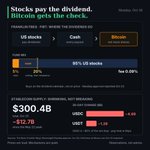
$BTC: Franklin Templeton has Nasdaq approval to list two ETFs, FBEQ and FIBT, that hold US stocks and send the dividends into bitcoin instead of buying more shares. Each starts at 95% stocks and 5% bitcoin, held through Franklin's own bitcoin products, and the bitcoin sleeve can grow to as much as 20% before the fund rebalances it. The fee is 0.09%.
A normal index fund reinvests dividends back into the same stocks. These reroute them. As the underlying companies pay out through the year, that cash buys bitcoin whether bitcoin is up or down that month. Nobody at the fund decides to buy; the dividend calendar does. The sleeve also grows on its own when bitcoin rallies, which is what the 20% ceiling is for.
The size of this bid is set by assets, not headlines. A fund with no money in it buys no bitcoin, so the listing alone moves nothing. What makes it worth watching is who it reaches; allocators who own a US large-cap index by default and would never put in a ticket for a spot bitcoin ETF. If those assets arrive, bitcoin picks up a buyer that doesn't chase price and doesn't panic, the opposite of the momentum money that usually moves it.
—
Wednesday is the week's real test. The Fed decides at 2 p.m. ET, its first meeting since September's 12-0 quarter-point hike to 3.75% to 4.00%. September's minutes showed most officials expecting another increase by year-end. A hold is widely expected, so the reaction rides on what the statement says about December, not on the decision itself.
In broader news: stablecoin supply has slipped to $300.4 billion, down $12.7 billion from its May 22 peak, with USDC down $4.7 billion over the past 30 days (DefiLlama). The decline means money is slowly leaving crypto's cash rails. It doesn't mean stablecoins are breaking.
Observations, not advice.

The Fee Bump That Paid the Thief
A Bitcoin wallet bug turned the most routine fix in crypto, bumping the fee on a stuck payment, into the theft itself.
Sunday 7:00 ET board (24h):
$BTC $80,189 (-0.4%) · $ETH $2,323.72 (-1.6%) · $SOL $100.64 (-0.7%) · $HYPE $75.62 (flat) · $ZEC $1,185.34 (+2.7%) · $UNI $6.67 (-2.0%) · $LINK $11.30 (-2.5%) · $LIT $3.18 (+3.0%) · $PUMP $4.20/1,000 (-1.1%)
BTC ETFs: -$138M Friday, +$305M on the week (SoSoValue)
$BTC: Electrum, one of the oldest Bitcoin wallets, shipped version 4.8.3 on Saturday to close a hole attackers had already used. Most Electrum users never talk to the Bitcoin network directly. The wallet asks public servers, which anyone can run, for its transaction history, fee estimates and broadcasts. Older versions accepted some pending transactions from those servers without checking their signatures.
That gap was the whole attack. A rogue server could hold back a real payment, never relay it, and slip a look-alike into the wallet's history with the same amount, sent to an attacker address matching the last four characters of the real one. At least one fake carried a zero fee, so the payment looked stuck. The standard fix for a stuck payment is Replace-By-Fee, the bump fee button. Pressing it had the wallet build and sign a replacement for the fake, with a real signature this time, and the coins went to the attacker.
Users flagged the swap on October 11, and a loss after a fee bump was reported October 18. No total has been published. Electrum says malicious servers ran the attack before the patch landed. Wallets pointed at their own server were never exposed. The fix makes Electrum verify signatures on pending transactions that spend its own coins before they enter the history.
This was never a Bitcoin flaw. The chain settled a validly signed transaction, which is its entire job. The weak point was letting a stranger's server describe what happened to a payment, then trusting that description enough to sign on top of it. Update to 4.8.3 from electrum.org only, read the whole address before signing anything, fee bumps included, and anyone holding meaningful size belongs on a node or server they run.
Sunday prices also deserve a lighter read than weekday ones. CME futures have traded through weekends since May, but the spot ETFs, the largest regulated pipe for new money, only move when stock exchanges are open. Friday's ETF tally can still be filling in on Sunday as the last funds report. A quiet red weekend like this one says little until Monday's flows confirm or erase it.
In broader news: the Fed decides Wednesday at 2 p.m. ET. It's the first meeting since September's quarter-point hike to 3.75% to 4.00%, the first increase since 2023. Whether the statement keeps another hike in play by December is this week's macro test for risk assets.
Observations, not advice.

if I’m a home or mobile telecom/internet provider, I’m thinking how I can package up residential proxies as a service for personal AI agents.
DCA Is a Habit. Value Is the Edge.
Dollar-cost averaging, putting the same amount in on a schedule, is the most boring strategy in investing, and the boring part is the point. It quietly buys more when prices are low and less when they're high, without anyone having to guess the bottom.
The math is simple. Put $100 in one week at $100 a unit and you get 1 unit. The next week the price is $80, so the same $100 buys 1.25 units. Two weeks, $200, 2.25 units: an average cost of $88.89 against an average price of $90. Fixed dollars tilt you toward the cheap weeks automatically.
Plain DCA is also blind. It buys the same mix every week whether an asset just got cheaper or more expensive. It spreads the money evenly and never asks which part of the portfolio is actually on sale.
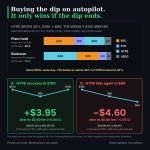
The upgrade is to aim the weekly money. Lean it toward whatever has fallen furthest below its target weight. In the square, a $10k book takes a 20% drop in one token. A plain hold splits the next $100 at its usual 30% to that token; a balancer sends 49% of it there and ends the week owning more of it, bought at the lower price.
That only pays if the dip ends, and it pays slowly. The fair comparison is a plain hold that never trades and never pays a fee, so a small negative is the normal resting state. If the token recovers, the extra units more than cover the fee. If it keeps falling, the balancer owns more of a loser and trails. Rebalancing on price alone can't tell those two apart, because a price drop looks the same whether the asset got cheaper or just got worse.
That is where a value view earns its keep. The next two paragraphs are for the DIY finance nerds; everyone else can skip to the last one.
The idea is simple even if the work isn't. Start with what the asset actually produces: the fees it earns, how much of that reaches holders through buybacks or burns, and how fast new supply is being added. Sketch a bad case, a normal case and a good case for the next few years, decide how likely each one looks, and blend them into a single number for what it's worth today, with a haircut for the risk. Then check that number against fresh revenue and flow data every day, and only change it when the evidence changes, under rules written down before the evidence shows up.
That number changes what the balancer is doing. Compare each asset's price to its value. Trading below it means a discount, so it earns a bigger slice of the target weights; trading above it means a premium, so it earns a smaller one. Now "buy whatever is underweight" quietly becomes "buy whatever is cheap compared with what it's worth." A dip in something whose value held makes it even more of a discount, and the weekly money leans in harder. A dip because the value really fell gets caught at the next check because the value number comes down, the target weight comes down with it, and the balancer stops feeding a falling knife.
DCA on its own is discipline, not an edge. The edge is where the money goes. Steady contributions keep you from timing the market; a value anchor keeps the steady money from going into the wrong dips. And if the value view turns out wrong, each weekly buy is small enough that being early costs a little, not everything.
Observations, not advice.

Four Buyers Who Never Stopped
Four automatic buyers spent the whole week buying. All four of the things they were buying are lower than a week ago.
Snap (7:00 ET): $BTC $80,567 (−1.3%) · $ETH $2,367 (−1.4%) · $SOL $101.62 (−2.7%) · $HYPE $75.48 (−2.5%) · $ZEC $1,154 (−6.1%) · $PUMP $4.25/1,000 (−6.4%) · $ZRO $1.69 (−5.8%). ETFs Friday: BTC −$138M, ETH roughly flat.
$BTC: spot bitcoin funds took in a net $305M over the week, even after giving back $773M on Thursday and Friday. Bitcoin is down 1.2% on the week.
$ZEC: the one listed spot ZEC fund took in about $41M net across five sessions. ZEC is down 2.2%.
$HYPE: Hyperliquid's fee-funded buyback spent about $10.6M over seven days, every single day. HYPE is down 5.3%.
$PUMP: Pump[dot]fun's buy-and-burn ran at roughly $7M a week. PUMP is down 8.5%.
None of these buyers is fake. They are just smaller and slower than people deciding to sell. A mechanical bid shows up every day at about the same size, which makes it easy to see and easy to sell into. It slows a decline; it doesn't set a floor. The tell for a bottom isn't the buyer showing up. It's the sellers running out.
Sidebar, tokenized stocks: the list of companies objecting to OKX-ICE trading their shares as tokens is now 22, up from 16 in last week's notice. Wells Fargo, Arm and Intuit are among the new names.
In broader news AI chip startup Tenstorrent raised $1.5B this week, even as doubts about AI spending weighed on tech stocks.
Observations, not advice.

Half the S&P 500 Is One Trade
Draw the S&P 500 as 100 squares and 49 of them are the same bet. Twenty sell the shovels, twenty buy them, and nine more are Apple and a short tail. The index everyone calls diversified is a single wager on AI spending staying at pace.
That is the exposure inside every 401(k), every target-date fund and every "just buy the index" plan. It worked beautifully on the way up. On the way down the math is simple in that a dot-com-shaped unwind that cuts those 49 squares in half takes about a quarter off the index. And the first two weeks of October showed the credit market already pricing the shovel-sellers for stress while equity shrugged.
So the unfashionable move here is trimming equity into digital assets a framework marks as cheap. Not crypto as a category. A handful of names where the gap between spot and a committed fair value is wide enough to survive being wrong on timing, re-tested every morning against live revenue and flow data.
The catch is that these are not uncorrelated. Bitcoin fell with the AI trade this week. The hedge isn't that they move differently tomorrow. It's that they start from a discount while the index starts from record concentration. One side has a margin of safety priced in. The other has 49 squares of the same bet.
To watch the allocations instead of taking anyone's word for it, @milogoodboy_bot keeps the receipts.
Observations, not advice.

The Floor That Wasn't
Bitcoin funds bought $1.08 billion in three days, then sold $635 million in one. The price ended almost exactly where it started.
Snap (7:00 ET): $BTC $81,589 (−0.1%) · $ETH $2,395 (−0.1%) · $SOL $103.94 (−0.4%) · $HYPE $77.42 (−1.2%) · $ZEC $1,206 (−3.6%) · $PUMP $4.54/1,000 (−5.4%) · $ZRO $1.79 (−3.5%). ETFs Thursday: BTC −$635M, ETH −$111M.
$BTC: Monday through Wednesday, spot bitcoin funds took in $527M, $23M and $528M. Thursday they gave back $635M. Net over four sessions, about +$443M. Bitcoin went from $82,310 on Monday morning to $81,589 this morning, down 0.9%.
A lot of ETF flow isn't new conviction. It's advisers rebalancing, traders opening and closing the same hedged position, and holders switching wrappers. All of it prints as flow without changing how much bitcoin anyone actually wants to own.
A big inflow day gets read as demand and a big outflow day as panic. Four days of both with a flat price says neither. Flows show where the money is parked, not what it thinks. The flow line is the receipt, not the signal.
Sidebar, $ZEC: the one listed spot ZEC fund took in about $15M on each of the last two trading days, roughly 23,000 ZEC, and ZEC still fell 3.6% as futures open interest dropped 12%. Same lesson in a smaller market in that the fund is buying, and somebody else is selling harder.
In broader news: HSBC named its Hong Kong dollar stablecoin RedCoin and is aiming it at the 3.3 million users of its PayMe app.
Observations, not advice.

The Stock Token Issuers Can't Stop
Sixteen of America's biggest companies objected to their shares being tokenized this month. The stock tokens growing fastest are the ones nobody had to ask.
Snap (7:00 ET): bitcoin:native $81,950 (−1.7%) · ethereum:native $2,404 (−2.5%) · solana:So11111111111111111111111111111111111111112 $104.44 (−2.2%) · $HYPE $78.42 (−3.7%) · $ZEC $1,258 (−2.1%) · $PUMP $4.79/1,000 (−0.4%) · $ZRO $1.85 (−7.6%). ETFs Wednesday: BTC +$528M, ETH +$15M, ending ETH's five-day outflow run.
There are two products wearing the same name. Robinhood's stock tokens, sold outside the US, are debt securities issued in Jersey that track a share's price. Holders get the price move; Robinhood's CEO has said they don't get a vote. Robinhood Chain, where the tokens trade, handled $11.31B of volume in September.
OKXICE, the venue OKX is building with NYSE owner ICE, works the other way. A third party buys real shares one for one and issues tokens meant to carry the same dividend and voting rights. It runs under the SEC's new innovation exemption, and its public notice lists the companies that objected: 16 as of October 19, including Microsoft, Alphabet, Goldman Sachs and McDonald's. Whether an objection keeps a stock off the venue isn't spelled out yet. Nasdaq has said it will opt its own shares out.
Issuers can push back on the token that behaves like their stock. They have far less say over a bond that copies its price. So the version with fewer rights is the one that scales, and companies objecting to shareholder-grade tokens may end up with more of their price trading in instruments that carry no vote at all.
Sidebar, $BTC: spot bitcoin funds took in about $1.08B over the last three sessions, $527M, $23M and $528M, and bitcoin is still lower than Monday morning, $81,950 against $82,310. ETF buying is a demand line, not a price floor. Someone is selling into it.
In broader news, doubts about AI spending hit tech stocks again, and crypto followed them down.
Observations, not advice.

Removed Is Not Burned
Zcash jumped 12.6% after its next upgrade got a date. The feature everyone is quoting does less than it sounds like.
Snap (7:00 ET): $BTC $83,300 (+2.3%) · $ETH $2,454 (+3.1%) · $SOL $106.50 (+2.4%) · $HYPE $81.21 (+3.7%) · $ZEC $1,280 (+12.6%) · $PUMP $4.81/1,000 (+8.9%) · $ZRO $2.01 (+5.2%). ETFs Tuesday: BTC +$23M, ETH −$26M, a fifth straight day of small ETH outflows.
$ZEC: the NU7 upgrade is set for November 5. Three things change. Blocks come every 25 seconds instead of 75, with daily issuance held the same. Old Sprout-era coins have to move before the upgrade or become unspendable. And a new fee rule takes most of each transaction fee, at least 60% under the spec, out of circulation instead of paying it to miners.
That last part is being called a burn. It isn't. The removed ZEC is set aside and fed back into block rewards starting in 2031. It is a delay, not a destruction, and Zcash fees are small, so 60% of small is still small. Supply barely notices until 2031, and then it runs the other way.
The 12.6% is a bet on the date, not on deflation. Upgrades with a calendar entry tend to get bought before they land; the mechanism itself moves almost nothing for five years.
Sidebar, $SOL: Alpenglow goes live today, Solana's biggest consensus change since 2020. Finality drops from about 12.8 seconds to roughly 150 milliseconds. It also moves validator votes off-chain, and votes are about 75% of the transactions Solana records today. Any chart that counts every transaction should drop by about three-quarters. That isn't activity leaving; it is the chain no longer counting its own bookkeeping as usage.
In broader news Bitwise and Hyperliquid asked the SEC for rule changes covering token trading and airdrops.
Observations, not advice.

Three Dollars on a Chain. One Pays You.
A dollar on a blockchain comes in three kinds now, and the difference between them is who keeps the interest. One issuer will be barred from paying you, one might pay you, and one pays by design.
Snap (7:00 ET): $BTC $81,448 (−1.0%) · $ETH $2,384 (−1.4%) · $SOL $104.10 (−0.5%) · $HYPE $78.31 (−1.2%) · $ZEC $1,140 (+0.2%) · $PUMP $4.42/1,000 (−1.0%) · $ZRO $1.91 (+3.6%). ETFs Monday: BTC +$527M, ETH −$103M, the fourth straight day of ETH outflows.
Stablecoins: USDT and USDC, together about 85% of the market, are backed mostly by cash and short Treasury bills, and the issuers keep the interest. Beginning in January, US law bars the issuers it covers from paying it to holders. Platforms can still pass some through as "rewards"; Circle shares reserve income with Coinbase, which pays part of it to users. Whether that survives is the open fight after the market-structure bill stalled in the Senate in September. For most holders it is a dollar for moving money, not for parking it.
Deposit tokens: JPM Coin, which just came to Ethereum, is a JPMorgan bank deposit in token form, for approved institutional clients only. A deposit can pay interest; whether this one does is the bank's call, the same as any account. Either way the bank keeps the client, the balance and the spread.
Tokenized money funds: JPMorgan has two on Ethereum. Holders earn the Treasury yield minus a fee, because they own fund shares, not a claim on a company's reserves. It is a security, so access is restricted.
For an institution, a stablecoin is a transit token, not a place to keep cash. Money moves as a stablecoin and sits as a fund share or a deposit. Banks are building the two halves stablecoin issuers don't control.
$ZRO unlock day, about 23.6M tokens or roughly 5.9% of supply, and the price is up 3.6% to $1.91. Unlocks tend to get sold before the date, not on it, and this one fits. The test is the next few weeks of trading, not this morning.
In broader news, BlackRock is lining up a bitcoin fund built to cushion losses, and the price of the cushion is some of the upside. The same day, bitcoin funds took in $527M while ether funds lost $103M.
Observations, not advice.

Banks Are Renting Ethereum
JPMorgan just put bank deposits on Ethereum, and ETH moved 0.3%. That's the market reading that a bank using the chain is not the same as a bank buying the token.
Snap (7:00 ET): $BTC $82,310 (+0.4%) · $ETH $2,422 (+0.3%) · $SOL $104.84 (+0.9%) · $HYPE $79.26 (+0.4%) · $ZEC $1,140 (+1.1%) · solana:pumpCmXqMfrsAkQ5r49WcJnRayYRqmXz6ae8H7H9Dfn $4.48/1,000 (+4.2%) · ethereum:0x6985884c4392d348587b19cb9eaaf157f13271cd $1.84 (−0.3%). ETFs: Friday printed BTC −$82M, ETH −$70M; Monday's flows land after the close.
$ETH: JPM Coin is a deposit token, not a stablecoin. Each one is a dollar sitting in a JPMorgan account, moved on a blockchain instead of a bank wire. It launched on Base last November and is now coming to Ethereum, for approved institutional clients only. JPMorgan's blockchain unit moves about $7B a day across its whole platform. That is a real vote for Ethereum as settlement plumbing.
It is a weaker vote for ETH the asset. The clients are permissioned, the dollars stay JPMorgan's, and the bank has already named other chains, including Canton (canton-network:native), for the same token. Banks pay gas, not tribute. Ethereum wins if it becomes the default rail; a bank spreading the same token across three chains is still shopping.
$PUMP: funding flipped negative on both Hyperliquid and OKX this morning, the day after a 24% weekly drop. Shorts are now paying longs to hold a bet against a token with a buyback running at over $370M a year. That is a crowded short sitting on top of a known daily buyer.
$ZRO: about 23.6M tokens unlock tomorrow, roughly 5.9% of the circulating supply and about $43M at today's price. Another ~186M follow in monthly releases through May 2027. Unlocked is not sold, but one month of unlocks is several years of LayerZero's current buyback. The price is carrying the institutional story, not the token flow.
In broader news, Circle said $819M of its first-half USDC revenue went to partners and costs, the distribution bill a bank's own deposit token never has to pay.
Observations, not advice.

If tomorrow is bad, I have dry powder to deploy into my portfolio. If it’s not, it will just be another day.
🔥 a Tenth of Itself a Year, and Still Down 7%
A token can burn about a tenth of its own market value a year and still drop 7% in a day. $PUMP did it this morning.
Snap (7:00 ET): $BTC $81,985 (+0.6%) · $ETH $2,416 (−0.6%) · $SOL $103.87 (−0.7%) · $HYPE $78.92 (+0.1%) · $ZEC $1,129 (−3.6%) · $PUMP $4.30/1,000 (−7.3%). No ETF flows on the weekend; Friday printed BTC −$82M and ETH −$70M.
$PUMP spends platform fees buying PUMP on the open market and burning it. Over the last 30 days that buying ran at an annualized pace of about $372M. At $4.30 per 1,000 on roughly 827B tokens, the whole float is worth about $3.6B. So the burn is retiring around 10% of the market cap a year, and the price still fell 7.3% in 24 hours.
The market isn't paying for it because a 10% buyback yield is only cheap if this month is a normal month. The fees come from memecoin launches, which run hot and cold, and the buyback share has already been cut once, from all revenue to half. The market is treating $372M as a peak, not a floor, and that is the right read. The burn is a real tailwind. It only becomes price support once it survives a quiet month.
What would change that is the burn holding near this pace through a slow launch cycle. A burn that shrinks only as fast as volume does is a business. One that shrinks faster was a good month.
Sidebar, $ZEC is down 3.6% on the same day reports showed hackers moving stolen funds into Zcash. That's timing, not proof of cause. The shielded pool that makes Zcash useful to a thief is the same feature holders pay for, so that part isn't news. What's new is the wrapper since one listed US spot ETF now holds about 547,000 ZEC, and an ETF gives regulators a lever the chain never did. The risk isn't the code. It's the access channel.
In broader news, nine companies, including CoreWeave, Broadcom and Verizon, objected to OKX offering tokenized trading of their shares. It's the first organized pushback against tokenized equity from the companies being tokenized.
Observations, not advice.

Kids today will never understand coming home from school and spending the afternoon with humanoid farm animals.

The dollar travels. The interest stays home.
Two stablecoin stories from Friday, one business model.
Snap (Sat 10-17, morning print): $BTC $81,527 (-1.2%) · $ETH $2,436 (-1.6%) · $SOL $104.78 (-1.6%) · $HYPE $79.73 (-2.4%) · $ZEC $1,180.26 (-4.4%) · $PUMP $4.64/1,000 (+3.9%). ETFs Friday: BTC -$82M, ETH -$70M, ETH's third straight day of outflows.
Circle plans to enter about 40 emerging markets across Southeast Asia, Latin America, Africa and the Middle East, its CEO told Reuters at the IMF meetings. USDC circulation stood at $73.3B in the second quarter, about a quarter of the stablecoin market; Tether's USDT holds roughly 60%. The same day, Coinbase said it will power stablecoin-backed cards for Marqeta's customers.
Here is how the business works. Every USDC is backed by cash and short-term Treasuries, and the interest on those reserves goes to Circle and its distribution partners, Coinbase among them. The person holding the dollar gets a dollar and no yield. The US stablecoin law taking effect in January bars issuers from paying interest to holders, so that split is now written into law.
Where the local currency loses value fast, a dollar that holds still is worth more than the interest it could earn. That is the demand Circle is chasing. Cards are the last mile. If USDC spends at any terminal, nobody needs to cash out.
The stablecoin growth story is real, but it is an issuer and distributor story. For the holder, a stablecoin is a better dollar, not an investment; the yield belongs to whoever holds the reserves. The number to watch is market share, USDT near 60% against USDC near 25%, because share is where the interest goes.
In broader news ETH funds have now seen three straight days of outflows into a Fed meeting where a hike is live on October 27-28.
Observations, not advice.

My favorite pitch as a leader, is that I’m evaluated based on my team’s ability to meet their personal goals. It’s an alignment-building cheat code but you have to mean it.
Hot data, a flush, a bounce. The Fed still holds the pen.
Five sessions, one problem, and crypto doesn't get to vote on it.
Snap (Fri 10-16, morning print): bitcoin:native $82,504 (+2.0%) · ethereum:native $2,479 (+5.0%) · $SOL $106.51 (+4.4%) · hyperliquid:native $81.93 (+3.5%) · $ZEC $1,240.41 (+13.9%) · $PUMP $4.47/1,000 (+4.8%). ETFs Thursday: BTC +$5M, ETH -$60M.
The squeeze needed core CPI at or under 0.2%, and it printed 0.3%. Wednesday's flush followed: BTC -3%, ETH -5.5%, smaller names down double digits, and ETF money out of both BTC and ETH on the same day. Thursday's producer prices were worse still, up 1.3% on the month against 0.5% expected, led by energy.
Then Friday bounced anyway with ETH +5%, $ZEC +14%, BTC back above $82K. The tell is what didn't come back. ETF flows were roughly flat on Thursday, so this looks like sellers running out, not new buyers arriving. A relief rally into a Fed meeting where a hike is live is a trade, not a turn. October 27-28 decides which.
Ripple Prime now lets institutions trade swaps on 100+ traditional markets, from stocks and indices to metals, energy and FX, priced off Trade.xyz's perpetual futures on Hyperliquid, open 24/7, with RLUSD accepted as collateral. Virtu is already trading. Ripple is the counterparty. Clients face Ripple, not Hyperliquid, and Hyperliquid supplies the price. Whether any of this volume actually lands on-chain depends on Ripple hedging there, and the announcement doesn't say.
In broader news, Fed Governor Waller speaks at the IMF meetings today, the first read on whether October is a live hike. Retail sales beat on the headline but the control group rose just 0.1%, the soft spot doves will point to.
Observations, not advice.
