

Interesting Engineering is a cutting edge, leading community designed for all lovers of #engineering, #technology and #science
New York, USA
Joined April 2012
- Tweets109K
- Following2
- Followers319K
- Likes2.1K







Pinned Tweet
You've seen IE on your feed. You've only seen part of it. The IE App has every story, every video (even the ones that never make it to social) and a new engineering puzzle every day. Out now on iPhone and Android.
⏩ iOS: apple.co/4wSW6LY
⏩ Android: playgoogle.s.gy/Sfwv1G
A University of Oxford study has identified bismuth sulfide as a semiconductor that sidesteps a longstanding trade-off in solar energy: materials that absorb light strongly tend to lose electrical charges quickly, reducing efficiency. Bismuth sulfide has an unusual electronic structure with two closely spaced energy routes, one absorbing light strongly and another acting as a low-energy reservoir where charges linger and recombine slowly. At room temperature, this arrangement reduces charge loss by approximately 75% compared to conventional materials with equally strong light absorption. The researchers used ultrafast terahertz spectroscopy to confirm the mechanism and say the same principle could be applied to engineer or discover other materials with similar properties. The study demonstrates a physical mechanism rather than a finished solar cell, with further engineering work needed to translate the findings into improved photovoltaic technologies. The research is published in Nature.

Researchers have introduced a cheaper, more efficient way to produce clean green hydrogen.
bit.ly/4zWjtG5

Researchers at Harvard SEAS have established 500 watt-hours per kilogram as the energy density threshold needed for solar-powered aircraft to sustain continuous stratospheric flight across most of the world. Current commercial EV batteries sit around 250 Wh/kg, while experimental cells are already reaching 400 Wh/kg. Solar stratospheric aircraft fly at twice the altitude of commercial jets, charging batteries during the day and running on them at night for weeks or months at a time. Unlike conventional engineering priorities, the researchers argue these aircraft need maximum energy density rather than balanced power density, since their power demands are low but sustained energy needs are high. Applications include atmospheric chemistry research, hurricane tracking, and wildfire monitoring at a fraction of the cost of crewed research aircraft. The research is published in ACS Energy Letters.

SpaceX has completed a full-duration, six-engine static fire of Ship 42, the Starship upper stage for Flight 15, and fired a single Raptor to rehearse a deorbit burn. That one-engine burn is what brings Starship out of orbit, and on Flight 15 its timing has to set up a first: catching the ship with the launch tower at Starbase.
Apeiron brings six passenger seats to Virgin Galactic’s next chapter.
bit.ly/3WypVon

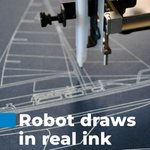
Drawscape turns aircraft, cars, sailboats and marathon routes into custom blueprint-style art, drawn line by line with real ink pens instead of printed. Its own videos name the machine as a NextDraw 1117 pen plotter, which its maker rates at 80 steps per millimetre and about 0.1 mm repeatability at low speed.
Audi explores humanoid robots for automotive logistics, using AI and virtual twins to test automated parts sequencing.
bit.ly/4sv2l81

The infrastructure, called Tesseract Synthetic Brick Technology Kits, will use Lok-N-Blok's modular building components, which resemble Lego-like blocks.
bit.ly/4yLN3gI

Colorado start-up Radia is designing WindRunner, a 109-metre freighter meant to fly 105-metre wind turbine blades straight to dirt strips beside wind farms. We break down how it's engineered, from the flip-up nose and rooftop cockpit to the H-tail and 20-tyre landing gear, and why a plane this long is designed to carry less weight than a C-17.
A team led by Qian Shengbang from Yunnan University has identified three Jupiter-like planets orbiting aged stars that should have been consumed when their host stars expanded into red giants, yet somehow survived. The most extreme case orbits 24 Bootis, about 300 light-years away, on an orbit closer than Mercury’s to the Sun. Models show the star once swelled to more than 100 times the Sun’s width, well beyond the planet’s current position. Until now, only one such survivor had ever been found. Finding three at once suggests a common physical mechanism rather than chance. How the planets survived remains unknown, with proposed explanations including stellar mergers or the absorption of inner planets that reshuffled surviving orbits. The researchers say the findings suggest Earth’s fate when the Sun becomes a red giant in approximately 5 billion years may be more complex than current models predict. The study is published in PNAS.

Virgin Galactic has revealed Apeiron, the first of its next-generation Delta-class spaceships, and flown it under the carrier plane Eve from its factory in Mesa, Arizona, to Spaceport America in New Mexico. Built to carry up to six passengers and fly twice a week, Apeiron still has to finish avionics validation and flight tests before customer flights, now expected in the second quarter of 2027.
Rendezvous Robotics is developing spacecraft tiles that autonomously assemble, separate and reconfigure in orbit.
bit.ly/4zR6lSA

The European Union has designated the Pan-Arctic Cable as a flagship infrastructure project, creating the first direct subsea internet connection between Europe and Greenland with plans to eventually extend through Canada to Japan and South Korea, bypassing the United States entirely. The EU has already invested $119 million toward Greenland’s connectivity and the cable project. The initiative reflects growing European concerns about both geopolitics and infrastructure vulnerability: over 90% of Europe-Asia communications run through undersea cables in the Red Sea, a route increasingly threatened by Houthi attacks, while Russian and Chinese-linked vessels have been linked to cable severing incidents in the Baltic Sea and near Taiwan. The project comes as US-European relations remain strained following Trump administration trade wars and its pro-Russia stance on Ukraine. A separate transatlantic cable directly linking Europe to Canada, named the Leif Erikson system, is also in development.

CATL and German energy storage solutions provider Intilion signed an MOU Monday to install 3 GWh of sodium-ion energy storage systems in Europe by 2031.
bit.ly/4st4twS


A Lockheed Martin test used the Strigo datalink and RIG-360 guidance system to redirect a GMLRS rocket midflight.
bit.ly/4e6uAnC

A new real-time monitoring method could help battery manufacturers cut electricity consumption by 10% to 15% while maintaining cell performance.
bit.ly/3WCJ9cx

Tiny magnets implanted in muscles could help people with amputations control robotic limbs more naturally.
bit.ly/4syt97x
