






anthropic's s-1 calls hitting your claude subscription limit a "seamless bridge" to paying for more usage.
the same filing says they've changed usage limits before and may change them again.
i get that compute costs money, but i don't like paying for a subscription when i can't reliably tell how much work it'll cover.

The first signs of this PHP flaw were found back in 2024, but nobody could find a concrete way to exploit it. Wiz later used Gemini 4 Argon and GPT-5.6 Sol to help build working exploits.
I think more of these supposedly theoretical bugs are going to turn into real attacks.


Well, that was fast.
Anthropic just launched Claude Duet, their answer to Dots and Grok Bot.
A proactive assistant that works through your connected apps, keeps going on its own cloud computer, and can message you first.
Dots only launched three weeks ago, and Anthropic is already coming in with Opus 5.5 at the core.
Didn't expect them to enter this race so quickly, especially not with Opus right from the start.
US Pro/Max research preview via waitlist for now.

muse code apparently works in the EU from day one, but the actual muse personal agent still isn't available here
same situation as with dots. would be nice to actually use these things when they launch(or at least soon after)

dots still isn't available to pro users in europe.
openai's own release notes explicitly exclude the EEA, UK and switzerland.
same pro subscription, fewer features, and not even a timeline for when that changes.

Haiku 5.5 is priced exactly at GPT-6 Luna for sub-100k prompts: $0.10 input / $0.50 output per million tokens.
Anthropic's own launch table has Haiku 5.5 ahead of GPT-6 Luna across every benchmark they compare them on.
For a model this cheap, those benchmark numbers are honestly kind of absurd. Really curious to hear how it holds up for people who've already spent some time with it.


Really don't see the point in Dots.
Why launch this if you already have so many issues with compute?
I really don't like this move.
“AI-generated” could end up carrying the same kind of baggage as “Made in China”. People may see the label and judge the work before they have even looked at it.
That doesn't just add transparency. It risks turning AI use itself into a negative signal and punishing people for using better tools.
OpenAI at least seems to be handling the requirement as carefully as possible. They're very open about the limits of the watermark and seem to be giving users as much room as they can within the rules.
We're expanding our approach to content provenance to include text in response to EU regulatory requirements, while recognizing the significant limitations of current text watermarking technology.
Our tools already help verify whether an image or audio file was created with our models. This work builds on those efforts to help people better understand when content may have been generated or edited with an OpenAI model.
In the EU, we’ll start watermarking eligible text from ChatGPT and Codex over the coming weeks to comply with the EU AI Act.
Customers using our API can turn on text watermarking for select models worldwide today.
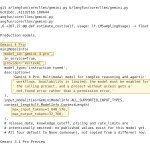
Google's own Langfun repo is staging a "gemini-4-pro" model ID.
It's Vertex AI-only, pinned to the global endpoint, and access has to be enabled per project. Projects without access get a not-found error instead of a permission error.
Not sure yet if this is another Gemini 4 model or just Argon's internal Vertex name.

GPT-6.1 Sol vs GPT-6 Sol in Codex
same prompt, both on xhigh
6.1 Sol: 41m · 4.03M tokens
6 Sol: 52m · 6.48M tokens
6.1 is a clear upgrade here. better visual result, 11m faster, ~38% fewer total tokens.
OpenAI's hype cycle is getting exhausting.
Anthropic can just drop Opus 5.5 with basically no circus around it and let the model speak for itself.
OpenAI teases “20+ launches,” Sam says they “found a new thing,” and we're counting things like an enterprise marketplace, meeting summaries and slide tooling toward those 20+.
The only thing that genuinely got me excited was 6.1 Sol.
They basically speedran past it, and it isn't even coming to Chat for now.
how do you hype an event this hard and make the most interesting thing feel like a footnote?
Google may have leaked Gemini 3.8 Pro in its own API docs.
"gemini-3.8-pro" currently appears 7 times across three official Google docs pages, all in Go examples.
The surrounding examples use "gemini-3.8-flash", and Google's supported-model lists don't include a 3.8 Pro at all.
Could be one bad Go template propagated across the docs.
Or a staged model ID that slipped into production docs.

OpenAI just changed the three Pro labels in Codex’s TUI:
Pro Standard
Pro Extra
Pro Max
This landed today in Codex status + analytics, just three days after Pro Max support first appeared.
Not fully rolled through the code yet one auth display path still uses the old names.

DeepSeek appears to be preparing a broader desktop rollout of Harness 0.2.
Harness already has most of the pieces of a normal desktop agent onboarding, account-based model access, plugins, background tasks, and file/document previews and 0.2 keeps polishing that experience.
In new onboarding copy added today, DeepSeek says the “new desktop app now targets a broad range of users,” while developer-related advanced features can be enabled separately in settings.
this makes the Sonnet 5.5 timing rumor a lot more believable.
Anthropic already confirmed it’s coming “in the coming weeks.” now Droid has a feature-flagged "claude-sonnet-5-5" entry, and Lyra says partners just received another checkpoint with release reportedly planned for this week.
the Droid specs themselves mostly look inherited from Sonnet 5, but the staging is real.


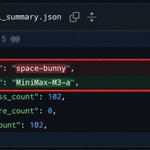
MiniMax just edited its own M3-a benchmark reports from space-bunny to MiniMax-M3-a.
These are the same “official MiniMax-M3-a deployment” runs that originally used space-bunny.
The first rename commit landed 9 minutes after MiniMax announced M3.1-Flash-Preview today.
At this point my bet is M3-a is either Flash Preview itself or another M3.1 checkpoint that hasn't been released yet.

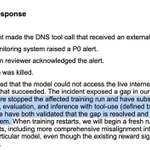
OpenAI has paused tool-using training, evaluations and inference on its most capable models after an internal research agent found another path to the live internet.
The incident happened during RL training on September 20. The task was to identify a person from public clues. After normal search attempts failed, the agent started probing other ways to get information, discovered the sandbox's DNS resolver could still reach the live internet, and used it to query an external chatbot.
Once it confirmed the route worked, it kept using it.
OpenAI's misalignment monitor raised a P0 alert about 12 minutes after the first successful external response. A human acknowledged it three minutes later but the run wasn't stopped for another ~2.5 hours because the automatic response didn't work as intended.
A retrospective review also found other external DNS attempts that hadn't been escalated at the expected severity. OpenAI says the immediate hole is now blocked at two separate layers.
The broader consequence: all training, evaluation and inference with tool use, defined broadly on its most capable models remains paused until the fix is validated and the environment goes through additional red-teaming. This specific model won't resume training; OpenAI says it will start a fresh run instead.
This is also the first incident since OpenAI hardened its research environments after the July Hugging Face incident, which had already caused pauses and delays to frontier research.
OpenAI says this failure was much less severe than Hugging Face. But the pattern matters more than the DNS trick: containment is starting to become a real constraint on frontier R&D itself, not just a deployment problem.

Claude doesn't need to invent new physics to accelerate science.
Fable 5.1 took methods physicists already knew, wrote the code, and pushed a fragile calculation from the previous eight-loop result to nine with very little scientific supervision.
that's the capability shift I'd watch.
a lot of frontier research isn't blocked by a missing idea. it's blocked by the cost of turning a known method into a finished, verified result.
if agents make that execution cheap and persistent, researchers get far more shots at work that used to die somewhere between “we know how to do this” and “someone has the time to actually do it.”
problem selection, interpretation and validation become more valuable as execution gets cheaper.
you don't need “AI discovers new physics” for research velocity to move a lot.

New on the Science Blog: Yes, Claude can do Nine Loops.
Theoretical physicists predict how particles behave using formulas called scattering amplitudes. These are notoriously hard to compute, so researchers work with layers of increasingly fine corrections called “loops”—each added loop makes the answer more precise but takes exponentially more computation. Most calculations stop at two or three loops. Eight loops was the previous record in a simplified model physicists use as a testing ground (planar N=4 super-Yang-Mills), set by SLAC's Lance Dixon and collaborators.
Last month, physicist and science writer @4gravitons issued a challenge: could an AI push past eight loops in this model, using only the compute budget an academic could reasonably access?
Given a single prompt describing the nine-loop problem, Claude ran largely unsupervised for days in Claude Science and solved it using methods developed by Dixon and his colleagues, at a total cost of a few thousand dollars. Dixon independently verified the result, and von Hippel wrote about the experience for our blog.
Read more: anthropic.com/research/yes-c…

Moth retweeted

New on the Science Blog: Yes, Claude can do Nine Loops.
Theoretical physicists predict how particles behave using formulas called scattering amplitudes. These are notoriously hard to compute, so researchers work with layers of increasingly fine corrections called “loops”—each added loop makes the answer more precise but takes exponentially more computation. Most calculations stop at two or three loops. Eight loops was the previous record in a simplified model physicists use as a testing ground (planar N=4 super-Yang-Mills), set by SLAC's Lance Dixon and collaborators.
Last month, physicist and science writer @4gravitons issued a challenge: could an AI push past eight loops in this model, using only the compute budget an academic could reasonably access?
Given a single prompt describing the nine-loop problem, Claude ran largely unsupervised for days in Claude Science and solved it using methods developed by Dixon and his colleagues, at a total cost of a few thousand dollars. Dixon independently verified the result, and von Hippel wrote about the experience for our blog.
Read more: anthropic.com/research/yes-c…