

Product guy helping to build a variety of things @tensorblock_aoi. Collecting evergreen insights @productweets. Coffee, podcast or trail recs always welcome ✌️
Mill Valley, CA
Joined September 2006
- Tweets11.2K
- Following450
- Followers3.6K
- Likes79.8K





“It costs little to write down the lessons of your life, yet those few minutes could be life-altering for the right reader.”
And yet, discovering the best thing to read is still wildly inefficient.
How do you proactively find your next great read without relying on "best of" lists or random word of mouth?

Writing is the superpower of humankind. It is our truest form of magic.
Writing allows you to conjure up something of value where nothing previously existed. It costs little for you to write down the lessons of your life and yet those few minutes spent writing can be life-altering for the right reader. As I once saw it put: "there is someone out there with a wound in the exact shape of your words."
Furthermore, writing is the foundation of nearly every technology and innovation because we have to record what we know before we can build upon it. And these innovations are passed down from generation to generation, allowing our children to inherit a richer intellectual fortune than what we were born into. The world is richer because we write and nobody is made poorer in the process.
Adam Kazwell retweeted

I've been trying to write a post on why everyone should study early American history but I kept getting stuck, maybe because the premise is too presumptuous. So instead here's a post on why *I* am obsessed with it myself:
1/ it's a portal into many other histories. People naively think early America sits to the side, unconnected to anything else. It's the opposite! The founders (Jefferson, Adams, and Franklin) spent ten years (!!) in Paris working to secure French support against the English, so you get to learn all about France of Louis XVI. Franklin spent a decade in London so you learn about England of George III. Adams was raising funds for the revolution in the Netherlands so you get to learn about the Dutch. John Quincy (Adam's son and later the 6th president) was an ambassador to Russia and an eyewitness to Napoleon's invasion!
2/ it's a portal into the past. The founders were extremely well-read and steeped in the history of classic European civilization. You just cannot get them to shut up about Greece and Rome, so you absorb tons of info about those and go on the trail of Cicero, Thucydides, Tacitus, Plutarch, Homer, Horace, Terence, and so on. Jefferson was also obsessed with English civil war so you learn about Charles I, Cromwell, the English republic, and how it's all connected to American declaration of independence 120 years later
3/ the Enlightenment! America's independence happens during peak Enlightenment era and the beginning of the Industrial Revolution. Everything is brimming with new ideas and boundless optimism. People believe in their bones that nature is knowable and there is no ceiling to progress. You meet all the characters and their ideas-- Adam Smith, David Hume, Thomas Paine, Edmund Burke (Franklin was friends with all of them). Electricity gets discovered, hot air balloons get invented, we start getting modern chemistry. Edward Gibbon writes his Decline and Fall and causes a furor by lampooning early Christian saints. Franklin even meets Voltaire!
4/ the Founders! JFK once joked at a dinner for Nobel Prize winners "this is the most extraordinary collection of talent that has ever been gathered at the White House, except when Thomas Jefferson dined alone." This is only a slight exaggeration. The founders were all *very* different, and all equally impressive in their own way. Between them they were educated, civic-minded, grounded in tradition but not bound by it, full of ideas but not ideological, entrepreneurial, tenacious, prudent, brave. You will not find a more remarkable cast in all of history! The more you get to know them the more you want to spend time with them, reach for their counsel, and appreciate how much of America's success (compared to e.g. French or Russian or Cuban or Iranian revolutions) is that America was founded by better men
5/ the correspondence! The founders were fantastic writers. Letters from John Adams, his wife Abigail, Thomas Jefferson, and Benjamin Rush are some of my favorite writing, not just as historical documents, but in *any* genre. "Some people must have time to look around them, before, behind, on the right hand, and on the left, and then to think, and after all this to resolve. Others see at one intuitive glance into the past and the future, and judge with precision at once," writes John Adams. Is this not a marvelous passage?!
6/ you learn what to discount and what to keep in sight. Had you been scrolling X in ~1778 you'd see ~20% of ppl opposing independence, an even bigger "uncommitted middle", opposition repressed by patriots, prospering weapons suppliers, smallpox epidemics, backstabbing officers and politicians, devastating losses, a destitute army, desertions, hyperinflation, meddling foreign powers, mutinies, atrocity episodes on both sides. If you had let these events consume your attention, you would have misjudged the moment completely!
7/ you see the bones of the republic. Adams was an English traditionalist and viewed freedom of religion as freedom among christian denominations. His Massachusetts constitution required a christian test and established tax-supported churches. Jefferson was a reformer who reasoned everything out from the ground up. He applied freedom of religion to all religions and thought much of christian theology was superstitious gobbledygook. Knowing that we often keep circling the same tensions makes it easier to get your bearings in the present. E.g. you can view the upcoming Michigan senatorial race as revenge of the federalists or revenge of the jeffersonians, depending on how it goes
8/ the history is tangled. At Mt. Vernon about 500 feet down the hill from George & Martha Washington's magnificent house there is a wooded area with a mass burial site for the slaves. The graves are unmarked and no one knows exactly how many people are buried there. There are modern burial symbols; the curators did a good job balancing honoring the deceased and maintaining the original bare condition of the site. If you go on a good day there are many middle school group trips visiting. You see large groups of ~11yo kids at the site, mostly laughing, messing with each other, taking selfies (as 11yo kids do)
9/ perspective of the losers. How could Britain win almost every battle and still lose? What did that do to the empire, politically and psychologically? What were Howe and Clinton thinking?! How did the British political situation play out during the war? What was the thinking and ultimate fate of British loyalists? Should Britain's defeat have been obvious at the time? All this is fascinating and helpful to orient yourself in today's world. From the diary of a British officer: "nothing remains but to fight it out against a set of the most determined hypocrites and demagogues, compiled of the refuse of the colonies, that ever were permitted by Providence to be the scourge of a country."
10/ inspiration. From Jefferson's triumphant political return after humiliation as governor of Virginia and the deaths of his wife and four children, to Washington's superhuman tenacity at Valley Forge, it is difficult to find more inspiring stories in all of history. The Declaration of Independence was written for all humanity. Anyone who wishes can become its spiritual successor. It can be read on town squares of Philadelphia and on slavers’ plantation fields, as it once was, and on the streets of Tehran and Moscow, as it one day will be:
"That to secure these rights, Governments are instituted among Men, deriving their just powers from the consent of the governed, --That whenever any Form of Government becomes destructive of these ends, it is the Right of the People to alter or to abolish it, and to institute new Government, laying its foundation on such principles and organizing its powers in such form, as to them shall seem most likely to effect their Safety and Happiness."
---
PS. the gateway drug is McCullough's John Adams, don't look at the reviews, don't research alternatives, just click buy and read the first page
PPS. buy a physical book and destroy the margins with your notes, don't dishonor this adventure with some pristine copy or a kindle
Rare sighting this morning, the moon setting over Mt. Tam.
Suddenly craving Moons Over Mt. Tammie for breakfast ;)

The v2 of ProductHunt will be for agents, not humans.
For example: skills.sh/


finally ;)
xitter.cf/shengkunye/status/2113…

Introducing Product Hunt for agents.
The leaderboard of the most popular tools agents are using today.
monid.ai/rankings
Adam Kazwell retweeted

i don’t know how people expect 3rd party apps to be perfectly optimized for new screens but also lock and key to avoid leaks.
side note. iphone shipped copy and paste two years after it launched. (ty iphone 3GS!)
i think things turned out alright.


“That's literally the craft of what comedy is...figuring out an idea and packaging it to where people can absorb it”
Love that line about “packaging an idea so people can absorb it.” That’s a skill that goes way beyond comedy.

Mark Normand admits comedy is mostly failure, and reveals that when he complained to Seinfeld about how much explaining crowds needed, Seinfeld told him packaging an idea so people can absorb it is literally the craft
"Sadly, it's mostly failure. Comedy is mostly failure. If you're doing it at a high level, it's a lot of failure, you know. Just like trying a new joke, bombs. Get a tough crowd. You have a heckle, you try to get the heckler and your line sucked. You know, it's just a lot of failing."
"I think learning it is just doing it. That's the only way to learn, is to do. That is, like, I yelled at, I didn't yell, but I was talking to Seinfeld once, and I was like, 'That annoys me how these crowds, they get weirded out by this and that. I just want them to understand. I just want them to get what I'm talking about. I have to do so much explaining.'"
"And he's like, 'Yeah, that's what we're doing here. That's literally the craft of what comedy is, is figuring out an idea and packaging it to where people can absorb it.' I just want them to get my jokes, but you still have to make them get it."

Dear designers...along with your taste, don't forget to leverage:
1. courageous curiosity: a function of your willingness to experiment and try new things
2. clarified desire: your ability to enquire, refine, and articulate what it is you actually want.
via: xitter.cf/jonnym1ller/status/208…

“If you think technology will solve your problems, you don't understand your problems and you don't understand technology.”


Adam Kazwell retweeted

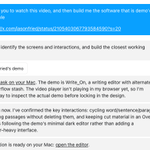
This is probably true. For example, I asked Claude to watch a YouTube launch video for a software product, and it recreated a custom version of it specific to my needs based only on frame sampling + my prompt.
That's...insane. I don't think this was possible 6 months ago. I'm able to make increasingly complex tools based on increasingly simple prompts.
Adjust your expectations accordingly...

Using Dot to create and refine slides in Figma does not spark joy.
Just the basics like "is this thing running?" are NOT obvious. It's so painful.

It's also maddening that the other ChatGPT capabilities don't seem to be leveraged by Dot at all....
I wanted to create a compelling image for our opening slide....did Dot help create that? Nooo...But if I go to chatgpt and select "create image", does it do exactly what I want? Yes!
cc @thsottiaux
Very excited to see creators reimagining the most fundamental ways we express and engage with ideas:
Writing
xitter.cf/jasonfried/status/2105…
Reading
xitter.cf/tareqistyping/status/2…


Very cool, @craigmod made a mini-site cataloging all of the long walks he’s taken since 2009, with maps and GPS tracks and links to essays/books/media that resulted from them: craigmod.com/walks/
Here's the specific walk from Things Become Other Things: craigmod.com/walks/#kii-peni…