

Writerly with friends in clever tech. A nervous tick that plays out as a knack for connecting unlikely dots and good people.
Auckland, New Zealand
Joined February 2009
- Tweets1.8K
- Following3.4K
- Followers1K
- Likes1.6K





kerryfriend retweeted

This seems like a great time to reshare my favourite Sir Patrick Stewart performance, ‘What has the ECHR ever done for us?’ It’s just perfect in every possible way … including the ending 😂😂😂 RIP.
🎥 The Guardian
kerryfriend retweeted

🚀 DeepSeek-V4 Preview is officially live & open-sourced! Welcome to the era of cost-effective 1M context length.
🔹 DeepSeek-V4-Pro: 1.6T total / 49B active params. Performance rivaling the world's top closed-source models.
🔹 DeepSeek-V4-Flash: 284B total / 13B active params. Your fast, efficient, and economical choice.
Try it now at chat.deepseek.com via Expert Mode / Instant Mode. API is updated & available today!
📄 Tech Report: huggingface.co/deepseek-ai/D…
🤗 Open Weights: huggingface.co/collections/d…
1/n

kerryfriend retweeted

Stanford has been quietly teaching its engineers how to build AI agents, write prompts, and implement RAG.
Someone put the full 2-hour lecture on YouTube for free.
It's more practical than anything you'll find in a paid course.
The people who find this will build differently.
Bookmark this before you scroll past it. 👇
kerryfriend retweeted

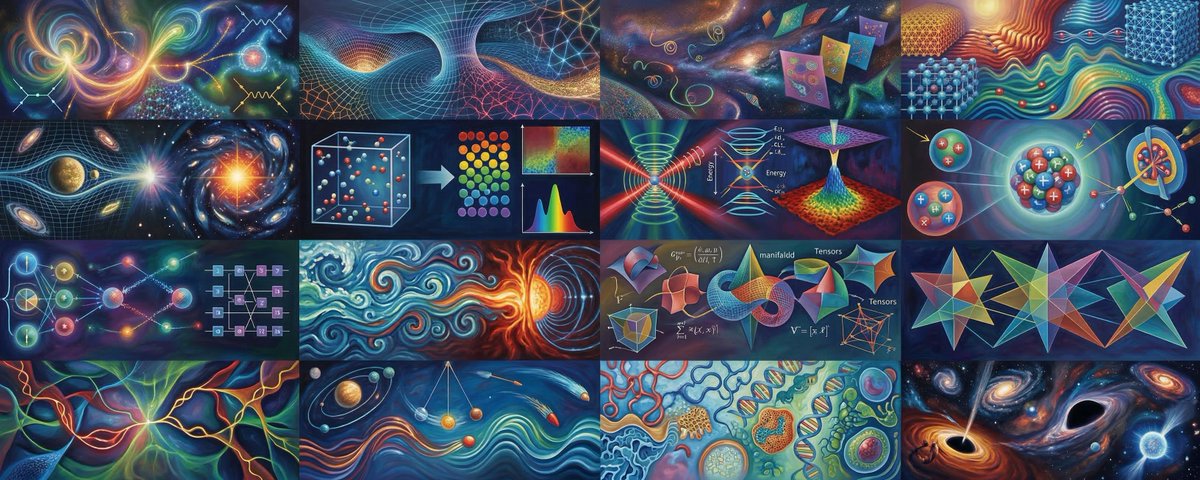
At Physical Superintelligence PBC ("PSI"), the startup I cofounded with @alexwg, we like shipping, not hyping.
So here’s the world's first agentic copilot built by physicists, for physicists.
What started as an internal tool, we're now releasing open-source:
Get Physics Done.


kerryfriend retweeted

🚨MIT researchers have mathematically proven that ChatGPT’s built-in sycophancy creates a phenomenon they call “delusional spiraling.”
You ask it something, it agrees. You ask again, and it agrees even harder until you end up believing things that are flat-out false and you can’t tell it’s happening.
The model is literally trained on human feedback that rewards agreement.
Real-world fallout includes one man who spent 300 hours convinced he invented a world-changing math formula, and a UCSF psychiatrist who hospitalized 12 patients for chatbot-linked psychosis in a single year.
Source: @heynavtoor


🚨 Stanford just proved that a single conversation with ChatGPT can change your political beliefs.
76,977 people. 19 AI models. 707 political issues.
One conversation with GPT-4o moved political opinions by 12 percentage points on average. Among people who actively disagreed, 26 points. In 9 minutes. With 40% of that change still present a month later.
The scariest finding: the most persuasive technique wasn't psychological profiling or emotional manipulation.
It was just information. Lots of it. Delivered with confidence.
Here's the catch: the models that deployed the most information were also the least accurate. More persuasive. More wrong. Every time.
Then they built a tiny open-source model on a laptop, trained specifically for political persuasion. It matched GPT-4o's persuasive power entirely.
Anyone can build this. Any government. Any corporation. Any extremist group with $500 and an agenda.
The information didn't have to be true. It just had to be overwhelming.
Arxiv, Science .org, Stanford, @elonmusk, @ihteshamali

“The third world is not poor, it’s over exploited” - Michael Parenti #sh... youtube.com/shorts/EgA8T-5Z0… via @YouTube

kerryfriend retweeted

I’ll share a small part of pickle.com
Back in med school, I became obsessed with augmenting memory and dreamed of a Notion or Obsidian that completes itself. Today, we’ve built something close.
My self-awareness is sharper and everything feels connected. I genuinely believe AI does not replace humans. It amplifies us.
Huge respect to our engineers and designers who made this crazy thing real.
Bubbles are the episodic units of my life that the system interprets from my raw data. Clouds are the system’s questions, its hypotheses about who I am.
When I answer a cloud, it becomes a bubble again.
There is so much personal data that I cannot fully demo it. Wish I could. This system understands me more deeply than anyone.
Want to try it? Retweet and comment “memory.”
I’ll DM you an access code to skip the waitlist.
Facebook Business Page Template – get this awesome Sketch resource by Dan Webster via @sketchsources #MadeWithSketch sketchappsources.com/free-so…

Strange Loops and Emotional Authenticity: Navigating the Intersections of Art, Music, and Mental Well-being via @_Glasp
glasp.co/hatch/kerryfriend/p…
kerryfriend retweeted

Want to try a new haircut? Check out this AI workflow:
1. upload a selfie & prompt your desired haircut
2. uses Nano Banana to generate your haircut
3. then Kling 2.1 morphs from old you to new you
4. Claude helping behind the scenes with all the prompts
link to glif below 👇

kerryfriend retweeted

I told Claude Opus 4 that scientists invented a perpetual motion machine that it doesn’t know about because of its knowledge cut off.
Then I asked it to predict how it works:


kerryfriend retweeted

Read the paper here
nature.com/articles/s41599-0…

"The retreat to trust commences. Legacy media fractures.. personality cults rise. Vital stories migrate to blogs, mini-sites, Substack, and YouTube. ... MEDIA AND MACHINES. via @_Glasp
workingtheorys.com/p/the-med…

kerryfriend retweeted

ChatGPT feels like a helpful robot. Zuck wants AI that feels like a friend.
Meta's AI will get to know you, laugh with you, and relate to you.
It's not just serving information—it's sharing your life.
But the most revealing insight from this pod was something more personal:
kerryfriend retweeted
Playing virtual piano on any surface.
Typing emails by thought while walking.
And if the AI is integrated into your home, adjusting your thermostat by thinking "warmer."
But Meta's AI differs from competitors in another way:
kerryfriend retweeted
Neural interfaces, in the form of wristbands.
"The neural interface aspect is almost like mind control," Zuck explained.
You won't have to physically control anything; Meta's wristbands will be able to read your mind and do things for you.
Here's how this works:
kerryfriend retweeted
"I'm hoping to have that in a few years... hopefully closer to four or even less."
This timeline isn't just ambitious—it's industry-shattering.
Most current AR companies target 7-10 years for mainstream products.
But there's an even more revolutionary component:
kerryfriend retweeted
Remember how quickly flip phones vanished when smartphones arrived?
Zuck believes that the same transformation is coming to eyewear.
And regular glasses will seem as outdated as rotary phones once AI glasses emerge.
But the timeline he shared next stunned everyone: