

PhD student @mbzuai Interp @mint_nlp_mbzuai | Prev : MSc @mbzuai Research Intern @RIKEN_AIP EE @its_campus
Indonesia
Joined June 2023
- Tweets864
- Following863
- Followers151
- Likes9.2K


New Anthropic Fellows research: Returning to the neuron basis for interpretability
Understanding what’s happening inside an AI model helps to make it safer. One obvious place to look is its neurons, or the simple units it’s built from. Early interpretability work did just that, but over the past couple years, researchers largely moved on from that idea, for three reasons: a single neuron often fires on several unrelated inputs, the way a concept is represented can change between two layers of neurons within a single model, and facts seem to be spread across many neurons.
We re-examined these problems by looking at what each neuron contributed to the model’s outputs, not just what caused that neuron to fire. All three problems turned out to be smaller than assumed. Neurons rarely add two unrelated concepts at once, their outputs mean roughly the same thing across most layers, and facts, though widely distributed across neurons, are still readable.
In a second post, we put these findings to use. With no extra training, neurons in open-weight models helped us to detect harmful text, steer behavior, and find hidden behaviors in finetuned models.
Part 1: alignment.anthropic.com/2026…
Part 2: alignment.anthropic.com/2026…
66
Cendekia | 🇮🇩 in 🇦🇪 retweeted


New Anthropic Fellows research: Returning to the neuron basis for interpretability
Understanding what’s happening inside an AI model helps to make it safer. One obvious place to look is its neurons, or the simple units it’s built from. Early interpretability work did just that, but over the past couple years, researchers largely moved on from that idea, for three reasons: a single neuron often fires on several unrelated inputs, the way a concept is represented can change between two layers of neurons within a single model, and facts seem to be spread across many neurons.
We re-examined these problems by looking at what each neuron contributed to the model’s outputs, not just what caused that neuron to fire. All three problems turned out to be smaller than assumed. Neurons rarely add two unrelated concepts at once, their outputs mean roughly the same thing across most layers, and facts, though widely distributed across neurons, are still readable.
In a second post, we put these findings to use. With no extra training, neurons in open-weight models helped us to detect harmful text, steer behavior, and find hidden behaviors in finetuned models.
Part 1: alignment.anthropic.com/2026…
Part 2: alignment.anthropic.com/2026…


YOOOO

【2027 IU WORLD TOUR CONCERT】
BANGKOK ➫ 2027.01.16-17
BULACAN ➫ 2027.01.30-31
KAOHSIUNG ➫ 2027.02.13-14
SYDNEY ➫ 2027.02.27
SINGAPORE ➫ 2027.03.06-07
KUALA LUMPUR ➫ 2027.03.27-28
TOKYO ➫ 2027.04.07-08
TAIPEI ➫ 2027.04.17-18
HONG KONG ➫ 2027.04.24-25
JAKARTA ➫ 2027.05.08-09
AND MORE
#아이유 #IU
#2027_IU_WORLD_TOUR


3
1
98
Cendekia | 🇮🇩 in 🇦🇪 retweeted

My EMNLP keynote "On The Value of Open Research in Language Modeling" is available!
underline.io/lecture/169662-…
I discuss why open research is important despite the progress made in industry, and some questions to think about to do more impactful open research.


Cendekia | 🇮🇩 in 🇦🇪 retweeted

🎉 Accepted to #EACL2027 (main)! w/ @MasahiroKaneko_ @inuikentaro at @mbzuai
"In 2008, Ronaldo played for" → Man Utd
"In 2019, Ronaldo played for" → Juventus
How do LMs pick the right one?
We trace how temporal information flows into factual recall.
📄 arxiv.org/abs/2611.01945

Cendekia | 🇮🇩 in 🇦🇪 retweeted

Gue terus belajar bahwa kebodohan itu fase, terutama kalo lu mau belajar. If you love your field so much, don't quit. Just learn to be better and embrace the shame.
Shame is humane, it means you have a good conscience.
Jgn kalah sm yg shameless sampe fraud demi naikin karir.
Cendekia | 🇮🇩 in 🇦🇪 retweeted

David Bau (@davidbau ; Northeastern University) spoke at the Cornell Tech Learning Machines Seminar on November 9: “Interpretability, Indirection and Introspection.” The recording is now on YouTube: youtube.com/watch?v=4eD89Uve…

Cendekia | 🇮🇩 in 🇦🇪 retweeted

Norbert Wiener, a forefather of control theory and arguably the first alignment researcher, warned in 1960 that we had better be sure “the purpose put into the machine is the purpose which we really desire.” New post: patterning as control (in the Toy Model of Superposition).
Definitely gonna read this!

New paper❗
Does understanding how AI models work actually make them safer?
This assumption often underlines interpretability research, but different subfields operationalise this intuition in very different ways. Our survey of mechanistic interpretability (MI) for safety provides an opinionated guide to the field of MI, detailing conceptual approaches and techniques under this broad banner and how different types of work relates to the mission of making AI model safer. 🧵
1
149
Tapi ini bukan soal supir ya kan pak 😋

Naik driverless taxi di Shenzen. Nggak ada supir, tapi arahnya jelas, ambil keputusannya pakai data, dan rutenya bisa dilihat semua penumpang lewat layar. Kok bisa sih? Soalnya di tempat lain kadang malah ada supir yg arahnya gak jelas dan nyetirnya bikin waswas seluruh penumpang.
78
Cendekia | 🇮🇩 in 🇦🇪 retweeted

A science of post-training can be built on interpretability.
Models know when they reward hack, and we see it, yet training ignores it. We propose Mechanistic Shaping: using the model’s own concepts to write training rules.
In vision, DPO & RL, and its effects on monitoring 🧵
Cendekia | 🇮🇩 in 🇦🇪 retweeted

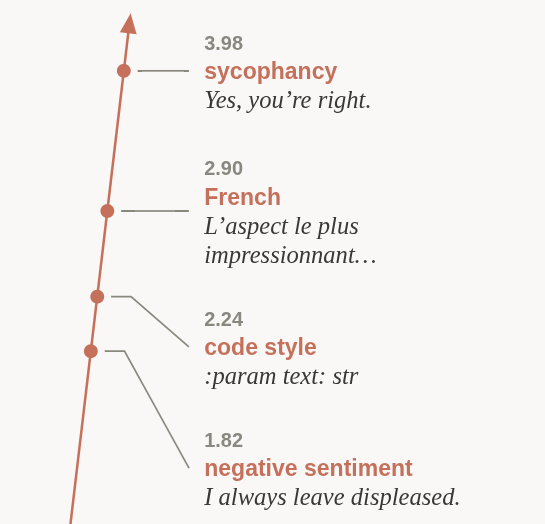
A single direction in LLM activation space, applied as a steering vector with four different norms, can cause the language model to perform a different behavior at each norm.
This and more in a new blog post, Do Not Rely on the Linear Representation Hypothesis. (link below.)


Cendekia | 🇮🇩 in 🇦🇪 retweeted

Interested in putting interpretability on more rigorous foundations? Check out our #EMNLP2026 tutorial slides!
I learned a ton from my fantastic collaborators @rpatrik96, @_shruti_joshi_, @dhanya_sridhar. Recommended for newcomers and experts alike!
📚 tinyurl.com/causality4mechin…

Cendekia | 🇮🇩 in 🇦🇪 retweeted

Really interesting tutorial, I highly recommand you explore.
From it I interpret that a lot of papers overclaim in mechanistic interpretability.
Now when readding "feature x is a single linear direction" apart from feeling bored, I feel it is overclaimed!

Interested in putting interpretability on more rigorous foundations? Check out our #EMNLP2026 tutorial slides!
I learned a ton from my fantastic collaborators @rpatrik96, @_shruti_joshi_, @dhanya_sridhar. Recommended for newcomers and experts alike!
📚 tinyurl.com/causality4mechin…
Cendekia | 🇮🇩 in 🇦🇪 retweeted

my hypothesis for why AI-generated slides for technical presentations are so awful:
people who don't have a lot of experience presenting think that to make a talk you just put all of the stuff you want to talk about on the slides, then you go through each slide and say the stuff the slide says.
how you're actually supposed to prepare a presentation: you decide what to say, write it out as a rough script, then put maybe 3% of the text on the slide, plus a bunch of visual aides (e.g. plots that only include data you're planning to discuss).
AI-generated presentations are mostly the former. they have a ton of stuff the presenter never mentions, and the stuff that is most useful for the presenter is absent or not highlighted. they include enough content for a presentation 10 times longer than the actual presentation is supposed to be.
maybe try doing it the other way: first write the script for what you actually want to say, and make sure you can say all of it in the time you have. then prompt the model to create the slides based on the script. ask it to use as little text a possible, and a minimalist visual style rather than the claude house style. you can thank me later (I accept both venmo and zelle).
Cendekia | 🇮🇩 in 🇦🇪 retweeted

Good slides are extremely intentional. When someone presents a paper, the paper already has all the information. But the speaker would make deliberate choices about things like, what to say and what not to say, what to put on a slide and what to say only verbally.
What to frame as a "side note" and when to say "this is the part I found particularly exciting."
Even individual word choices, like the subject, verb, and adjective, and when to pause, are intentional.
In fact, a good speaker would never really give a talk about a paper, even when that's seemingly what they're doing.
They would talk about what they want to say, like the story they want to tell, the kind of research they like, the vision they have, etc. Then they use the paper to support / back up their message.
Some tools are perfectly fine to use. But some skills take so much time and efforts, like years, and some tools proactively prevents learning them.

my hypothesis for why AI-generated slides for technical presentations are so awful:
people who don't have a lot of experience presenting think that to make a talk you just put all of the stuff you want to talk about on the slides, then you go through each slide and say the stuff the slide says.
how you're actually supposed to prepare a presentation: you decide what to say, write it out as a rough script, then put maybe 3% of the text on the slide, plus a bunch of visual aides (e.g. plots that only include data you're planning to discuss).
AI-generated presentations are mostly the former. they have a ton of stuff the presenter never mentions, and the stuff that is most useful for the presenter is absent or not highlighted. they include enough content for a presentation 10 times longer than the actual presentation is supposed to be.
maybe try doing it the other way: first write the script for what you actually want to say, and make sure you can say all of it in the time you have. then prompt the model to create the slides based on the script. ask it to use as little text a possible, and a minimalist visual style rather than the claude house style. you can thank me later (I accept both venmo and zelle).
Cendekia | 🇮🇩 in 🇦🇪 retweeted

Writing your thoughts down for your vision of what a project should be, and making slides for it after should be done primarily by hand! They are the parts where you need to think the most. Don't outsource it!

Good slides are extremely intentional. When someone presents a paper, the paper already has all the information. But the speaker would make deliberate choices about things like, what to say and what not to say, what to put on a slide and what to say only verbally.
What to frame as a "side note" and when to say "this is the part I found particularly exciting."
Even individual word choices, like the subject, verb, and adjective, and when to pause, are intentional.
In fact, a good speaker would never really give a talk about a paper, even when that's seemingly what they're doing.
They would talk about what they want to say, like the story they want to tell, the kind of research they like, the vision they have, etc. Then they use the paper to support / back up their message.
Some tools are perfectly fine to use. But some skills take so much time and efforts, like years, and some tools proactively prevents learning them.