

An Adobe Company. Helping 28M+ marketers be found everywhere search happens
Boston, MA
Joined February 2009
- Tweets214K
- Following10.7K
- Followers314K
- Likes38K




SEO question, then vs now:
Old → How do we rank higher?
New → How do we become a trusted source everywhere AI looks?
Rankings still matter. But AI answers pull from citations, mentions, and repeated signals far beyond your site.
Example: LinkedIn already drives ~11% of AI citations, more than many major publishers.
social.semrush.com/4iovrkT.

Are your go-to SEO tactics still effective in the age of AI search?
From programmatic SEO and content refreshes to long-tail keywords and unlinked brand mentions, familiar strategies are evolving as search changes.
Brian Dean breaks down seven classic SEO tactics to show what still works, what needs to change, and how to adapt your strategy for AI search.
Watch the full video 👇 social.semrush.com/3W3z8F7.

Why isn’t your brand showing up in AI search? The problem could be in one of four areas:
1. Discoverability: AI systems can't reliably access the information they need about the brand
2. Clarity: AI systems access that information but describe the brand inaccurately or inconsistently
3. Authority: AI systems describe the brand accurately but rarely include it in relevant comparisons or shortlists
4. Trust: AI systems consider the brand but rarely recommend it, or recommend it with recurring caveats
Each problem needs a different fix. Our guide explains how to diagnose the gaps and decide what to tackle first 👇
social.semrush.com/4srzcdS.

Everything you need to know about on-page SEO in 2026 to improve visibility and performance ↓
social.semrush.com/4z9RUcz.

Your brand appeared in ChatGPT. Now prove it matters. Join our live AI visibility AMA on October 29th to unpack mentions, citations, competitor tracking, and what actually works.
No slides. Just answers.
Bring your questions 👇
social.semrush.com/3TTTobz.

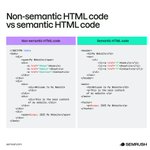
Semantic HTML helps machines understand your content the same way humans do – through structure and meaning.
Here’s how to implement it properly: social.semrush.com/4yGrMVs.

Your friendly reminder that you need to be visible in AI-driven search surfaces like Google’s AI Overviews and ChatGPT 💭
This checklist covers tasks that can help you gain visibility, no matter where your audience is searching! (If you have limited time or resources, focus on the most relevant tasks. Then, return to this guide whenever you’re ready to move on) ⬇️ social.semrush.com/48f4c7q.

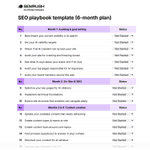
If you’re trying to earn visibility in AI-generated search results, here’s where to start: our 6-month playbook template 👇
social.semrush.com/3TPwYIA.

Google’s new AI shopping features could change both how customers discover products and how they buy them.
Information Agents may mean fewer visits to your website, but the visitors who do arrive could be closer to making a purchase. That makes conversion readiness just as important as visibility.
For ecommerce brands, there’s another priority: getting UCP-ready to be eligible for Google’s Universal Cart.
Here’s what these changes mean for your strategy and how to prepare 👇
social.semrush.com/4z4Mi35.

In AI search, structure is signal.
Semantic HTML is one of the clearest signals you can give 👇
social.semrush.com/3VWUhAQ.

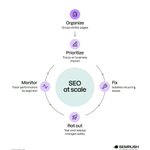
Scaling SEO across thousands of pages? Here are 5 ways to make it manageable:
1. Organize SEO work by page type
2. Prioritize page types by business impact
3. Fix recurring SEO issues at scale
4. Roll out changes safely
5. Monitor performance by segment
Get the full framework for managing SEO at scale 👇
social.semrush.com/4i1ZwYv.


AI visibility data becomes more useful when you turn it into clear, repeatable reporting.
Use this 6-step framework to audit your brand and communicate findings across marketing, PR, and leadership:
1. Benchmark overall visibility – measure mentions, share of voice, and competitor presence.
2. Identify cited content – find which pages AI systems use and where your brand is missed.
3. Find topical gaps – uncover prompts where competitors appear but your brand doesn’t.
4. Analyze brand sentiment – evaluate how AI platforms describe your brand and identify perception gaps.
5. Assess external sources – track third-party domains shaping AI answers and brand recommendations.
6. Check technical readiness – identify site issues that affect AI access and content interpretation.
Turn scattered search signals into measurable priorities and clearer decisions 👇
social.semrush.com/4elNI0U.

AI Overviews now appear for 88% of the commercial keywords in our study, up from 45.75% in September 2025.
Which commercial queries trigger AI Overviews most often, and where could your brand be missing from the answers?
Find out which modifiers matter most 👇
social.semrush.com/4BkZfYi.


Optimize your content for stronger SEO and AI visibility with these 20 practical tactics 👇 social.semrush.com/4ihQ95V.

Google’s AI Overview said Feature Upvote didn’t have a REST API, even though it did.
Here’s how they addressed the problem: they corrected outdated information on their website, published clear, up-to-date content, and requested indexing in Google Search Console.
Within an hour, the AI Overview started correcting its answer. Full consistency took a few more days.
See how they fixed it and what your brand can learn from their approach 👇
social.semrush.com/4yEi5qG.

Create a landing page that drives results.
Here's what the best-performing pages have in common ↓
social.semrush.com/3VPgrF9.

AI Overviews are showing up where purchase decisions happen.
Our latest study tracked 400 commercial keywords across banking, software, and ecommerce from September 2025 to August 2026. The findings reveal how quickly AI Overviews have expanded across searches with clear buying intent.
Three key findings:
• “Best X for Y” queries reached 96.12% AI Overview coverage, up 53 percentage points.
• Review queries climbed from 30% to nearly 90%, the biggest increase of any modifier.
• “Brand alternatives” searches saw a 34-point increase, while “brand vs. brand” searches rose by 23 points.
By August 2026, AI Overviews appeared for 88% of the keywords studied, and 97% of estimated search volume across those keywords.
Practical takeaway: review pages, product comparisons, pricing pages, and alternative lists are all potential entry points into AI-generated answers. Understanding which queries trigger AI Overviews, and which sources get cited, can help you decide where to focus your content efforts.
Explore the study 👇
social.semrush.com/4iwZFDs.

