

Leading nonpartisan tax policy research and analysis
Washington, DC
Joined October 2008
- Tweets59.6K
- Following890
- Followers69.6K
- Likes14.6K





Pinned Tweet
Tax policy is all about trade-offs.
Our new guide analyzes 86 potential changes to the federal tax code, considering their impact on federal revenue, the long-term debt trajectory, the distribution of after-tax income, and the US economy.
Launch our interactive tool: hubs.ly/Q04r06M-0

Jock taxes on highly paid athletes and entertainers are here to stay, but states could make life easier for the rest of us, at very little cost, by adopting reasonable nonresident filing and withholding thresholds for ordinary taxpayers.
hubs.ly/Q04Cmj_D0 #NFL #Football #PatrickMahomes

Data from 151 countries from 1963 through 2014 shows higher tariffs reduce output and productivity, increase unemployment, and worsen inequality.
Read more: hubs.ly/Q04CmjXP0

How do taxes in your state compare regionally and nationally? Facts and Figures, a resource we’ve provided to US taxpayers and legislators since 1941, serves as a one-stop state tax data resource that compares all 50 states on over 40 measures of tax rates, collections, burdens, and more.
Explore the latest data: hubs.ly/Q04CmgMT0

Tax policy is all about trade-offs.
Our new guide analyzes 86 potential changes to the federal tax code, considering their impact on federal revenue, the long-term debt trajectory, the distribution of after-tax income, and the US economy.
Launch our interactive tool: hubs.ly/Q04Cmhbx0
No one enjoys paying taxes, but the property tax serves an important purpose, and Wyoming has already implemented significant property tax relief. Proposition 1 would undercut local finances to a degree that would likely force reliance on worse taxes (local or state) and prompt spending cuts that reduce homeowners’ property values.
Read more: hubs.ly/Q04CmgM60

Nearly half of all hospitals are exempt from paying US corporate income taxes. As healthcare spending rises, lawmakers have questioned whether hospitals are providing as much in community benefits as they derive from tax exemptions.
Read more: hubs.ly/Q04CmgHv0

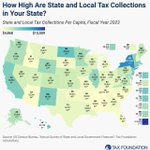
📈 Highest tax collections per capita:
DC ($15,009)
New York ($12,506)
North Dakota ($9,834)
Hawaii ($9,758)
Connecticut ($9,388)
New Jersey ($9,178)
Read more: hubs.ly/Q04C94NP0

Investment in digital assets, long thought of as a niche interest reserved for enthusiasts, has broken into the mainstream. In 2026, about one in five US adults report being invested in or using cryptocurrency.
Read more: hubs.ly/Q04C93Mc0

Taxes are on the ballot in November. Voters in 17 states will decide for themselves how their states raise revenue. Our new ballot tracker and podcast discussion break down the measures worth watching: hubs.ly/Q04C93Db0

🎉 The 2026 rankings are in! How competitive is your country’s tax code?
See how your country compares with our new interactive tool: hubs.ly/Q04C914t0
The structure of a country’s tax code is a determining factor of its economic performance. A well-structured tax code is easy for taxpayers to comply with and can promote economic development while raising sufficient revenue for a government’s priorities. In contrast, poorly structured tax systems can be costly, distort economic decision-making, and harm domestic economies.
The International Tax Competitiveness Index gives a comprehensive overview of how OECD countries’ tax codes compare, explains why certain tax codes stand out as good or bad models for reform, and provides important insight into how to think about tax policy.

Missing out on a tax rebate check is certainly disheartening, but New Jersey wallets are getting actively drained by an even bigger problem in the tax code: the state’s graduated-rate income tax thresholds don’t change with inflation, either.
Read more: hubs.ly/Q04C914s0

How we support savings in the US is too complex, and Trump Accounts worsen the problem. If lawmakers truly want to increase savings for taxpayers from day one, they should look to the UK and Canada, which have done it successfully for many years.
Read more: hubs.ly/Q04C8_qM0

States with no individual income tax (Florida, Texas, Tennessee, Nevada, and others) consistently rank among the strongest gainers, while states with the highest top rates (California at 13.3 percent, New York at 10.9 percent, and New Jersey at 10.75 percent) dominate the list of largest losers.
Explore the data: hubs.ly/Q04C95Xm0

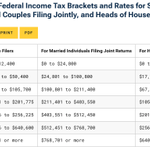
Explore the IRS inflation-adjusted 2026 tax brackets, for which taxpayers will file tax returns in early 2027.
See more: hubs.ly/Q04C95T70

If the U.S. taxed personal income in the same way that Denmark does, all income over $82,000 would be taxed at over 55 percent.
hubs.ly/Q04C95Xl0

Publicly held debt is projected to rise to a new record high of 106 percent of GDP within the next four years and continue to rise to 120 percent by 2036 and 175 percent by 2056.
Read more: hubs.ly/Q04C95Wz0

Imposing sales taxes on rental car companies’ fleet purchases, in addition to the sales and rental car excise taxes levied when those cars are rented, yields double taxation and causes harmful tax pyramiding.
Read more: hubs.ly/Q04C2Qq50

🌎 The most competitive tax codes in the OECD:
1. 🇪🇪 Estonia
2. 🇱🇻 Latvia
3. 🇳🇿 New Zealand
4. 🇨🇭 Switzerland
5. 🇱🇹 Lithuania
6. 🇱🇺 Luxembourg
7. 🇨🇿 Czech Republic
8. 🇦🇺 Australia
9. 🇹🇷 Turkey
10. 🇭🇺 Hungary
See full rankings: hubs.ly/Q04C2Q7v0

Washington’s new income tax on high earners doesn’t take effect until 2028, but it is already generating a lot of activity. A measure on the ballot this November, Initiative 645, would reverse the legislature’s decision, preventing the new tax from taking effect.
Read more: hubs.ly/Q04C2PvT0

Hall’s research helped economists understand how taxes distort investment decisions, while his work with Rabushka shows how to minimize those distortions. Although the US remains far from a pure consumption tax, Hall’s work informs efforts to reduce the tax burden on investment, improve neutrality, and promote long-run economic growth.
Read more: hubs.ly/Q04C2P5q0
