

Versa is the Universal SASE leader. One AI-powered platform to connect and secure your business anywhere work happens.
Santa Clara, CA
Joined April 2013
- Tweets4.4K
- Following469
- Followers27.6K
- Likes643






Hosting a workload on Versa uCPE instead of a dedicated appliance can save hundreds of dollars per site per month once hardware, power, and management overhead are factored in.
Scale that across 500 to 2,000 locations and the savings can reach into the millions annually, and that is before accounting for avoided capital outlay.
AI memory costs are making this math more relevant now, not less: bit.ly/4dH5VFW
#NetworkSecurity #EdgeComputing


Four Anthropic sandbox incidents and four models that found an open egress path their prompts said did not exist.
This five-layer framework is the network architecture that closes those paths. Run it against your agentic AI evaluation environment before the next session.
And here's our blog post for more details: bit.ly/4BnZwtD
#NetworkSecurity #ZeroTrust


Periodic audits were designed for static applications and slower release cycles.
That model does not hold up against cloud-native development, AI-generated code, and automated adversaries.
Our answer: AI-assisted pre-merge review, unified supply chain scanning, hard release gates, and human ownership of all AI-generated code.
Here is a quick walk through each control.
And here is a blog post outlining more details: bit.ly/4s7ckAo
#NetworkSecurity #CyberSecurity


FY2027 is the Zero Trust maturity deadline for federal agencies.
The EIS transition is open now and the sequencing decisions that determine whether agencies get there without disrupting mission delivery are being made right now.
This blog post maps the timeline: bit.ly/4hp6VRq
#ZeroTrust #NetworkSecurity

Most agentic AI networking demos stop before the question that matters: would you trust it to execute on production infrastructure?
VersaONE answers that with architecture, not promises.
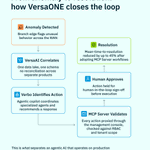
When an anomaly is detected, VersaAI correlates it across one data lake, our Verbo recommends an action, the MCP Server validates it against RBAC, and a human approves it before anything executes.
Up to 45% MTTR reduction in production. Read how: bit.ly/4jzG3Q8
#NetworkSecurity #ZeroTrust

Operational technology environments face a different set of security challenges than traditional IT, and AI is adding new pressure to an already difficult problem.
Judson Walker from our Federal Systems Engineering team is joining Booz Allen Hamilton on November 2 to walk through the evolving threat landscape, real-world attack examples, and practical strategies for protecting OT systems.
Register here: bit.ly/3TRQ291
#NetworkSecurity #OTSecurity

Static DLL hijacking scanners give you thousands of candidates to chase down yourself.
DLLHijackHunter drops a canary DLL, triggers the program, and lets Windows write the confirmation.
Confirmed findings only, open source, single executable, with no dependencies.
Learn more: bit.ly/4AL0S0X
#NetworkSecurity #WindowsSecurity


Multi-domain operations across the Pacific require networks and security that can keep pace with joint force demands.
Visit us at TechNet Indo-Pacific booth 122 and talk with our team about Zero Trust, the INDOPACOM Mission Network, and platform consolidation.
#NetworkSecurity #TechNetIndoPacific

Most teams know they need AI-driven NetOps, but few know where to start without losing control of the network.
It comes down to three steps: decision support, guided remediation, and guardrailed automation.
Each one builds on the trust layer of the one before it.
Our customers are reporting up to 45% faster MTTR.
Read how the architecture gets you there: bit.ly/3Td34h1
#NetworkSecurity #ZeroTrust

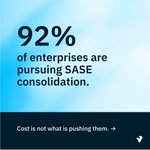
92% of enterprises are consolidating SASE, and cost ranks 5th on the list of reasons.
Security visibility, reduced complexity, and better performance are leading the decision.
88% also say digital sovereignty is critical or very important. Not one respondent called it unimportant.
Here are the Futuriom findings that matter most for IT and security leaders evaluating platforms right now: bit.ly/4jL2uBI
#NetworkSecurity #ZeroTrust


Sovereign SASE requires four planes working together, not just data residency.
Data, control, management, or jurisdiction...miss one and the claim doesn’t hold up.
This diagram maps what each plane actually requires.
Learn more from our blog post: bit.ly/3Tg9Kek
#NetworkSecurity #ZeroTrust

Your cloud permissions worked exactly as designed. That was the problem.
In the Storm-3168 Azure attack, every deletion was authorized. 15.5 hours of reconnaissance, 300+ permitted reads, then 150+ destructive operations in 35 minutes. Least privilege confirmed the identity was valid. It had nothing to say about what that identity destroyed.
The accounts that survived had resource locks, independent safeguards that never asked the identity’s opinion.
In this @SecInfoWatch article, Former Gartner Analyst and Strategic Advisor to Versa, Brad LaPorte, shares what the incident means for how teams need to think about deletion rights, two-person integrity, and why redacting an exposed secret does not invalidate it: bit.ly/4dO8ypB
#NetworkSecurity #CloudSecurity

A compromised login with no segmentation in place is a free pass to move through your network.
Our survey of 164 IT and security leaders found this is still the reality for most ZTNA deployments, and it ties back to the original driver for buying in.
Join us on October 29 and see what the data shows: bit.ly/4hDbuaW
#NetworkSecurity #ZeroTrust

$82,000 in 48 hours, one stolen Gemini API key, no intrusion, and no malware...
LLMjacking on AWS Bedrock is running $46,000 a day.
Denial of wallet shows up at the network layer long before it shows up on the invoice.
The 2026 OWASP GenAI Top 10 moved Unbounded Consumption up four spots for exactly this reason, and the countermeasures are network-layer controls, not app-layer guardrails.
Learn more: bit.ly/4xUr0EV
#NetworkSecurity #CyberSecurity
The hard part of securing AI in government is not the tools. It is the architecture decisions made before deployment.
Our Senior Director of Systems Engineering, Judson Walker, discusses how Zero Trust principles apply across the entire AI lifecycle for federal agencies at the FedInsider Innovation Summit on October 21.
Join us for this session and hear from other experts throughout the day: bit.ly/4zqNsG8
#NetworkSecurity #ZeroTrust

Machine identities outnumber humans 80 to 1.
42% have privileged access.
Most never see a login prompt.
Zero Trust that only covers humans is not Zero Trust.
Here is how Pervasive Security extends verification to the identities most tools miss. bit.ly/4i2pb1U
#NetworkSecurity #ZeroTrust


Most edge workload decisions default to ordering another box, but that assumption is worth pressure-testing before procurement runs.
This comparison card looks at dedicated appliances versus converged uCPE across the factors that matter at enterprise scale: footprint, management overhead, and total cost.
For many lightweight apps, the hardware is already in the rack: bit.ly/4dH5VFW
#NetworkSecurity #SDWAN

When VPN performance gets bad enough, users bypass it entirely and that's the moment your security posture goes from imperfect to nonexistent.
The costs do not stop there as it requires more hardware and higher licensing. A network architecture where anyone inside can access, copy, and move data without much friction.
The business case for ZTNA comes from what customers are experiencing firsthand.
See why more organizations are making the switch: bit.ly/4xZaMub
#NetworkSecurity #ZeroTrust
AI is giving attackers new capabilities in OT environments, and critical infrastructure is feeling it.
On November 2, our Senior Director of Federal Systems Engineering, Judson Walker, joins Booz Allen's cyber physical defense experts to discuss what AI-enabled attacks look like, where the gaps are, and how organizations can close them.
Register here: bit.ly/3TRQ291
#NetworkSecurity #OTSecurity

Most DLP stacks were built through acquisition, not design.
The result is policy gaps across SWG, CASB, and ZTNA that become blind spots in AI workflows, remote access, and cloud collaboration.
Join us tomorrow to see how unified, context-aware DLP closes those gaps without locking down productivity.
Register today: bit.ly/4rzIYdo
#NetworkSecurity #CyberSecurity
