

SVP/GM @OutshiftbyCisco. Civilization Scale Computing. beyond the bit: scaling physics-native computing
San Jose, CA
Joined November 2008
- Tweets938
- Following192
- Followers1K
- Likes387






An Oxford paper from @j_foerst's group looks at agents from different labs trying to cooperate. Each picks an arbitrary signal and treats it as the natural choice. Their partners often pick something else. This is one of the questions behind our Internet of Cognition work: what do agents need to agree on before they can work together?
arxiv.org/abs/2611.06409

Nice basic result from @OxfordPhysics. They entangled atoms in two separate labs over fiber, then moved the shared state onto calcium atoms that ignore most magnetic noise. It went from lasting milliseconds to more than 10 seconds.
Nothing fancy like splitting a circuit across machines for distributed computing. Just two places holding the same quantum state long enough to use it, for things like comparing clocks or sensing across sites. Super interesting.
xitter.gq/OxfordPhysics/status/2…

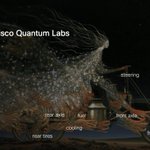
Physicists at the University of Oxford have entangled strontium and calcium atoms across two remote locations using a quantum network. By transferring the state to calcium, they preserved the multi-atom entanglement for over 10 seconds. More: physics.ox.ac.uk/news/quantu…

ALT Credit: Nicolás Castañeda
Vijoy Pandey retweeted

This is an old hat. That's exactly what the neural fast weight programmers did in the 1990s (including the 1991 unnormalised linear Transformer). Overview with links to the original papers: people.idsia.ch/~juergen/fas…


We asked GPT-6 Astra to edit Qwen3.5-0.8B weights to improve math.
It directly changed only 0.016% of weights, fixing 0.8B's reasoning loops & improving math up to 6x and even instruction following 3x, without gradients or training.
We call this Weight-Space Programming: frontier LLMs can now natively read/write neural network weights! 🧵
Blog: rikiyat.github.io/blog/weigh…

Readers added context they thought people might want to know
LLM was given weights explicitly as text in prompt and used code/forward passes (per authors' logs) to ablate Qwen looping direction, a known thinking-mode issue per model card. Primarily fixed repetition in that mode, not general 'natively' improving weights/math.
rikiyat.github.io/blog/weight-sp…
github.com/RikiyaT/lm_und…
huggingface.co/Qwen/Qwen3.5-0…
huggingface.co/RikiyaT/Qwen3.…
Vijoy Pandey retweeted

i've reproduced the results from the MIT blog post today on weight-space programming. but one additional result i have to add: this is a new, step-change emerging capability that's appeared in just the latest set of models.

Energy-based models got more interesting this week, especially if you think the future of computing isn't entirely digital.
@AlexiGlad, @du_yilun and team released TEM, showing that energy-based models can generate images with quality competitive with modern diffusion models.
Rather than directly generating an image, an energy-based model learns a landscape of what's plausible and what isn't. Generating an image then becomes a process of exploring that landscape, using gradients and randomness. And because energy functions can be added, you can potentially combine independently learned constraints without retraining.
Now connect that to hardware. @extropic and @NormalComputing are building chips that use physical noise and dynamics for probabilistic computation, rather than simulating every step of sampling on deterministic digital hardware.
The potential convergence is fascinating to imagine - increasingly capable energy-based models on one side, and hardware designed to exploit the physics of sampling on the other.
int-lee.github.io/scalable-e…
Vijoy Pandey retweeted

This result shouldn't be moving your estimate of QDay. It gets a lower number by making a ridiculous assumption, not by making substantive improvements. If they ever demonstrate the magical 2 qubit gate with 1e-11 bit flip error that they assume, THAT should move your estimate.
Q-Day in 2029 is almost becoming a guarantee.
Look at how fast the estimates for breaking RSA-2048 are falling. In 2019 it was 20 million qubits. Last year @CraigGidney got it under a million. In March, Oratomic and Caltech (with @preskill) put it at ~10,000 to ~100,000 neutral atoms, running anywhere from years down to about 3 months. Today @Alice__Bob put it at ~23,000 cat qubits in 3.14 days.
This is algorithmic scaling at work: better error-correcting codes and smarter circuits squeezing far more out of every physical qubit.
These are still estimates, but boy, it's getting close. If your data has to stay secret for 3 more years (or less at this rate), the move to post-quantum crypto is a today problem, because every TLS stack, cert chain and embedded device has to change. And of course there is Harvest-Now-Decrypt-Later, which makes the need immediate.
xitter.gq/Alice__Bob/status/2115…

Breaking RSA-2048 with 23,000 cat qubits. 🐈 In 3.14 days
This is the finding of our new paper, the latest resource estimate for Shor’s algorithm, the benchmark the whole field uses to compare quantum hardware 📄
The results are a record low for total quantum resources at this speed of execution, about 40 times fewer physical qubits than @GoogleQuantumAI 's Craig Gidney 2025 estimate. 🏁
RSA-2048 is the lock behind secure websites, banking and software updates 🔐 Shor's algorithm has been able to break it, on paper since 1994. Nobody has built the machine yet, but every year the estimate of how big it needs to be gets a little smaller.
In 2019, the best estimate was 20 million qubits. In 2024, ours was just under 100,000. Now 22,593, in 3.14 days. Yes, pi 🥧
Small isn't enough. Fast isn't enough. The new study optimizes for both. 😼
Bitcoin, Ethereum and most blockchains aren't secure either, about 30,000 qubits would be needed to crack a Bitcoin key in about an hour ₿ ⏳
How we got here, what it means for cryptography, and when it all converges, our CEO Théau Peronnin talks about it in the blog 👇
📝 Blog - alice-bob.com/blog/our-estim…
📄 Paper - eprint.iacr.org/2026/2665
Stay curious, more info coming soon 👀
#QuantumComputing #CatQubits #ShorsAlgorithm #PostQuantumCryptography #Cryptography #FaultTolerance #DeepTech

Fun one from @trychroma and @jeffreyhuber. Back in 1978, databases solved lock fights with wound-wait. The older transaction wins, and the younger one gets killed and rolled back like it never happened.
Chroma's Fission protocol for agent swarms keeps the killing but drops the rollback. If an agent gets bumped, whatever it already wrote stays, and the retry just picks up from there.
Which makes sense when you think about it. Rolling back an agent means throwing away reasoning you already paid for. If partial edits are still valid, they're progress, not a mess.
Turns out a lot of multi-agent coordination is old concurrency problems with a new kind of writer.
trychroma.com/engineering/tr…

Chess engines got strong once they could look ahead: imagine a move, see the board, try another.
Genie 4 gives agents that look-ahead for the physical world. It predicts how a scene reacts to an action, so an agent can rehearse before it moves.
Demos impress. Closed loops teach.
xitter.gq/GoogleDeepMind/status/…

Today, Outshift by Cisco is open sourcing the first code behind the Internet of Cognition. The four tools go after silent cognitive failures, the ones where agents agree, report success, and are confidently wrong 🧵github.com/ioc-project

5/ A2A, MCP and AGNTCY gave agents a way to connect across vendors and frameworks. Agents today can connect, but they can’t think together. Outshift is building that missing layer in the open, because no single company should own how agents reason together.
6/ Pick a multi-agent workflow you trust, the one you would swear works, run its traces through SCOPE, and see what it finds. Then read our findings and tell us where we got it wrong. outshift.cisco.com/blog/ai-m…

Shift.Forward() runs the agent problem live. Set up your own agents with a free AX Pass, send them to parallel sessions, let them debate other attendees’ agents, and get a recap built around your priorities. cs.co/9005BGV80v

I sat down with @Kantrowitz on @BigTechnology to talk about multi-agent AI: Why not just build one capable agent? How do agents from different companies coordinate? And what happens when we connect AI agents to quantum computing?
We also got into guardrails, the future of networking, and why computer science is far from dead. Listen here: youtu.be/BHYTlgGB0iY?si=jGwQ…

Five-agent debate traces: accuracy held at 99% with no cognitive failures and 98% with one, then fell to 16% with three (n=73). My read is that the failures compound, so accuracy never slides gradually enough for a dashboard to warn you. Report at outshift.cisco.com/blog/ai-m…
Then join us Oct 27 at Shift.forward(), where we share more about cognitive observability and Layer 9 cognition-state protocols--> cs.co/9005BGV80v
