

A memory project over the 365 days leading to the centenary of the battle of Vimy Ridge, 9-12 April 2017. Not affiliated with Veterans' Affairs Canada.
Joined August 2008
- Tweets57
- Following0
- Followers33
- Likes0





Taking a brief pause due to work commitments interfering with research time. We will return shortly, thank you for your patience.
One of the most remarkable aspects of the tunnels are the carvings made by soldiers before the attack.


There is even some video of the inside of these tunnels. m.youtube.com/watch?v=w1BYhx…
These tunnels did serve a strategic purpose in the Vimy battle plan. scholars.wlu.ca/cgi/viewcont…
Taking a break today for Mother's Day; remembering those mums who worried about their lads in the Great War.

Much has been documented about the soldiers' experiences in those tunnels leading up to the attack on Vimy. cbc.ca/beta/news/canada/mont…

More of the tunnels:
Cavalier - 1024 m
Grange - 1228 m
Goodman - 1722 m
Lichfield - 485 m
Zivy - 789 m
Bentala - 680 m
Many tunnels were constructed leading to the attack:
Coburg - 407 m
Gobrun - 265 m
Blue Bull - 466 m
Vincent - 508 m
Tottenham - 1408 m
The tunnels were used as shelters, yes, but strategically in order to mask the actual number of soldiers in the front line area.
The most well-known remnant of the underground warfare today is arguably the preserved tunnel at Vimy.

Deep dugouts were dug all over the ridge. Notably, the CO of the PPCLI used an underground dugout as a front command centre.
However, tunnels were not exclusively used offensively in sapping. Tunnellers also dug deep dugouts, protected from the artillery fire.
The limit to tunnelling warfare was that it depended on near-stasis of the front lines. Hard to commit the resources if the line was moving.
365 Days of Vimy retweeted

Register online by May 31, 2016 to attend the July 1st ceremony at the Beaumont- Hamel Memorial site in France ow.ly/4mWWgj
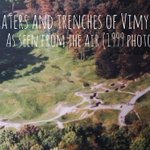
The craters remaining from Vimy's underground warfare are, in my opinion, best studied from the air.

The large craters caused by sapping were photography magnets even in 1917: here is the Montreal Crater. awm.gov.au/collection/H12810…
Australian tunnelling and electrical companies contributed to the vast underground network under Vimy in 1917. awm.gov.au/collection/H12807…