

We’re a citizens movement. We want to stop climate change, reverse biodiversity loss, create more space for wild nature, and help emerging countries develop.
Earth
Joined October 2021
- Tweets2.7K
- Following412
- Followers7.7K
- Likes3.7K




Pinned Tweet
NEW WEPLANET REPORT — BUILD THE FOOD FIREWALL
Europe’s food system was built for a stable world, but that world is changing. Geopolitics, climate, and trade are all becoming harder to predict.
Food — specifically, the resources Europe relies on to produce food — cannot enter the region if any trade or supply chain chokepoints close. Around 84% of EU protein relies on imported feed, additives or fertiliser at some point in production, and China now makes nearly 80% of the world's vitamins.
In a world of unstable trade and a changing climate, this dependency sets Europe up for something called a “protein shock”: when essential imports for food production become scarce or sharply more expensive.
In response to these vulnerabilities, our latest report written by Martin Reich says this: build the Food Firewall — now.
In an open letter, former military generals, EU Commissioners and UN office-holders join us in cautioning against inaction.
Invest in advanced fermentation inside the EU. This way, Europe can reduce overseas dependencies, build food sovereignty, and support domestic biotechnology.
Read the full report and the open letter here: weplanet.org/foodfirewall
#WePlanet #FoodFirewall #NationalSecurity #Biomanufacturing #NewProteins


Are coral reefs doomed? Not if you ask Marie Celine Piednoir.
In this week's episode of the Saving the World from Bad Ideas podcast, host Mark Lynas and Marie Celine discuss the threats facing coral reefs globally and how the Climate Resilient Coral Reefs Commitment is an initiative for reef-holding nations to protect these precious ecosystems.
In this clip, Marie Celine speaks about a reef she dived on in Fiji, and that despite being destroyed in a cyclone in 2016, the underwater garden is back to its robust, beautiful state. The reefs can rebound, if given the chance.
As Marie Celine says, there is hope for the corals — and subsequently, our planet. We have to keep on fighting.
Watch the full episode here -> youtube.com/watch?v=iEVYAi9-…
#WePlanet #Podcast #CoralReefs #Diving
4
262
WePlanet retweeted

Obrigado ao @theluisribeiro por ter apresentado na @SICNoticias os números para os quais a @weplanetint alerta:
A Europa não é soberana na sua alimentação.


What happens to Europe's food system if trade and imports come to a halt?
In this video, WePlanet's Senior Policy Advisor Martin Reich, author of our new report "Building the EU Food Firewall", breaks down the report's findings on Europe's food system vulnerabilities — and how European politicians can step up and build the Food Firewall.
Europe's food system was built for a stable world. That world is changing. Geopolitics, climate and trade are all getting harder to predict, and our food supply depends on them more than most people realise:
🟣 Around 84% of EU protein relies on imported feed, additives or fertiliser at some point in production —
That means if trade routes or supply chains close, the resources Europe needs to produce food won't arrive. That sets the region up for a "protein shock", when essential imports for food production suddenly become scarce or far more expensive.
Martin's message is clear: build the Food Firewall, now. That means investing in advanced fermentation inside the EU to cut overseas dependencies, build food sovereignty and grow Europe's own biotechnology sector.
In an open letter, former military generals, EU Commissioners and UN office-holders join us in calling for a European Food Firewall.
▶️ Watch Martin's video below and read the full report and open letter here: foodfirewall.org
#WePlanet #FoodFirewall #Imports #Trade
WePlanet retweeted

.@weplanetint’s new report explores how resilient foods could strengthen food security. Citing ALLFED research, it shows the need for both resilient domestic production & open trade to prepare for global catastrophic risks. tinyurl.com/5bducvuv

In this episode of Saving the World from Bad Ideas, host Mark Lynas is joined by Marie Celine Piednoir, coordinator of the Climate Resilient Coral Reefs Commitment, an international initiative bringing governments together to protect coral reefs. Marie Celine explains the threats coral reefs face as ocean temperatures rise from climate change, as well as regional, local pressures like overfishing and pollution. Yet, Marie Celine maintains that there is still hope, and that we shouldn’t give up.
She discusses how the Commitment is helping countries protect the coral reefs, particularly those showing the most promise in withstanding climate change, and the importance of international funding for reefs’ conservation. She also gives all of us — governments, scientists and individuals — advice on how we can all take action to safeguard these colorful, vibrant and biodiverse ecosystems.
Learn more about the commitment here -> coralcommitment.com/protect-…
#CoralReef #OceanScience #MarineBiology #Podcast
7
297
What happens to Europe's food system if trade and imports come to a halt?
In this video, WePlanet's Senior Policy Advisor Martin Reich, author of our new report "Building the EU Food Firewall", breaks down the report's findings on Europe's food system vulnerabilities — and how European politicians can step up and build the Food Firewall.
Europe's food system was built for a stable world. That world is changing. Geopolitics, climate and trade are all getting harder to predict, and our food supply depends on them more than most people realise:
🟣 Around 84% of EU protein relies on imported feed, additives or fertiliser at some point in production —
That means if trade routes or supply chains close, the resources Europe needs to produce food won't arrive. That sets the region up for a "protein shock", when essential imports for food production suddenly become scarce or far more expensive.
Martin's message is clear: build the Food Firewall, now. That means investing in advanced fermentation inside the EU to cut overseas dependencies, build food sovereignty and grow Europe's own biotechnology sector.
In an open letter, former military generals, EU Commissioners and UN office-holders join us in calling for a European Food Firewall.
▶️ Watch Martin's video below and read the full report and open letter here: foodfirewall.org
#WePlanet #FoodFirewall #Imports #Trade
The UK-EU reset deal announced on Friday could have killed the UK's novel protein sector. But it didn't, and WePlanet had a part to play in that. Let us explain.
Since Brexit, the UK has powered ahead on cultivated meat and advanced fermentation, and on the boring-but-important bit that goes with them: the rules on how these products can be brought to market safely and quickly, so everyday people can actually eat them. That has meant driving high levels of investment and doing the hard work of improving regulation, so these products don't get stuck in years of slow red tape.
Under the reset deal, this progress could have been torpedoed. While the UK has moved forward on lab-grown meat and other vital novel proteins, the EU has gone radically backwards, doing almost everything it can to destroy them. That includes banning them outright in some countries (looking at you, Italy and Hungary!), passing complicated labelling bans on what novel proteins can and can't call themselves and, so far, excluding them from food safety reforms that could speed up approval times.
Had UK novel protein start-ups been forced to sign up to the EU's innovation-stifling rules on Friday, it would have been a disaster for the British sector and made getting lab-grown meat to market in the UK much harder.
Earlier this year, WePlanet broke a crucial story in the UK media warning that novel proteins weren't the only thing at risk. In major stories in the Daily Mail, The Telegraph and other top-tier outlets, we revealed that beloved British household snacks like Roast Beef Monster Munch would also have fallen victim to these backward EU regulations.
The British establishment might not be diehard supporters of lab-grown meat (for now), but they are certainly dedicated to their snacks. With other players like the @altproteinsuk leading the charge, we're glad to have played our part in helping the UK hold its nerve and secure a temporary exemption from the EU's self-imposed fantasy ride towards the agricultural past.
#WePlanet #NovelProteins #PrecisionFermentation #RebootFood

ALT text that says "victory: UK holds its nerve on novel proteins" and a computer-generated image of DNA in the background bottom text reads: In a win for cultivated meat and advanced fermentation, the UK secures an exemption from the EU's novel food rules"
In this clip from Saving the World from Bad Ideas, Mark is joined by Tea Törmänen, WePlanet’s Head of Global Development and a member of the Finnish Green Party.
Mark admits that, like every environmentalist he knew, he used to oppose nuclear. Tea never did.
Growing up in Finland, a country that has sustainably operated on nuclear energy for decades — and now, has built the world’s first deep geological repository for spent nuclear fuel — Tea has never understood the opposition to the clean energy source.
"For me nuclear waste has always been more like a political issue. It's not a scientific or a technological issue, we have solutions. And in Finland we were able to solve the political problem." - Tea
Watch the full episode here -> youtu.be/ClelIz2KqMU?si=v0Y6…
#NuclearEnergy #Podcast #Finland
Climate change is giving antibiotic-resistant bacteria more opportunities to spread.
The European Environment Agency is calling for better environmental monitoring and a holistic approach to tackling antimicrobial resistance, recognising that human, animal and environmental health are closely connected.
Adapting scientific approaches and oversight will be key as our planet heads into less predictable outcomes. shorturl.at/7QDZF
#EEA #AntibioticResistance

On the latest episode of Saving the World from Bad Ideas Podcast, WePlanet’s Head of Global Development, Tea Törmänen, talks with host Mark Lynas about going to Switzerland to make the case for lifting the nation's ban on new nuclear builds. She spoke at an event organised by Women in Nuclear Europe and explained why, in Finland, you don’t have to be against nuclear to be an environmentalist.
The reaction from parts of the Swiss environmental movement says a lot about how polarised this debate still is.
Watch the full epsiode here -> youtube.com/watch?v=ClelIz2K…
#NuclearEnergy #Switzerland #GreenParty
Xylella fastidiosa is a bacterium killing olive trees, and in places like Puglia, Italy, the olive harvest is a key cultural practice.
At WePlanet, we'd ask: could genetically modified, pest-resistant olive trees offer a solution? 🫒
#GMO #geneticallymodified
europeancorrespondent.com/en…

1
5
266
It seems every environmentalist loves the idea of a shared garden allotment — you know, the picturesque plots of land you rent amongst your neighbors to grow veggies and keep bees.
However, as @Joelscotthalkes explains in this video, it's not all sunshine and bean sprouts. In a study from the University of Michigan, researchers found these veggie gardens have a carbon intensity *6 times higher* than conventionally farmed supermarket veg.
How is this possible? Watch the video to find out...
#WePlanet #Ecomodernism #FoodSystems #RebootFood
Reporting back from COP31 in Turkey —
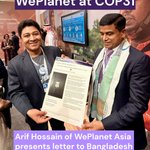
Today, a WePlanet delegation led by Arif Hossain, Regional Head of WePlanet Asia, along with allies and representatives from the nuclear energy sector, presented a Letter of Appreciation to Bangladesh State Minister Forhad Hossain Azad for advancing the Rooppur Nuclear Power Plant project and initiating its trial power supply to Bangladesh's national grid.
Located in western Bangladesh, Rooppur is the country’s first nuclear power plant. Its two reactors, each with a planned capacity of 1,200 MW, will provide a combined 2,400 MW of electricity, helping meet growing energy demand in Bangladesh while strengthening energy security, decarbonizing and diversifying the country's electricity supply.
These engagements reflect WePlanet’s commitment to recognising scientific and technological progress, encouraging constructive dialogue, and promoting nuclear energy as an important part of a clean, reliable and sustainable energy future.
The State Minister warmly welcomed WePlanet’s gesture and expressed his appreciation for the recognition. He also invited the delegation to visit the Rooppur Nuclear Power Plant. The meeting provided an opportunity to establish direct communication for future engagement and collaboration.
#COP31 #WePlanet #NuclearEnergy #Bangladesh


As COP31 takes place in Antalya, Turkey, pro-nuclear energy associations are calling for nuclear power to be explicitly recognized in the framework for global electrification.
With world leaders convening to address compounding climate crises, overlooking nuclear energy as a key driver of a decarbonized, electrified future would be a mistake. Nuclear must be part of the conversation. shorturl.at/GSgbN
#NuclearEnergy #COP31

A new report by our friends @euroveg_eu compared VAT on 33 food categories across all 27 EU member states. They found that 12 countries apply *higher* VAT to at least one plant-based product than to its animal-based equivalent.
Price influences food choices — and as such, plant-based drinks deserve equal treatment to dairy. Consumers deserve the right to be able to purchase alternatives to meat and dairy without paying a fine.
Be sure to read the full report here: shorturl.at/HoTCF
#PlantBased #EUPolicy #VAT

In this week's episode of Saving the World from Bad Ideas podcast, host Mark Lynas is joined by Dakota Gruener, CEO of Reflective, a nonprofit working to advance research into sunlight reflection as a method to combat global heating and cool the planet. 🌍
Mark and Dakota discuss the tool of sunlight reflection methods (SRM) as a potential means to save the planet from climate breakdown, and why further research is vital — not because it makes SRM inevitable, but because we need better scientific evidence to inform a decision about deployment or not.
Dakota argues that we, as a global community, must embrace researching reflective technology — whether stratospheric sulfur injections, marine cloud brightening or something else — as a means to better understand the options before it’s too late.
#Solar #Reflective #SunlightReflection #GlobalHeating
Victory! WePlanet celebrates Boots finally announcing they're dropping krill from their shelves
The UK-based retail giant Boots has confirmed it no longer sources Antarctic krill for its Omega-3 products. This is a huge win — for penguins and whales and all wildlife that depend on krill.
It's also a win for us at WePlanet — alongside our advocacy partners like Sea Shepherd, other campaigners and members of the public — who have campaigned to pressure Boots and other retailers to abandon the outdated and unnecessary use of krill for Omega-3 oil capsules.
It's a promising sign of growing momentum against the use of krill oil in the retail sector and beyond. If you have ever signed a WePlanet petition, complained to Boots or ramped up the pressure on social media to pressure Boots to drop krill — thank you. Your support is a key part of this victory. 💚
Now... onto the next retailer. Together, we can end industrial krill trawling once and for all.
Read our blog explaining the issue here -> shorturl.at/RqitX
#Krill #Antarctica #Victory #Envrionmentalism

Preparing for the 2026–2027 El Niño season: Strengthening agricultural resilience, food security and disaster preparedness
Last week, WePlanet Africa brought together over 200 farmers, agricultural students and other stakeholders at Gwebi Agricultural College in Zimbabwe for a public lecture on preparing for the El Niño season.
Through a series of expert presentations and discussions amongst attendees, the conference identified key issues — such as rainfall uncertainty, crop failure and food instability — alongside the development of practical plans on how to best respond to these projected risks.
The event showcased the importance of bringing community together in the strategic planning and preparedness for uncertain climate outcomes for agricultural communities in Zimbabwe and beyond.
We applaud WePlanet Africa and the Gwebi Agricultural College for facilitating a successful event in building climate resilience!
#WePlanet #DisasterPreparedness #Zimbabwe


Scientists are working on genetically modified crops that fertilize themselves straight out of thin air. 🌾⚡
Right now, feeding the world relies heavily on the Haber-Bosch process — a 100-year-old chemical reaction that pulls nitrogen out of the air to make synthetic fertilizer like ammonia.
But this process consumes nearly 1% to 2% of total global energy and emits hundreds of millions of tons of carbon emissions every single year — not good for the planet.
In this video, WePlanet's @Joelscotthalkes breaks down why synthetic fertilizer is bottlenecking sustainable farming, and how genetically modifying crops to fix their own atmospheric nitrogen could completely change agriculture.
#RebootFood #GMOs #PlantScience #BioTech
The 31st Conference of the Parties (COP31) will be hosted in Turkey until November 20th. The international conference will, of course, push for a global transition to cleaner energy — but for Turkey, coal still generates a significant share of the country's electricity. The nation also has yet to commit to a coal phase-out date.
Coal is the most carbon-intensive major fossil fuel and a significant contributor to global greenhouse gas emissions. Our planet is overdue for an accelerated transition away from coal — we must embrace the potential of nuclear power and renewables.
shorturl.at/A5ybk
#NuclearEnergy #COP31 #ClimateChange
