

The American Society for Transplantation and Cellular Therapy Scientific Journal: @ASTCT_Journal #Tandem27
Chicago, Illinois
Joined April 2013
- Tweets8.1K
- Following445
- Followers12.3K
- Likes8.6K






Can off-the-shelf regulatory T-cell (Treg) therapy help prevent graft-versus-host disease (GVHD)?
In this first-in-human study, investigators evaluated gp120-activated allogeneic regulatory T cells (ATreg) derived from HLA-unmatched donors as a novel approach to GVHD prevention after allogeneic hematopoietic cell transplantation. The findings demonstrated successful engraftment, no infusion-related toxicities, and no grade 3-4 acute GVHD within the first 100 days after transplant.
Read more: ow.ly/UlkR5101oA0

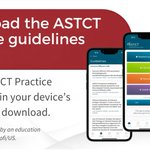
Take ASTCT guidelines wherever you go. 📱
Access resources on GVHD, conditioning regimens, stem cell collection and mobilization, supportive care, survivorship, HCT and more with the free ASTCT Practice Guideline App.
Download today: ow.ly/Yetw5101owO

Looking for support to attend Tandem 2027? SIG Travel Grants help members participate in the meeting, connect with peers, and engage more deeply with the ASTCT community and are awarded to selected members of the following Special Interest Groups (SIGs) to allay the costs of attending the 2027 Tandem Meetings:
✅ Advanced Practice Professional
✅ Nursing
✅ Pharmacy
✅ Social Work
Apply now: 🔗ow.ly/FVWH5101o4a

Choosing a conditioning approach means weighing more than intensity alone. How do available RTC approaches compare? What trade-offs should factor into regimen selection? And how can patient- and disease-specific characteristics help guide your decision?
Reduced-Toxicity Conditioning Treatments: What Clinicians Need to Know Now explores the evidence behind conditioning approaches and strengthens your ability to differentiate among available options.
ow.ly/qZ0W50ZPMUl
#AML #MDS #StemCellTransplant #Hematology #MedicalEducation #AlloHCT

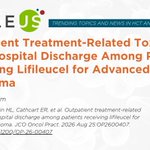
How often do serious treatment-related toxicities occur after patients leave the hospital following lifileucel therapy for advanced melanoma?
A new study found that severe outpatient toxicities were uncommon after discharge, suggesting that follow-up requirements for tumor-infiltrating lymphocyte (TIL) therapy may differ from the intensive monitoring strategies often used for CAR T-cell therapy. The findings provide important insights into post-treatment care, readmissions, and patient monitoring as TIL therapy continues to expand.
Read more: ow.ly/uNNR5101nPZ

Transplant is a team sport, and #Tandem27 has education designed for everyone on that team. Explore the 2027 program to find agendas for role-specific and specialty tracks at the meetings: ow.ly/yCAn5101nOE

New from Healio and ASTCT
The treatment landscape for classical Hodgkin lymphoma continues to evolve with the introduction of novel agents and changing transplantation strategies. In this Healio Q&A, Sairah Ahmed, MD, discusses ASTCT’s updated clinical practice recommendations, including the role of autologous transplantation, integration of brentuximab vedotin and checkpoint inhibitors, maintenance approaches, and current considerations for allogeneic transplantation.
Explore how these evidence-based recommendations are helping clinicians navigate the modern management of relapsed or refractory classical Hodgkin lymphoma.
Read more: ow.ly/6vYJ5101nGp

ASTCT retweeted

📅 Mark your calendar!
The next @ASTCT conference on toxicities of #transplantation & #CellularTherapies will be Nov. 13-14 in Chicago.
Get full details of the multidisciplinary event here 👇 vist.ly/5q7gk

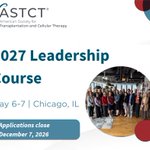
The ASTCT Leadership Course is a year-long program to develop the next generation of leaders in hematopoietic cell transplantation, cellular and gene therapy. ASTCT will select 15 participants will receive personalized coaching and career advice from experts in the field.
Open to physicians and non-physicians in leadership roles, this program covers tuition, travel and accommodation, concluding with a Leadership Course alumni reception at the 2028 Tandem Meetings.
Apply by Dec. 7, 2026: ow.ly/meOM51036Kv

Early-career investigators in pediatric transplantation and cellular therapy: Apply for a Jeff Gordon Children's Foundation Travel Grant to attend #Tandem27.
Up to 10 grants available for eligible residents, fellows and junior faculty. Open to U.S. and international applicants. Deadline: Nov. 9. 🔗ow.ly/6QHC5101nmp

Outstanding work deserves recognition.
Submit a nomination for an ASTCT SIG Award and help celebrate the professionals making a meaningful impact across transplantation and cellular therapy.
🔗 ow.ly/lj705101n71

Planning for #Tandem27? Apply for an ASTCT SIG Travel Grant to help cover the cost of attending the meeting.
Available for APP, Nursing, Pharmacy and Social Work SIG members. Apply now: 🔗ow.ly/GVn65101n0G

ASTCT volunteers help shape educational programs, member engagement initiatives, and resources that support the field.
If you're looking for new ways to contribute, develop leadership skills and collaborate with colleagues across the community, consider volunteering with ASTCT.
🔗 ow.ly/EcH75101mR1

What is the right duration of antibiotic therapy after hematopoietic cell transplantation?
In this expert discussion, Diego R. Hijano, MD, MSc, Gabriela Marón, MD, MSc, and Fareed Khawaja, MBBS, review emerging clinical evidence, evolving guidelines, and future research directions surrounding antibiotic de-escalation in transplant recipients.
Tune in: ow.ly/HgZe5101mH2

Join ASTCT Nov. 13-14 in Chicago for the 5th International Conference on Toxicities of Transplantation and Cellular Therapies.
Sessions will explore CAR T-related toxicities beyond CRS and ICANS, AI in clinical care and research, toxicities in older adults and emerging challenges in cellular therapy. Register now!
🔗 ow.ly/y2OI5101mty

#Tandem27 Travel Grant opportunity for young investigators focused on advancing treatments for pediatric patients in hematopoietic cell transplantation and cellular therapy.
Review eligibility criteria and apply by Nov. 9. ow.ly/rLII5101m7b

Is age enough to determine fitness for transplantation or CAR T-cell therapy?
In this Nucleus thought leadership article, Marco Ruiz, MD, and Marc J. Braunstein, MD, PhD, FACP, FASCO, discuss how multidimensional frailty assessment can help identify vulnerabilities, guide supportive interventions, and support more individualized treatment decisions for older adults. Read the article: ow.ly/mOVK5101lGC

Introducing Narrative Medicine on ASTCT Nucleus
Behind every transplant, cellular therapy infusion, research breakthrough, and patient journey is a story worth telling.
ASTCT Nucleus is now accepting submissions for its new Narrative Medicine series, a dedicated space for patients, caregivers, clinicians, researchers, and trainees to share the experiences, lessons, and moments that shape our field.
Explore the inaugural article, Beyond the Blood Counts, and consider sharing your own story with the ASTCT community: ow.ly/4UsW5101mlT
Submit here: ow.ly/B3q95101mlR

Every day, ASTCT members are advancing transplantation and cellular therapy through exceptional patient care, research, education, and service to the field.
Help recognize those contributions by submitting a nomination for an ASTCT SIG Award. Award categories include:
🏆 Transplant Infectious Diseases SIG Award • Lifetime Achievement Award
🏆 Nursing SIG Awards • Lifetime Achievement Award
• Rising Star Award
🏆 Advanced Practice Provider SIG Awards • Lifetime Achievement Award
• Rising Star Award
🏆 Survivorship SIG Awards • Lifetime Achievement Award
• Early-Career Achievement Award
Nominations close Nov. 9
🔗 ow.ly/AXJk5101lh7

Clinical guidance at your fingertips.
Download the ASTCT Practice Guidelines App to access the latest recommendations, review new guidelines and quickly search for information when you need it most.
📱 Learn more: 🔗 ow.ly/fwvH5101lCF
