

AI. Former marketing lead at global Top 100 company. Crypto since 2018. Sharing strategies that actually work. All posts are NFA | DYOR.
Joined April 2012
- Tweets40.9K
- Following709
- Followers98.3K
- Likes18.3K
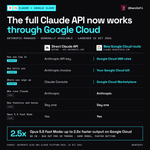






Your Google Cloud budget can now pay for Claude.
On Oct 22, Anthropic made the full Claude API available through Google Cloud. Anthropic still runs it. Google handles the login and the bill.
What changes:
- Log in with Google Cloud IAM roles instead of API keys
- Pay on your Google Cloud bill (counts toward your existing Google commitment)
- Sign up through Google Cloud Marketplace
What stays the same:
- Anthropic runs Claude
- New features and betas arrive on day one
- Opus 5.5 Fast Mode: up to 2.5x faster output at $8/$40 per million tokens
This isn’t the old Vertex AI route, where Google runs Claude. That one still exists. The new route gets new features faster, and the Google-run one is still better if you need strict regional data residency.
Companies that already have a Google Cloud contract just lost their biggest excuse not to use Claude.

$HYPE is compressing above the $75–$77 support zone on the daily chart, also a descending trendline
I see a potential reversal attempt here because this zone aligns with the old June highs and the base of Septembers mini pump.
I’m still waiting for a clear daily close above the descending trendline.
The MACD is becoming less negative, which could mean selling momentum is easing, although a bullish crossover has not confirmed.
I'll become more bullish if $75–$77 holds and price clears that trendline.
I’d then watch $82–$83 first, followed by $88, with $94–$96 further overhead if those levels are reclaimed.
A daily close below $75 would weaken this setup.
For now, I’m watching whether this support test produces a sustained break of the downtrend.

10 DeFi catalysts in 26 days. Here’s every date.
$SKY: The Atlas poll closes Oct 29. It includes a 900K USDS grant to the Skybase Foundation and adds Spark’s Diamond PAU on Base.
$CRV: A vote to double crvUSD lending on the sreUSD market from 30M to 60M ends Oct 29. Debt was already at $23.8M of the 30M cap.
$GMX: The GT airdrop snapshot ends Nov 1 at 00:00 UTC. You need a 100+ daily average of staked GMX and must finish at or above it. Payout date not set yet.
$ENA: Core contributor unlock on Nov 2. Investor unlocks already ended with the Oct 5 release.
$CRV: The vote to add the USDte/USDT pool to Curve gauges ends Nov 2. Techdollar wants $10M+ in liquidity by year-end.
$ARB: About 92.65M ARB unlocks on Nov 16, roughly $15.6M at today’s price. Watch the flows before assuming it all gets sold.
$ZRO: About 23.6M ZRO unlocks on Nov 20, roughly $38.8M.
$CAKE: Bridge your CAKE off opBNB before 00:00 UTC on Nov 23. LayerZero is ending opBNB support.
$LDO: Lido’s permissionless 0x02 module went live Oct 23 with a 32-validator queue and will scale up in steps.
$CRV: A Llamalend v2 stETH/ETH market on Ethereum is in the works. No on-chain vote yet.
The big three to watch are supply ($ENA, $ARB, $ZRO), governance (Curve caps and new markets) and deadlines ($GMX snapshot, $CAKE bridge).
Which DeFi catalyst deserves the closest attention this month?

Stop blaming Claude for wasting tokens. You might be flying blind.
Anthropic’s OpenTelemetry beta lets you trace Claude agent runs step by step: every model call, tool call, retry, error, and token.
Here’s what you can uncover:
→ Token leaks: Context grows every turn, driving up costs.
→ Infinite loops: Agents repeat the same failing tool calls.
→ Hidden bottlenecks: One slow step holds up the entire run.
→ Fake spend totals: Duplicate spans can make token usage look 3x higher.
The fix: Trace one failed run, find the first error, identify wasted tokens, and rerun after making changes.
The real AI advantage isn't just cheaper models. It's knowing exactly where your agents waste money.
Read the guide below to start debugging Claude agents with OpenTelemetry.


Ok this is fuc*ing crazy
AI agents can send payments autonomously. But what happens when something goes wrong?
Miles Deutscher just explored one of the biggest gaps in agentic commerce with GenLayer at Token2049: the trust layer for a market projected to reach $3.5T in agent transactions by 2031.
• 00:00 - Why AI agents need trust, identity, and payments
• 02:30 - Build a decentralized court system for AI commerce
• 04:00 - Use different AI models to judge subjective disputes
• 06:00 - Reach rulings through GenLayer's Optimistic Democracy
• 08:00 - Escalate appeals by adding more AI validators
• 09:30 - Connect the trust layer to the wider agent economy
Autonomous commerce needs more than payments. It needs a way to resolve disputes.
Traditional smart contracts execute predefined rules. They struggle when a transaction depends on subjective questions, such as whether work was completed properly.
GenLayer introduces Intelligent Contracts that can access web data and LLMs. Different AI validators evaluate the evidence and work toward consensus on ambiguous outcomes.
Escrow, staking incentives, and appeals help support the process.
If AI agents are going to transact with strangers at scale, the infrastructure must handle disagreements without relying on traditional courts for every dispute.
Payments let agents transact. Identity helps establish who they are. Trust determines what happens when things go wrong.
Watch the full interview with the GenLayer team.
AI x CRYPTO x BIG TECH: OCTOBER PARTNERSHIP RECAP
9 partnerships from October, and 5 of them run through Ripple.
Samsung, Stripe, Mastercard, Standard Chartered and LG CNS all moved closer to crypto rails this month.
$SOL x Samsung Wallet: USDC on Solana is rolling out to 82M Galaxy devices in the US.
$XRP x Standard Chartered: RLUSD custody is live through its Dubai branch, with LMAX collateral planned next.
$XRP x Privy (Stripe): Embedded XRPL wallets for payments and AI agents. Announced, not live yet.
$XRP x DriveWealth: RLUSD settlement and custody plugged into a global investing platform.
$XRP x Meritz Securities: Ripple’s first Korean securities firm partner, exploring custody and tokenization.
$XRP x Cross River Bank: RLUSD now sits inside a US bank’s core banking system.
$XLM x Ascend + M1X: A repo backed by a tokenized sovereign bond, rolled 72 times every hour at SOFR + 10bps.
$ETH ecosystem x Mastercard: Agent Pay for Machines opens to developers after pilots with Coinbase, Base and Cloudflare.
$LINK x LG CNS: Chainlink infrastructure for Korean won stablecoins on LG CNS’s institutional platform.
The pattern is clear. Banks are adding stablecoins to their core systems, and payment giants are building rails for AI agents to pay each other.
Which partnership has the strongest long-term implications?

the biggest AI business opportunity might be selling to plumbers, not tech companies.
Greg Isenberg and James Dickerson just broke down how to use AI to help Main Street businesses turn existing ad traffic into more booked jobs:
• 02:10 - Use AI agents to find and score $2M+ plumbing and HVAC businesses
• 04:50 - Audit websites and identify leaks that cost companies leads
• 12:40 - Fix weak landing pages, missing reviews, and confusing booking flows
• 17:40 - Build branded funnels with $79 tune-ups and repair-or-replace quizzes
• 24:20 - Use Dream 100 outreach to win high-value local clients
• 28:20 - Combine targeted mail, local relationships, and Meta ads
• 36:00 - Charge $2.5K–$5K upfront, then $1K–$2K monthly
the key insight: don't sell AI. Sell more booked jobs.
Plumbers and HVAC companies already spend money attracting customers. The opportunity is fixing what happens after someone clicks an ad.
Use AI to research a niche, find businesses with weak funnels, build better landing pages, and create offers that turn interest into appointments.
Then prove the return on investment through more calls, booked jobs, and revenue.
Start with one city and one trade. Build a case study, earn trust, and repeat the process.
You don't need a huge audience or another AI agent startup.
You need a valuable problem, a clear offer, and a way to show business owners that your work pays for itself.
Watch the full breakdown on how AI becomes a real business beyond the tech bubble.
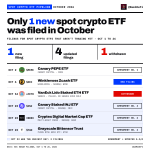
Only 1 new spot crypto ETF was filed in October.
Six filings came in for spot crypto ETFs that aren’t trading yet. One was new, four were updates and one was pulled.
Here’s who filed:
- $PEPE: canary PEPE ETF | amendment no. 1 | oct 2
- $ZEC: winklevoss zcash ETF | new s-1, nasdaq: WINK | oct 6
- lido staked ETH: vaneck ETF | withdrawn | oct 14
- $INJ: canary staked INJ ETF | amendment no. 4 | oct 23
- cryptex digital market cap ETF: multi-asset index | amendment no. 6 | oct 23
- $TAO: grayscale bittensor trust | amendment no. 2 | oct 23
$ZEC was the only new name. It would be the second Zcash ETF after Grayscale’s.
VanEck pulled its Lido staked ETH fund. It never sold a single share.
Oct 23 was the busiest day, with $INJ, Cryptex and $TAO all filing updates.
The $TAO filing would rename the trust Grayscale Bittensor ETF and list it on NYSE Arca as GTAO. It’s a plan, not a launch.
Data: SEC EDGAR

Top 10 AI Crypto Projects by Social Activity
$LINK: 2,043,313
$NEAR: 1,403,179
$INJ: 1,017,832
$TAO: 769,998
$ICP: 687,056
$FET: 215,516
$WLD: 202,160
$RENDER: 200,036
$FIL: 121,692
$VVV: 111,769
$LINK leads this group with more than 2 million engagements, followed by $NEAR and $INJ.
source: LunarCrush

$INJ Q3 Recap 🔹
$INJ rose 63% in Q3, from $4.54 to $7.41. July added 7% and August 1.3%, then September did the heavy lifting with a 50.5% run that peaked at $8.18 on Sep 26.
🔹 Institutions and Regulation
INJ’s MiCA white paper was published Jul 16, covering 30 European markets with one disclosure document.
POSCO International and LG CNS finished a proof of concept tokenizing trade receivables on Injective, with AI agents helping verify the trade documents.
Injective’s affiliate, Injective Institutional Services, became an SEC-registered transfer agent on Aug 19.
Pineapple Financial passed $1B in mortgage records on Injective and plans to bring 29,000+ mortgages worth over $10B onchain.
🔹 Stablecoins and Network
The v1.20.3 interoperability upgrade (IIP-677) went live in July.
On Sep 10, Injective USDC replaced Noble as the Cosmos standard. dYdX integrated it first, and Skip:Go made it the default route.
INJ went live on Solana as an SPL token in September.
The Meridian upgrade on Sep 24 brought regulated token standards for RWA issuers. It passed with about 99% support.
🔹 The Token and ETFs
21Shares amended its spot INJ ETF filing on Sep 18.
The first Stockdrop paired INJ burns from the community buyback with tokenized stock rewards on Robinhood Chain.
Canary amended its staked INJ ETF filing, with plans to stake at least 90% of the fund’s INJ.
Two ETF filings, an SEC-registered transfer agent and a MiCA white paper, all in one quarter.
Is $INJ the most regulation-ready L1 in crypto?

99.6% of RLUSD payments came from just 110 bot wallets.
That’s one of 10 crypto stories from this week:
- Mastercard: an AI agent made 9 payments to 2 merchants without a checkout page. Settled on Base, still a pilot
- Stellar: a new “W” address could break old wallets. Mainnet vote on Nov 23
- Ethereum: a record 43.8M ETH is staked, but the yield fell from 2.81% to 2.63%
- SEC: the comment period closed on a $5M startup lane and a $75M fundraising lane
- RLUSD: 7.79M of 7.82M payments were dust from bots. Only 14,600 were worth $1 or more
- Lending vaults: deposits grew from $4B to over $10B since early 2025
- Qubic: a weak random-number function exposed 1,404 wallets and $1.4M was stolen
- France: MPs voted 38 to 37 to tax crypto-to-stablecoin swaps. Not law yet
- Lightning: losing one ACINQ node hurts the network 4x more than losing all 619 Core Lightning nodes
- Ethereum: AI agents proved 8 live contracts correct in 15 days, including Curve’s 2023 bug
Agents are starting to pay, code and audit on their own. Governments are writing the rules just as fast.
Which one surprised you most?

Ten catalysts land on the crypto calendar this week, led by the Fed’s rate decision on Oct 28 and the GDP and PCE data on Oct 29.
Crypto watchlist for October 26 to November 1:
$BTC: FOMC Decision | Oct 28
$BTC: Q3 GDP + September PCE | Oct 29
$XRP: Ripple Swell | Oct 27-29
$ZEC: Zcon7 | Oct 27-29
$COIN / $MSTR: Q3 Earnings | Oct 29
$LINK: Link:NYC Institutional Event | Oct 29
$UNI: Unichain Moves to OP Enterprise | Oct 29
$SUI: Token Unlock | Nov 1
$SOL: Samsung Wallet USDC Rollout | Late Oct (no exact date)
$NEAR: HSP-029 Vote to Cut Issuance from 2.5% to 1.6% | Ongoing
Thursday is the busiest day. GDP and PCE hit in the morning, the day after the Fed. Then Link:NYC, the Unichain migration and the Coinbase and Strategy earnings all land the same day.
The bigger risk is macro volatility from the Fed. Samsung’s Solana rollout is the adoption catalyst, but it still has no confirmed date.
Which of these are you positioning for this week?

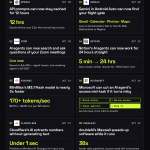
AI agents got more power this week. They also got more guardrails.
Here are the 10 updates that matter:
- OpenAI: API prompts can now stay cached for 12 hours. Cache writes cost 2.5x the normal input price.
- Google: Gemini in Android Auto can find your flight gate from Gmail and Calendar. Not live in Nigeria or the UK yet.
- Zoom: AI agents can now search your meetings through new APIs. A live meeting agent arrives in Q1 2027.
- Notion: agents can now work for 24 hours straight, up from 5 minutes.
- MiniMax: M3.1 Flash runs at 170+ tokens a second for $0.15 per million input tokens.
- Microsoft: it can now cut an agent’s access mid-task if the agent starts acting risky.
- Cloudflare: a new model pulls numbers out of documents without generating any text.
- doubleAI: Maxwell speeds up software while it runs. One pipeline got 38x faster with no code changes.
- World × Zoom: a “Human Badge” proves a real person is on your call. Three images have to match.
- Cursor: cloud agents can now work across 500 repos at once.
The pattern is clear. Agents are running longer, touching more systems and spending less to do it. Now the big companies are building ways to watch them.
Which one matters most to you?

Your AI agent might be slower because you gave it TOO MANY agents.
Anthropic is now advising companies to remove unnecessary subagents from their AI systems.
Why? A single agent equipped with the right skills can often outperform a complex multi-agent setup. One customer even saw execution run roughly 2x faster.
Here’s the architecture shift:
→ Skills: Teach the agent how to perform tasks through procedures, expertise, and instructions.
→ Tools / MCP: Give the agent the ability to act through APIs, integrations, and live data.
→ Subagents: Reserve them for parallel work, isolated context, and tasks that need separate reasoning.
The secret is progressive disclosure.
Instead of loading everything upfront or spawning agents for every task, one agent discovers the skills and tools it needs, when it needs them.
Anthropic’s advice: Fold unnecessary subagents into the main workflow, turn their instructions into skills, expose their actions as tools, then test the results.
Are we overengineering multi-agent systems?

Anthropic is now recommending that companies REMOVE unnecessary subagents from their AI systems.
This is a pretty significant shift in agent architecture, with their team finding that a single agent equipped with skills can frequently outperform complex multi-agent systems, and one customer seeing roughly 2x faster execution.
The emerging rules of thumb:
→ Skills: Teach the agent HOW to do something, including procedures, expertise, and instructions.
→ Tools / MCP: Give the agent the ability to DO things through APIs, actions, and live data.
→ Subagents: Use for parallel work, isolated context, or tasks a single agent struggles with.
The interesting part is progressive disclosure. Instead of spawning specialized agents or stuffing everything into a giant prompt, one agent discovers and loads skills and tools as needed.
Their advice is to fold existing subagents into the main loop, turn their instructions into skills, expose their actions as tools, and run evals to see if performance holds up.
As models have gotten smarter, improving agent architecture is becoming less about what you can add and more about what you can delete.
claude.com/resources/article…

$TAO’s next big unlock might be giving AI builders more financial freedom.
Bittensor’s eTAO upgrade makes subnet economics more flexible.
→ Owners can customize alpha emissions
→ Miners retain at least 33% of emissions
→ Subnets could buy services from each other
→ Builders could borrow against alpha without selling
→ Automatic weight adjustments help protect root TAO stakers
On the latest Novelty Search, @const_reborn explains how flexible emissions could help builders fund compute, research, and complete AI products.
The bigger vision: subnets stop operating in isolation and start building an interconnected AI economy.
Could $TAO evolve into the economic backbone of decentralized AI?

eTAO gives subnet owners more freedom to fund the compute and research their projects need.
On the latest Novelty Search, @const_reborn explains how flexible emissions fit into his vision for building complete AI products on Bittensor.
He also outlines plans for subnets to buy each other’s services and for builders to borrow against alpha without selling it.
Full episode in the first comment


