

Building Vector: The Enterprise AI Operating System @ https://xitter.cf/t.co/D38E5CXwiA and LifeOS: The Human Magnification OS @ https://xitter.cf/t.co/muV0Un09sA | Ex: Apple, Robinhood, HP, Army
San Francisco Bay Area
Joined March 2007
- Tweets29.7K
- Following1.7K
- Followers161K
- Likes24.5K




Pinned Tweet
I feel like everyone is going to figure out at the same time (in 1-4 months or so) that our biggest problem today with AI isn’t actually an AI problem.
The problem is we’re not giving our AIs clear enough definitions of what we want.
So our AIs basically go off and build in some direction, but not exactly the direction you want to go in.
This problem has three main parts:
1. You knowing what you want
2. You being able to articulate that thing thoroughly and accurately
3. Your AI being able to do that thing
Everyone assumes the problem is with number 3, but it’s usually a combination of 1 and 2.
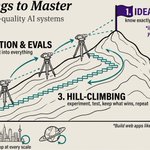
The next biggest advancement in AI (or one of them anyway) is going to come from harnesses building this concept of ideal state, evals, and hill-climbing directly into their DNA.
In the model providers can help as well by eliciting this from the user and building this before any work is done.
Ideal State, Evals, and hill-climbing. This is where it’s at.
There's been a 1,500% jump in forward deployed AI engineers in China. These are people who don't just know AI but are good at going inside companies and getting it implemented for them.
scmp.com/tech/tech-trends/ar…

Microsoft has offered to buy out an entire quarter of their workforce. Feels like that's the voluntary phase before it becomes less optional.
dailymail.com/yourmoney/arti…


ᴅᴀɴɪᴇʟ ᴍɪᴇssʟᴇʀ 🛡️ retweeted
I disagree with @mattpocockuk that the code should be the source of truth when building with AI.
- The intent in our minds is the true source
- How we capture that in English is 2nd
- Code is an implementation, and it's actually 3rd
Writing is closer to thought than code.
danielmiessler.com/blog/writ…

A list of products affected by PHP2Shell.
securityonline.info/php2shel…

I disagree with @mattpocockuk that the code should be the source of truth when building with AI.
- The intent in our minds is the true source
- How we capture that in English is 2nd
- Code is an implementation, and it's actually 3rd
Writing is closer to thought than code.
danielmiessler.com/blog/writ…
This feels quasi-criminal to me.
I'm no lawyer, but I am not ok with criminal shit being done, without anyone's knowledge, and then it being somehow made un-criminal because it was in the 4,000 page terms and conditions and technically there's a way to opt out.
Super gross.

If you've ever wondered why smart TVs are so cheap, this is why.
@log4j rooted his Samsung and found an always-on hot mic, automatic content recognition, geolocation, network mapping, ad targeting and user profiling, shared with Samsung's "400 partners".
A lot of it can be blocked in <15 min, wrote a basic guide below.
What your TV is doing
The main culprit is ACR (automatic content recognition). Your TV screenshots what's on screen, fingerprints it, and sends it home to build your ad profile. Samsung does it every 500ms, LG every 10ms [1].
What is insane: it happens on connected devices too.
Plug in your laptop, your console, your work machine, and your TV can fingerprint that via HDMI [1].
He also found that if your Samsung doesn't have a mic, it'll look for one from a connected soundbar or bluetooth device.
xitter.cf/log4j/status/211376224…
It's on by default, and you likely agreed to it on the setup screen you clicked through in 10 seconds.
Step 1: Turn off ACR
Samsung: Terms & Privacy → Viewing Information Services
LG: Live Plus
Vizio: Viewing Data
Roku: "Use info from TV inputs"
Sony/Google TV: Samba Interactive TV
Menus vary by model, but those are the names to look for. While you're in there, opt out of interest-based ads, reset your advertising ID, decline every optional privacy agreement, turn off voice recognition, and delete apps you never open.
Step 2: Give smart devices their own network
Put the TV, cameras, speakers and vacuum on your router's guest/IoT network. The logic is simple: these devices rarely get patched. If one gets compromised (getting drastically more frequent with AI), it shouldn't be able to see your other devices or home network.
Step 3: Block trackers for the whole house with DNS-level filtering
NextDNS (cloud-based) is easy and has a solid free plan. Pi-hole is a little bit more work if you prefer self hosting. For simplicity we'll focus on the former.
1. Sign up at nextdns.io (free tier is plenty)
2. Privacy tab: add a blocklist (OISD is a good bet) and turn on Native Tracking Protection for Samsung, LG, Roku, Amazon (see attached image)
3. Setup tab: copy your endpoint
4. Paste it into your router's DNS settings as DNS-over-HTTPS/TLS (or use the IPs + "Link IP" if your router only does plain DNS)
5. Bonus: block outbound port 53 except to your router. Some devices hardcode their own DNS to get around you
Then open the NextDNS logs and watch how often your TV phones home. It's eye-opening. If an app or update breaks, find the domain in the logs and allowlist it.
Why they do this
TV prices are down 97% since 2000 [2]. Most of that is better manufacturing and brutal competition. But once margins on the hardware hit zero, the cost moved to you.
In Q3 2024, Vizio lost $6.7M selling TVs and made $115.8M in gross profit from ads and viewing data [3]. They've said on earnings calls that they keep TV prices low to grow the audience they sell to advertisers. Walmart bought them in 2024.
This isn't a conspiracy theory either. Vizio paid $2.2M to the FTC in 2017 for tracking 11 million TVs without consent. Last December, Texas sued Samsung, LG, Sony, Hisense and TCL over ACR. Samsung and LG have since agreed to stop collecting that data without explicit consent [4].
TL;DR
1. ACR off
2. Ads + voice off
3. Smart devices on their own network
4. NextDNS filtering on the router
Sources:
[1] ACR study: arxiv.org/abs/2409.06203
[2] Cost of US consumer goods: aei.org/economics/chart-of-t…
[3] Vizio Q3 2024: sec.gov/Archives/edgar/data/…
[4] Texas v. Samsung: texasattorneygeneral.gov/new…


I think this is a really good explainer.
But I have a slightly different explanation that’s pretty elegant to remember.
1. Both models and harnesses are made to help you get what you want from AI
2. Models are getting much better, but they can only do so much because they don't know everything about you and how you like things to be done.
3. Harnesses are like model assistants. They help the model get the information that it needs to help you in a way that matches your preferences.
4. In general, the better the models get, the less you will need the harness because they are ultimately pursuing the same goal of getting you exactly what you want.
5. The best harnesses today are focused not on micromanaging the steps to use to accomplish something (we should leave that to the model), but instead on describing exactly how you like things to be done. The more the harness knows about you and your preferences, the better it can provide the model what it needs to give you the best result.
6. In other words, the model is the “how” and the harness’s job is to provide the highest quality “what”.


I recommend reading this breach data in the voice of the Count from Sesame Street.

despite the unfortunate timing, we take disclosures seriously at @typesafeai
at approximately 6:49PM this Friday evening, we became aware of a massive unauthorized leak of ALL customer noul outputs
in effort to maximize transparency, here is the link: gist.github.com/diogo149/810…
To me you were the one who started the trend of labs becoming visible and responsive to the community.
So you have helped the AI industry not just internally through all the stuff you worked on, but in a meta way as well by making the labs more accessible.
Thank you for both!

I’ve left Anthropic after more than a year of working on Claude Code and seeing it scale larger than I ever imagined.
I have really loved working at Ant and believe deeply in the mission, and most of all, the idea of a race to the top.
The idea that if we work hard and responsibly, we can raise the bar and inspire others to great outcomes. And if we all push each other to be better, things can be radically good. I will carry the spirit of this with me forever.
My colleagues at Anthropic are the most talented, thoughtful, competent, and earnest people I have ever met. I am glad they are at the wheel and trust them deeply.
To the community on X, thank you for everything. You’ve made this the most fun (and sometimes stressful) job I’ve ever had.
For me, it is time for a bit of a break before diving into something new.
If you want more excellent Claude Code content, you should follow @addyosmani , @lydiahallie, @_catwu, @ClaudeDevs and of course @bcherny who started it all.
This is my surprised face.

Just wait til everyone has a Mythos-level Thanos Guantlet with full golden retriever sycophancy.
I keep telling you all: We’re not even slightly ready.
We’re living in the opening scenes in a pandemic movie.
Pretty soon the narrative will be, “Dario should have warned us about the dangers of open source models!”
I can’t wait to see the AA benchmarks on this model. Absolutely insane.
But it’s a bit of a strange situation to call it open. First the weights done come out for another month.
And second, it’s a 2.8 trillion param model. So pretty hard to run at home for most people.
In effect most Chinese models like this end up being run almost exactly like OpenAI or Anthropic: directly over their cloud.

Introducing Kimi K3.1 Pro: our most capable 3T-class open-weight model.
🔹 1M-token context, 2.8T total / 104B active params (MoE), Multimodal.
🔹 Full-project coding: games in Unreal, Unity & Godot.
🔹 Excels at parametric 3D modeling in Blender & CAD.
🔹 More reliable at finance work: Accurate modeling with hallucination down by 65%.
🔹 Matching the strongest proprietary models across coding, agentic and knowledge benchmarks.
Kimi K3.1 Pro and K3.1 Pro Highspeed (2–3× faster) are now live on Kimi.ai, Kimi Work, Kimi Code, and the Kimi API.
Open weights by Nov 4, 2026.
🔗 API: platform.kimi.ai
🔗 Tech blog: kimi.ai/blog/kimi-k3-1-pro

Palo Alto says they're vulnerable to the PHP flaws via their management interfaces.
At this point I don't trust SSH daemons being visible to the internet. I highly recommend people put as much stuff as possible behind systems like Tailscale / Cloudflare Tunnels, and similar services.
Not a perfect solution, but we should consider anything rawdogging on the internet to be in play.
securityonline.info/pan-os-p…

While this whole Purge, or Great Fire, is starting to roll over us we need to consider another quite disturbing thought.
We're all talking about software, but if you've been watching the AI maker space for the last several months it's become clear that hardware is absolutely on the board now as well. You can kind of point an AI at a piece of hardware and it just Neo's that shit.
So this isn't just an applications, services, APIs, libraries situation. It's also about to be a hardware, sensors, devices, Internet of Things situation as well.
And of course they're all interlinked: the software, firmware, and the hardware.
ᴅᴀɴɪᴇʟ ᴍɪᴇssʟᴇʀ 🛡️ retweeted
I know you disagree, but this is incorrect.
The complete, natural language articulation of what you want should be primary.
Old-school specs are lossy abstractions of that type of articulation. But code is also just a flawed implementation of the idea. Of the ideal.
The primary artifact should be the fully articulated ideal state definition of exactly what you want. In language. And granular, testable criteria with evals.
And then the code is the lossy output from that.
And the goal should be to have that output align with the idea as closely as possible.
The code isn’t primary. The idea itself is.

I have a few pieces of cybersecurity advice for anyone willing to listen:
Reduce the number of vendors your core security depends on.
Expect lots of small, medium-sized, and even some large security / services companies to get compromised in the next year or so, if they aren't already.
Put most of your trust in the absolute top tier of companies in terms of security and engineering.
These are companies like Google, Apple, and (I would argue) Cloudflare. A good heuristic is how big and talented their security teams, and how much money their company invests in security.
If there is a security issue in Chrome, or iOS, for example, you can be damn sure that hundreds or thousands of the smartest people in the world are working to fix it. And these companies would be willing and/or happy to spend tens of millions of dollars instantly to solve the issue.
I'm not going to name companies, but there are many applications and services out there for managing keys, passwords, source code, secrets, etc., where the security teams are decent, but they're basically large startups. The security teams are far more varied in talent levels and budget levels.
Basically we're about to be hit with a tidal wave (or global forest fire, pick your metaphor) of both advanced and persistent attacks with existing vulnerabilities, as well as lots of completely new attacks nobody's seen before.
You want to have your personal and company security relying on as few of these small to medium sized companies as possible. Not because they're totally incompetent, but because many of them are likely not up to the challenge of defending against millions of agents running open source attack models and harnesses.
Look at your whole security tech stack. See where you can reduce dependency on small-to-medium sized Jenga blocks that have a high chance of getting compromised during this storm.
And remember, it's not just that the teams and budgets aren't as big as companies like Google and Apple. It's also the fact that these companies (like password managers, for example) are so damn attractive.
Millions of users and their passwords. These are not good places to have credentials right now. Or data. Or infrastructure.
This is not an absolute thing. I'm not saying cancel all engagements and get our of all small companies or whatever. Or that the big ones will be perfect either.
I'm saying, as a general truth, on the whole, moving in this direction is likely to make you more secure while this thing hits us.
I know you disagree, but this is incorrect.
The complete, natural language articulation of what you want should be primary.
Old-school specs are lossy abstractions of that type of articulation. But code is also just a flawed implementation of the idea. Of the ideal.
The primary artifact should be the fully articulated ideal state definition of exactly what you want. In language. And granular, testable criteria with evals.
And then the code is the lossy output from that.
And the goal should be to have that output align with the idea as closely as possible.
The code isn’t primary. The idea itself is.
So real you wince while reading it.

Security called me at 6:12 AM today.
"Patch every PHP server immediately."
I asked what happened.
"Two critical vulnerabilities. Remote code execution. No authentication required."
Cool.
How many PHP servers do we have?
According to inventory: 12
According to reality:
Nobody knows.
We found one running WordPress.
Three running old internal tools.
One under someone's desk.
Two inside vendor appliances.
A forgotten employee directory from 2016.
And a server named:
PHP-OLD-DO-NOT-TOUCH
Naturally, that one runs payroll exports.
Then we found a PHP 5.6 box.
I asked who owned it.
The documentation said:
BRIAN.
Brian left in 2019.
We called Brian.
He said:
"Oh wow, that's still running?"
Excellent.
By 8 AM, leadership joined the incident call.
CEO:
"Can hackers actually get in?"
Security:
"Potentially yes."
CEO:
"Without a password?"
Security:
"Yes."
CEO:
"Then why do WE need passwords?"
Not the lesson.
Finance asked if we could wait until the weekend to patch because downtime affects revenue.
Security explained that the alternative was letting strangers execute code on our servers.
Finance asked for a cost comparison.
At 9:17, someone suggested temporarily taking the vulnerable websites offline.
Marketing refused.
"Our campaign is live."
So for the next hour, the company officially decided maintaining a landing page for 20% off webinar registration was more important than preventing remote server takeover.
We finally patched everything we could find.
Then our scanner discovered another PHP server.
Hostname:
TEMP-PHP-2014
Uptime:
4,512 days.
Nobody knows what it does.
Nobody owns it.
Nobody can shut it down.
But every time we block network access, the warehouse stops printing shipping labels.
Security has classified it as critical infrastructure.
It is running PHP 5.4.
The vulnerability has existed longer than half our employees.
The emergency patch took four hours.
Finding out what PHP actually runs took eleven.
The internet isn't held together with code.
It's held together with servers everyone is afraid to turn off.