

We're an AI research lab building a search engine for the future
SF
Joined August 2021
- Tweets833
- Following37
- Followers65.1K
- Likes2.6K




Exa retweeted

I had fun chatting with Exa for their inclusion on the 3b1b talent page. It got me thinking about how a lot of the goals for better search end up aligning with goals of better credit assignment/attribution.

We sat down with @3blue1brown to discuss our research vision of "Attention over all the world's information."
Plus why knowledge should not live in model weights, the compression trick behind cheaper retrieval, and why we hire through work trials.
1:20 – What is “attention over everything”?
4:46 – A knowledge graph of the whole web
11:32 – How do you evaluate search for AI agents?
15:13 – Why not put everything in the weights?
22:55 – Why Exa hires through work trials
25:15 – The compression trick behind cheaper retrieval
27:40 – Dealing with misinformation
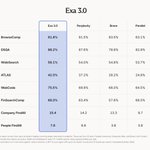
Exa 3.0, Exa Lite, upgraded highlights, and our expanded index are available today through the API.
Read more: exa.ai/blog/exa-3
💪

Exa just passed $100m in annualized revenue.
We've grown almost exactly 10x per year for 3 years. We now handle 2 billion requests a month from 200k+ teams. And it’s still so early:
We predict agents will search 1000x more than humans by 2030.
Agents don't search like humans. They write long, complex queries and want all the world's data, not just the web. We've spent 5 years building a search engine designed for them.
We now serve personal agents, AI labs, coding agents, GTM agents, really any agent. Exa gives these agents access to 100s of billions of web documents and tons of proprietary data.
Our customers are increasingly noticing that information is the bottleneck to agent performance. While the world seems close to perfect intelligence with models like Fable and Astra, we are very far from perfect information.
To our small but legendary team, thank you for getting us here, from engineering to research to GTM to ops.
To our customers, it is an honor to serve you. We have some exciting releases coming soon and can't wait to share them 🫡

Exa retweeted

Exa just passed $100m in annualized revenue.
We've grown almost exactly 10x per year for 3 years. We now handle 2 billion requests a month from 200k+ teams. And it’s still so early:
We predict agents will search 1000x more than humans by 2030.
Agents don't search like humans. They write long, complex queries and want all the world's data, not just the web. We've spent 5 years building a search engine designed for them.
We now serve personal agents, AI labs, coding agents, GTM agents, really any agent. Exa gives these agents access to 100s of billions of web documents and tons of proprietary data.
Our customers are increasingly noticing that information is the bottleneck to agent performance. While the world seems close to perfect intelligence with models like Fable and Astra, we are very far from perfect information.
To our small but legendary team, thank you for getting us here, from engineering to research to GTM to ops.
To our customers, it is an honor to serve you. We have some exciting releases coming soon and can't wait to share them 🫡
We sat down with @3blue1brown to discuss our research vision of "Attention over all the world's information."
Plus why knowledge should not live in model weights, the compression trick behind cheaper retrieval, and why we hire through work trials.
1:20 – What is “attention over everything”?
4:46 – A knowledge graph of the whole web
11:32 – How do you evaluate search for AI agents?
15:13 – Why not put everything in the weights?
22:55 – Why Exa hires through work trials
25:15 – The compression trick behind cheaper retrieval
27:40 – Dealing with misinformation
We built ATLAS, a web search benchmark for how agents actually search today.
Existing agentic search benchmarks are often outdated, contaminated, or saturated. ATLAS is designed to separate strong search from weak search.
Learn more: exa.ai/blog/atlas-benchmark

ATLAS tasks require many sources to retrieve fresh or niche information.
Questions are synthetically generated through an automated pipeline based on real-world search trends, covering 20+ topic categories.

Even the top search agents set to the highest effort modes cannot find 1/3 of the verified information.
Read the full research: exa.ai/blog/atlas-benchmark

Exa Places significantly improves the accuracy of personal agents that are performing tasks with local intent.
It has the highest accuracy across search providers we evaluated.

Exa Places is live across all our endpoints at no additional cost!
Learn more
exa.ai/blog/places-search


