

Radical agitator for African unity, sovereignty and self-determination.
Soroti City, Uganda
Joined September 2019
- Tweets9.5K
- Following74
- Followers93.4K
- Likes45.8K




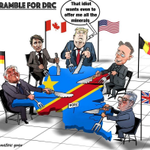


To demand the territorial integrity of continental Africa and her people's right to self-determination, invoking Pan-Africanism to condemn Western involvement, while we (Uganda & Rwanda) ourselves violate the sovereignty of our neighbors like DRC, is pseudo-Pan-Africanism.
2
703
The saying that “When small men begin to cast big shadows, it means that the sun is about to set” is a vivid reminder that the illusion of greatness often arises when the time of decline is near, particularly towards the end of a political dispensation. On the surface, the saying pictures a natural occurrence where shadows become taller as the sun sets.
But beyond the poetic imagery, it depicts a period when individuals with little to no talent or intellect, and no political stature of consequence to speak of, and who would ordinarily be little more than obscure footnotes in public life, arrogate to themselves disproportionate influence through their proximity to the centre of power. This is increasingly the case in Uganda, where @DaudiKabanda and others in the @PLUsecretariat wantonly and with impunity flaunt their proximity to Gen. Muhoozi, openly belittling and disparaging national leaders with whom they disagree.
The most recent, and perhaps most notable, example was Hon. Kabanda’s post in which he mockingly suggested that he might end up marrying the Vice President of Uganda, H.E. @jessica_alupo, because, apparently, he had heard that she ‘likes young men’. In doing so, not only does Kabanda sexualise the person of the Vice President, but he also insinuates that she, a married woman with a husband and children, engages in extramarital sexual relationships with younger men, and that he would therefore like to try his own luck! This is an unprecedentedly crude and deeply personal attack on the person and dignity of a senior national leader, an affront to the honour of the office of the Vice Presidency, a slight to the authority of the President of Uganda, who is the appointing authority, and an insult to the dignity of women in general.
Now, the fact that Kabanda, a Member of Parliament, can speak of a Vice President in such derogatory terms without any prospect of punitive consequences speaks volumes about the rise of small men casting big shadows in Uganda’s succession politics. Soon, even lower-ranking PLU cadres will be issuing orders, throwing their weight around, and demanding compliance across the country, each within their own little sphere of influence. This is reminiscent of Nazi Germany’s SA, whose members, emboldened by their proximity to the Nazi leadership, became increasingly notorious for flaunting their power, disregarding established institutions and intimidating those they considered opponents, often with little fear of consequences. Such is the danger of allowing individuals who hold no corresponding constitutional authority to exercise influence simply by invoking their proximity to those in power.
How tall the shadows of small men like Kabanda will grow before they finally overreach themselves, one cannot predict. But, recognising the sign for what it is—that the taller their shadows grow, the closer the sun is to setting—all right-thinking Ugandans across the political aisle, not least Gen. @mkainerugaba himself, should rein in the Kabandas before their impunity irreparably damages the reputation of PLU, reducing it to little more than a political cult, which, in modern politics, is hardly a sustainable pathway to acquiring state power. For in the darkness that follows the setting sun, there is never a guaranteed winner!


Overlapping civil conflicts in Ethiopia and Sudan, increasingly spilling across their shared border in both directions, could eventually trigger an interstate war if not addressed early.
1
3
751
If the intention of this article was to legitimise the ongoing arrests, intimidation and targeting of Teso politicians by framing the region as a likely theatre of renewed rebellion, then it has achieved that quite effectively. Even Iteso in the comments section are corroborating, even celebrating, Charles's recollection of their past and trauma.
Charles's historical account of Teso's previous insurgency, its casualties, the Mukura massacre, displacement and cattle losses is, yes, accurate. But the psychology of the entire piece presupposes that another rebellion is brewing in the region. This is, admittedly, sophisticated narrative framing! And Charles, whether intentionally or otherwise, uses his platform, credibility and voice to validate the narrative of a ‘security situation in Teso’ under the guise of well-intentioned historical and political analysis.
He builds his foundation on historical facts, then transitions into current political developments, particularly the succession question and competition over resources, to construct a context within which another Teso insurgency appears plausible. The average reader, and even the otherwise informed reader, is thus led, almost unconsciously, to use this lens to interpret current developments in Teso.
Notice how he imperceptibly presents the possibility of impending conflict in Teso as though it were an emerging reality, without actually establishing the evidence for it? The reader unfamiliar with Teso comes away believing that the region is once again on the verge of armed resistance, and even Iteso familiar with their own region are subtly led towards accepting that interpretation.
The article's psychology, it seems, is to legitimise the ongoing arrests and intimidation of influential personalities from Teso as necessary security interventions, even where others might reasonably question whether the allegations are genuine or politically motivated. Charles has, in effect, invoked Teso's historical experience of rebellion to provide a historical justification for interpreting present-day political developments in the region through the lens of insurgency.
On the surface, he comes off as warning Uganda against repeating the mistakes of its past, while amplifying the impression that Iteso are preparing to repeat that past.

Teso’s Ghosts Stir Again As Uganda’s Succession Battle Heats Up
Several African peoples have a proverb that says: “He who has been bitten by a snake once should run at the sight of a lizard; but he who forgets is swallowed by the python.” It comes to mind because the Teso region of north-eastern Uganda could well be plunged into a catastrophic conflict again, 33 years after the last one ended.
What became known as the Teso insurgency lasted from 1987 to 1993. It was a rebellion against President Yoweri Museveni’s National Resistance Movement (NRM) government by the Uganda People’s Army (UPA), led by Peter Otai, a former Minister of State for Defence in Milton Obote’s second Uganda People’s Congress (UPC) government. Other armed groups later joined in.
Tens of thousands of people were killed. One of the most horrific incidents, which still chills people today, happened on July 11, 1989. Soldiers rounded up about 300 men suspected of being “rebel collaborators”, locked many of them inside a steel railway wagon at Mukura railway station and reportedly lit a fire near it. By the time the wagon was opened, 69 of the unarmed men had suffocated to death.
Human rights organisations reported that up to 350,000 people in Teso, roughly half the sub-region’s population at the time, were forced into camps for internally displaced people (IDPs).
Estimates suggest that about 500,000 head of cattle, the backbone of the region’s economy, were stolen or lost during the conflict.
The insurgency finally ended in 1993, six years after it began, through a mix of military pressure and peace efforts led by the Teso Commission, which was set up in 1990.
Teso was one of the places where the NRM went through its baptism of fire as a governing regime and where its transformation into a security state began. Now, with a proxy fight over the Museveni succession and competition for ground resources in a country bursting at the seams with a fast-growing population, the region could slide back into the hellfire it once knew.
If, in the end, Uganda fails to outrun its bloody past, it will not be because that past was not traumatic enough to learn from.

Also, @PLUsecretariat needs to streamline its communication strategy, channels and spokesperson arrangements. You cannot have everybody speaking on your behalf, or in your name.
Do you realise that Hon. Ecweru's statement, largely interpreted as representing PLU, is what brought Iteso together on this issue and spilled over into the current contentions with PLU?
I am seeing individuals who are calling for calm, dialogue and reconciliation over the Elwelu saga being attacked by a small clique of people.
The MP for Soroti City West, Hon. @EchoduOfficial, issued a very sombre and measured statement that everyone should be applauding. Now, some people are claiming that he is tribalising the whole thing.
Ironically, when you read Echodu's statement, there is not the slightest attempt to tribalise the issue, apart from the fact that he speaks as a leader from Teso. It seems some individuals would rather cheer on radical calls that only fuel more controversy. They are imputing their own insecurities and preoccupation with tribalism onto others.
These fellows seem to think everyone thinks provincially, just like they do.
I respect people like @EchoduOfficial who are calling for, and actively working towards, de-escalating the tension. Why attack and threaten them with your own fabricated nonsense, even going personal to attack the man's family life.
Please stop it.
The tension as it is currently, is not good for Teso, and Uganda, for that matter.
Futurical retweeted

I strongly object to any attempt to go to war with Eritrea.
Ethiopians and Eritreans are brotherly people having close ties.
Dialogue on any matter than going for war.
Africa doesn't need more wars.
@Futurical

I believe that Ethiopia has legal & a moral right extending beyond sovereignty to remove the Isaias regime in order to put an end to the aggression, interference, & obstruction of dev’t & progress that it has faced from that regime over the past 30 years.
reuters.com/world/africa/eth…
