

The Universal Data Acceleration Network | Powered by RLNC
Joined June 2024
- Tweets1.7K
- Following2
- Followers53.2K
- Likes2.5K






Pinned Tweet
The Optimum team is pleased to announce our first mainnet deployment, mump2p on Ethereum. With mump2p, data moves across all of Ethereum 2-3x faster, boosting validator performance and network health.
$3.4B of Ethereum stake is already being boosted by mump2p, and we’re now opening up free access for all Ethereum node operators.

Optimum retweeted

On the day we publicly launched @get_optimum mump2p I told @Grantblocmates we'd eventually see the majority of Ethereum stake running it.
Nearly a month in we're up to 7.8%, and I'm willing to bet we hit 10% by the end of the year. Bookmark it.
There's a new fast block propagation protocol in town, and the Ethereum ecosystem is starting to take notice. @ethdaily 👀


ETH Daily - 13th Friday 📰
-BNY adding ETH staking 🏦
-Optimum mump2p adoption 📊
-Ethos opens to all users 🆔
Read more: ethdaily.io/bny-will-support…

BTW mump2p is free for all Ethereum node operators- solo stakers, institutions, all are welcome to join the data acceleration network.
Get up and running in under an hour at: console.getoptimum.xyz
21
1,008


Optimum retweeted

Every year a couple hundred of the world's top information theorists gather for IEEE's IT Workshop. This year I presented our (@get_optimum) latest research paper on efficient and scalable P2P broadcasting, as well as discussing the process of bringing academic research into production.
The tech behind Optimum was developed in my lab at MIT, and our first protocol recently went live on @ethereum mainnet. Years of academic research have now officially made it to a real live blockchain, but the work doesn't stop here.
With this paper, we set out to show that the same approach that accelerates data on Ethereum also works on chains like @solana and @monad, cutting source bandwidth or propagation latency by up to an order of magnitude. I'll link the full paper below for those interested.


Optimum retweeted

//
🗣️ 新記事公開!
\\
先日Ethereumに対応したデータ伝播プロトコルOptimum( @get_optimum )と、ノード向けの実装「mump2p」についての解説記事を公開しました。
✅ Optimumとはどんなプロトコルか
✅ mump2pについて
✅ #PR ロジックパズル大会「Certus IQ Cup」
🔗記事
contents.fracton.ventures/p/…

Boost your node at console.getoptimum.xyz
It's free for all Ethereum validators and set up can be completed by 1 engineer in under 1 hour.

Optimum retweeted
It's great to see more people taking notice of what @get_optimum is builing! @blockonomi
Free and faster block propagation for Ethereum is up and running, and we have so much more in the works.
blockonomi.com/ethereum-stak…

Word of a fast new p2p protocol for Ethereum is ~propagating~ across the industry.
Check out this piece on mump2p from @cryptodotnews 👇
crypto.news/ethereum-p2p-pro…

Optimum retweeted
One of my favorite moments in my interview with @Genzio was getting to share how my collaborators and I initially came up with the concept for Random Linear Network Coding, combining information theory with the work I was doing on optic networking.
Now nearly two decades later, RLNC is powering the @get_optimum data acceleration network and boosting blocks live on @ethereum.
11,700 $ETH in 11 hours: An analysis of Ethereum block rewards on 10/30/26.
On the day before Halloween things were already getting spooky onchain. Hackers stole billions from Binance and used Ethereum to move a large portion of the looted coins. However, they weren't the only ones cashing in that day. This activity and its ripple effects through the markets created some extraordinarily valuable blockspace, with single bids as high as 501 ETH going into the pockets of proposers. For context a full 24 hours of bids typically adds up to 100-150 ETH. Keeping with the Halloween theme, proposing a block during this period was like trick-or-treating in the neighborhood that gives out full size candy bars.
Our research team set out to answer 2 questions:
- How did mump2p perform during this volatile period?
- How much additional ETH could validators have captured if they had fully leveraged mump2p’s speed advantage?
1. Block propagation via mump2p maintained its performance advantage over Gossipsub. During the 11 hour hack period mump2p’s average p95 latency advantage was 253ms, in line with the advantage seen both pre and post-hack. The percentage of blocks accelerated was similarly stable, 90% during the hack period vs. 89% before and after.
2. Proposers running mump2p have an edge when it comes to capturing higher bids, since they can safely delay their bid selection thanks to the time saved on propagation. This being the case, we wanted to find out how much extra ETH validators could have captured if they delayed their bid selection by 200ms.
Results: Across 3,100 blocks during the hack period, delaying bid selection by 200ms would have yielded an average of about .15 extra ETH per block. This works out to a total of over 460 ETH during the hack period, and in dollar terms that’s over $1 million left on the table.
Concluding Thoughts: MEV is highly variable. When things get crazy onchain block rewards can spike massively, allowing proposers to capture large amounts of ETH on single blocks. They can leverage Optimum’s speed advantage to extend their bid selection cutoff, and doing so will often result in seeing a higher bid. Speed is money, especially during these sort of tail events like hacks and extreme market volatility.

Optimum retweeted

⚡️ Ethereum's Block Delivery Just Got a Potential 3.5x Speed Boost
An independent team, @get_optimum, is bringing an alternative networking solution to Ethereum.
Its new P2P protocol, mump2p, went live on Ethereum mainnet on October 20, 2026.
Here's why it matters 👇
1/ The problem: Slow block propagation
When a validator produces a new block, it must distribute that block to other validators worldwide.
The faster they receive it, the sooner they can process it and reach consensus.
Ethereum currently uses GossipSub to distribute this data.
2/ The solution: mump2p
Optimum uses a technology called Random Linear Network Coding (RLNC).
Instead of repeatedly forwarding identical data, mump2p:
- Splits information into smaller pieces.
- Combines them into coded packets.
- Allows validators to reconstruct the original data after receiving enough packets.
Think of it like downloading a large file through multiple sources instead of relying on one source.
The goal is to make block distribution faster and more efficient.
3/ The reported results
According to Optimum:
- Up to 3.5x faster block delivery compared with standard GossipSub.
- 7.8% of staked ETH represented by participating validators by November.
- Works alongside existing consensus clients without changing Ethereum's consensus rules.
However, independent testing by StereumLabs found mixed results across different clients. More testing is needed to validate the gains.
4/ Why does this matter?
Faster block propagation can help Ethereum achieve:
- Lower delays in block distribution.
- More efficient communication between validators.
- Better infrastructure for future network scaling.
Vitalik has also discussed erasure-coded networking as part of Ethereum's future roadmap, although those proposals are separate from Optimum's implementation.
Ethereum scaling isn't just about higher TPS or cheaper gas fees.
The underlying networking infrastructure matters just as much.
What's interesting here is that an independent team like Optimum is experimenting with an alternative solution without requiring changes to Ethereum's consensus rules.
It's not a direct TPS upgrade, but if proven effective at scale, it could become an important improvement to Ethereum's infrastructure.


It's been 2 weeks since we publicly launched mump2p, a free and faster data propagation protocol for @ethereum. Now 7.8% of all staked ETH is running it.
Our goal is to get mump2p in the hands of every node operator, increase their performance, and turn decentralized networking from a scaling bottleneck into a scaling advantage.
Boost your node in minutes at console.getoptimum.xyz

Optimum retweeted
My team @get_optimum built the p2p networking efficiency improvement that @VitalikButerin is talking about in his second point here, and it's live on Ethereum mainnet today.
We use Random Linear Network Coding, which is a provably optimum coding scheme for broadcasting data across decentralized networks. It's already making an impact with 90% of blocks reaching validators ~2x faster. We released it as a free sidecar, so any validator can run it with no consensus changes required.
High performance p2p networking matters even more as Ethereum moves towards shorter slots and PQ security. RLNC is designed so that propagation speeds won't slow down when large data objects like PQ signatures need to be transmitted across the network.

I agree! Lots of pareto improvements.
Top few I see are:
1. DC available chain (current PQ roadmap) only has a few hundred validators in the hot path of each slot. Consensus time ~= log(validator count), so going from 30k vals -> 500 is plausibly a 2x speed boost.
2. Erasure coded P2P improves expected propagation time of big objects with no downside except some code complexity (which is manageable, esp given that this is not consensus code)
3. Few-slot finality. PQ sig aggregation is able to handle a message from every validator per round, and even at very conservative params (eg. ~5 rounds of aggregation, 1m validators) current math/simulations imply finality in under a minute (compare: 2.5 epochs = 16 min avg finality today)
So effectively, significant efficiency gains are part of the (currently understood) PQ security roadmap "for free"
Optimum retweeted
Vitalik just ranked erasure-coded P2P among the highest-leverage Ethereum upgrades.
Same class of coded propagation we've been shipping with mump2p (RLNC). Live as a sidecar on Ethereum mainnet since Oct 20. Not consensus code. Same frame he used.
Total Value Boosted now sits at 3.44M ETH ($7.38B) on DefiLlama. Last 7 days: 2.17× faster block propagation vs standard gossip. Operators keep stake where it is. They only change how blocks travel.
Still on standard gossip? About an hour of one engineer's time to try. Your peers are already moving.
Speed is money.

ALT DefiLlama Optimum Total Value Boosted (TVB) chart and metrics: 3.44M ETH ($7.38B)
I agree! Lots of pareto improvements.
Top few I see are:
1. DC available chain (current PQ roadmap) only has a few hundred validators in the hot path of each slot. Consensus time ~= log(validator count), so going from 30k vals -> 500 is plausibly a 2x speed boost.
2. Erasure coded P2P improves expected propagation time of big objects with no downside except some code complexity (which is manageable, esp given that this is not consensus code)
3. Few-slot finality. PQ sig aggregation is able to handle a message from every validator per round, and even at very conservative params (eg. ~5 rounds of aggregation, 1m validators) current math/simulations imply finality in under a minute (compare: 2.5 epochs = 16 min avg finality today)
So effectively, significant efficiency gains are part of the (currently understood) PQ security roadmap "for free"
Optimum retweeted
Point 2 is exactly the class of coded propagation we @get_optimum have been shipping with mump2p (RLNC). already live as a sidecar on Ethereum mainnet. Indeed, it is not consensus code.
Introducing Joanne Fuller, Optimum's new Senior Data Scientist!
She comes from an academic background, earning her PhD in cryptography from Queensland University of Technology in Australia. From there she took her talents to Consensys' R&D team, working on both formal verification and The Merge.
Now she brings her passion for numbers and deep Ethereum infrastructure knowledge to our data team, analyzing Optimum Network performance and quantifying the impact it has for our users.

Optimum retweeted

This is the most exciting infrastructure company in the industry.

For validators, latency is money.
Faster, more predictable block propagation means less risk of missing deadlines, more time to build better blocks, and higher APY.
That's what @get_optimum's mump2p brings to Ethereum, built on RLNC, the network coding tech co-invented at MIT by Optimum CEO & Co-Founder @MurielMedard
Node operators can onboard for free → getoptimum.xyz
Full conversation with @CamiRusso on The Defiant 🔗
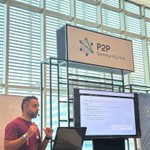
📍 Devcon, Mumbai
📸 Optimum CTO @h_p_sing presenting mump2p at the @p2pcommunityhub


Check out @MurielMedard latest interview with @DefiantNews to find out exactly why top node operators are choosing mump2p, and what network-wide advantages it's bringing to Ethereum.
For validators, latency is money.
Faster, more predictable block propagation means less risk of missing deadlines, more time to build better blocks, and higher APY.
That's what @get_optimum's mump2p brings to Ethereum, built on RLNC, the network coding tech co-invented at MIT by Optimum CEO & Co-Founder @MurielMedard
Node operators can onboard for free → getoptimum.xyz
Full conversation with @CamiRusso on The Defiant 🔗