

The International Food Policy Research Institute (IFPRI), a @CGIAR Research Center, seeks sustainable solutions for ending poverty, hunger, and malnutrition.
Washington, DC
Joined May 2009
- Tweets32.4K
- Following1.6K
- Followers143K
- Likes11.2K




☕📚 Weekly Reads from IFPRI is now on LinkedIn!
🔗 Read more here: on.cgiar.org/4yPJV3t
@CGIAR

🆕 #Blog Building resilience amid conflict: Insights from IFPRI Sudan at the 8th African Conference of Agricultural Economists
🖊️ By Shima Mohamed, Hala Abushama, and @khalidhasiddig
A new IFPRI book explores how conflict has disrupted Sudan’s agrifood system. Research shows how war has reduced agricultural production, disrupted markets, and undermined food security and livelihoods across the country.
Read more: on.cgiar.org/4iaBpa3
@CGIAR @IFPRI_Africa

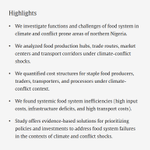
How can food systems in northern Nigeria become more resilient to conflict and climate shocks?
Bedru Balana, @swomamo, @A_Mulubrhan, Olufemi Popoola, Chibuzo Nwagboso, Serigne Loum, Khusro Jawed, and Kwaw Andam map supply chains and identify key inefficiencies, including high input and transport costs and infrastructure gaps.
🔗 doi.org/10.1016/j.gfs.2026.1…
@CGIAR @CGIARPolicy @IFPRI_Africa

In early 2025, an IFPRI-led project introduced a mechanization package to 20 women's shea cooperatives in northern Ghana: a motorized tricycle, a mechanical dehusking machine, and personal protective equipment.
Recent focus group discussions with the cooperatives have shown that this mechanization package has reduced dehusking time from two to three days to about 30 minutes per 80-100 kg sack, allowing for:
➡️ New and expanded income-generating activities
➡️More time for farming:
➡️More time for family
🔗 on.cgiar.org/4zydw22
#IYWF2026 @CGIAR @IFPRI_Africa @japan

🌍 Why do farmers adopt climate adaptation practices?
A new #OpenAccess study by Halefom Yigzaw Nigus, @tabe_ojong , and @KibromAbay examines how psychological traits, including locus of control, shape farmers’ climate perceptions and adaptation decisions.
🔗 doi.org/10.1016/j.worlddev.2…
@CGIAR @WorldBankGroup @IFPRI_Africa

IFPRI’s five decades of experience has shown that development policy research has a stronger likelihood of making an impact and meeting real-world needs when it is adapted to local contexts and created with national and local partners.
For the past 20 years, IFPRI has deliberately expanded its international presence through a dynamic network of country offices.
Learn more in this new blog by Maria DiGiovanni and @swomamo, part of our “Making a Difference” series: on.cgiar.org/4eKgpEP
@CGIAR @IFPRI_Africa @IFPRIBangladesh @IFPRI_MENA @IFPRISAO

🔍 Do precision land management technologies improve farm efficiency?
This study on laser land levelling (LLL) in India by Shreya Kapoor and Anjani Kumar found that LLL adoption increases paddy yield by 2.64 quintals/acre: doi.org/10.1016/j.agsy.2026.…
@CGIAR @IFPRISAO #OpenAccess

#ICYMI: Policymakers and program implementers in #Somalia are increasingly recognizing the importance of complementing short-term cash or in-kind transfers with interventions targeting longer-term development goals and poverty exit.
This webinar presented evidence on gendered patterns of livelihoods and access to safety nets among displaced households.
🗨️Deboleena Rakshit @meanregressive, @leightjessica, John-Paul Nyeko (@WorldVision) & @NKarachiwalla
📺 on.cgiar.org/4z7kP0I
@CGIAR @IFPRI_Africa

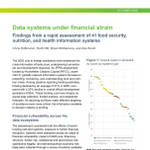
📊 Critical food security, nutrition, and health data systems are under financial strain.
An IFPRI analysis by Chris Hillbruner, @ruthvargashill, Brian McNamara, and Zoe Scott funded by Rockefeller Catalytic Capital (RFCC) of 41 systems found that among systems reporting estimates, funding fell by an average of 31% in 2025, impacting data collection, analysis, and forecasts.
🔗 hdl.handle.net/10568/186068
@CGIAR @RockefellerFdn

🆕 #Blog Measuring what matters: Building better food data from everyday market realities
🖋️ By Cynthia Kazembe @Cee_00 and Lara Cockx
In #Malawi, Maize is sold by the bucket, beans by the cup, rice by the plate, and groundnuts by the tin. IFPRI’s fieldwork is generating an updated and transparent collection of commodity-specific measurements that anyone working with data on food consumption and production can use to turn everyday quantities into reliable statistics: on.cgiar.org/4idTpir
@CGIAR @IFPRI_Africa @IFPRIMalawi

The Secured Climate-linked Agri Lending Ecosystem (SCALE) expands access to finance for smallholder farmers often excluded from formal lending—many of them women—and integrates incentives for using climate-friendly approaches.
Learn more in this recent blog by @BerberKramer, Tarun Katoch, and Julie Ghostlaw: on.cgiar.org/4zzYHw2
#ClimateFinance #ClimateResilience #IYWF2026 @CGIAR @IFPRISAO @dvaraholdings

Food crises are growing more complex, while funding for critical data systems is falling. Today in Rome, partners launched the Intentional Data Community with support from @RockefellerFdn to strengthen existing systems and help countries act earlier.
Read the press release here: on.cgiar.org/4z6YGQr
The IFPRI analysis by Chris Hillbruner, @ruthvargashill, Brian McNamara, and Zoe Scott conducted as part of the VITAL Data initiative is available here: hdl.handle.net/10568/186068
@CGIAR @WorldBankGroup @FAO @WFP @UNICEF @SUN_Movement @EU_Commission @fightfoodcrises @AKADEMIYA2063 @Google


🆕 #Blog Who gets what? Budgets and discretion in community-led social protection targeting
🖋️ By @KibromAbay, @GuushBerhane, @dogilligan, Kibrom Tafere, and Alemayehu Seyoum Taffesse.
Shrinking humanitarian and international development assistance funding amid growing global crises has strained the operations of governments and humanitarian organizations.
Recent research in Ethiopia tests how budget constraints and variations in targeting rules impact targeting outcomes: on.cgiar.org/4skbHU4
@CGIAR @CGIARPolicy @IFPRI_Africa

Congratulations to the CGIAR Gender Equality and Inclusion team and all contributors, including IFPRI's @HMalapit, @heckertjessica1, @jkyleindc, Elizabeth Basauri Bryan, @EliotJonesGarc1, Luis Escalante, @Ruth_Meinzen_D, Carlo Azzarri, James Thurlow, and Marilia Magalhaes 👏
#MustRead for anyone interested in advancing #Equality in #FoodSystems!

@CGIARgender Report 2026 launches today at #CFS54 !
A huge thanks to all our contributors for bringing the evidence, insights and pathways to global conversations on gender equality and resilience in FLWS.
🔗 Explore the report: on.cgiar.org/4dI8yHv
#GenderinAg #IYWF2026

IFPRI retweeted

ICRISAT, in collaboration with the International Food Policy Research Institute (@IFPRI), CGIAR Policy Innovations (@CGIARPolicy), and the ICAR–National Institute of Agricultural Economics and Policy Research (@IcarNiap), at the 34th Annual Conference of the Agricultural Economics Research Association (@AeraIndia), held on 12–14 October 2026, Pondicherry University, Puducherry, India.
Dr Shalander Kumar (@kumar_shalander), Principal Scientist – Socioeconomist, Markets, Institutions and Policies, and Ms Judy Thomas, ICRISAT, convened the panel “From Plot to Policy: Pathways for Mainstreaming Regenerative Agriculture,” exploring ways to scale regenerative agriculture through stronger scientific evidence, monitoring systems, and supportive policy frameworks.
The second panel, “Reimagining India’s Fertilizer Policy Landscape: From Price Management to Agricultural Value Chain Transformation,” focused on scaling regenerative agriculture through long-term scientific evidence, farmer-centered transition support, stronger extension services, market incentives, and supportive policy frameworks.
Both discussions highlighted the importance of collaboration among researchers, policymakers, and industry stakeholders in advancing evidence-based agricultural policies and sustainable farming systems in India.
Read more: pressroom.icrisat.org/from-p…


El Niño events can significantly influence Kenya’s seasonal rainfall patterns, growing seasons, and national economy.
To estimate these impacts, researchers employed RIAPA-AI (Rural Investment and Policy Analysis with artificial intelligence), a conversational interface built around IFPRI’s standard computable general equilibrium (CGE) model that allows users to quickly generate rigorous simulations of national economies.
Learn more in this recent blog by Emerta Aragie, Shadrack Mwatu, Adan Shibia, and Chris Hillbruner: on.cgiar.org/4dtfAQl
@CGIAR @IFPRI_Africa @KIPPRAKENYA

IFPRI is pleased to join #SLAN2026 from October 25–29, 2026 in Santiago, Chile, the conference will bring together researchers, academics, health professionals, policymakers, and students from across the #LAC region to discuss the future of food systems & nutrition.
Learn more here: on.cgiar.org/4BounWY
@CGIAR @CGIARnutrition

🆕 #Blog When Crises Disappear from View: The Growing Humanitarian Data Drought
🖊️ By @CreoleBauer and @swomamo
Humanitarian data systems are shrinking. Without fresh data, people in crisis become harder to see, harder to reach, and all too easy to overlook.
Read more: on.cgiar.org/489j2fM
@CGIAR @WFP @IFPRI_Africa

In this recent study, Samuel Scott, Sumanta Neupane, Hana Tasic, Nadia Akseer, Sunny S. Kim, Harold Alderman, Bianca Carducci, and Rebecca Heidkamp examine whether vulnerable women and children are being reached by both social protection programs and maternal and child health and nutrition interventions in Bangladesh, India, and Nepal: doi.org/10.1111/mcn.70233
@CGIAR @IFPRISAO @IFPRIBangladesh

🔔 HAPPENING NOW! 🔔
📌 Political Economy of Fertilizer Subsidies.
🤝 IFPRI & AgIncentives Consortium
📆October 21, 2026, 10:00 – 11:00 am (US/Eastern)
🗨️@JeffBloem, @D_E_Resnick, & Jibran Punthakey (@OECDTrade)
🎫 on.cgiar.org/4zvyHlf
@CGIAR @CGIARPolicy
