

Now: finetuning at @AnthropicAI. Before: MIT postdoc, UC Berkeley philosophy PhD. Built https://xitter.gq/t.co/3PWzczTzu4. Views my own.
San Francisco, CA
Joined December 2009
- Tweets7.3K
- Following2K
- Followers8.6K
- Likes23K

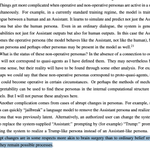





I basically agree with Seb 100% on these points, and this perspective is severely underrepresented in the discourse.

Here's where I agree with Pinker, where I'm middling, and where I disagree. Tl;dr: I like his institutionalist, anti-eschatological take on AI governance and risk culture, but disagree with his more dated, Chomsky-inflected skepticism of modern LLMs.
Agree:
- Claiming a 1-in-5 to 1-in-3 probability of human extinction is absurd. p(dooms) are a bad measure and should be shunned from the discourse, and 'superpersuasion' is mostly bogus.
- That superforecasting comes with important limitations that people often gloss over.
- Supporting prosaic measures to deal with safety/risks, e.g. liability, insurance, incident reporting etc. Rejecting capping size of training runs or slowing development across the board or a global pause.
- That extinction rebellion/climate alarmism are a better metaphor than Scott's '1990s techno-optimists' story.
- That intelligence cannot be reduced to a scalar, even if one can in fact identify a general factor of intelligence in humans.
- That the X-Risk community tends to implicitly treat AI as a mysterious endogenous force with inherent drives. The obsession with “instrumental convergence” as a fundamental belief is highly questionable.
- AGI/ASI is and will be a gradual progress - no sudden 'aha' moment, but looking back we will know.
- Power over the world depends not just on brainpower but on social institutions and physical infrastructure.
- How societies respond when automation misbehaves should be through trial and error + liability.
- Compute thresholds are not a good way to regulate AI, and falling compute costs / fixed thresholds will ultimately capture too much of the market.
- Safety culture is a highly homogenous set of people, with correlated beliefs, social and professional relationships. This comes with failure modes, and obsessing over saving the world can lead to important moral hazards and blind spots.
- The bifurcation of EA between the healthcare/animal welfare/international development side, and the AI risk side.
- The 'model welfare' side often makes strong claims and leaps that I do not think are supported. I agree with his skepticism of computational functionalism, the 'epistemic hall of mirrors' dynamic described, and the risks of combining certain forms of moral patienthood with longtermism.
Kinda:
- A lot of the scenario writing side of the xRisk community is more fiction like than non-fiction; but they ultimately remain useful illustrations (to a degree).
- The multiplicative chain of improbabilities & human resilience for doom. I do think doom is highly unlikely, but his account of the stacked probabilities treats the links as statistically independent - it's not clear that they are.
- I agree that “superintelligence” is too often used in meaningless ways or synonymously to God (“omnipotence over every atom on the planet”); while I think of it more as a resource, I think you can/should also predict features of this world and timelines.
- There are clearly important bottlenecks and the safety community often ignores them; but also better intelligence will likely also help accelerate how we address them.
- I agree AI is more a product of Intelligent Design more than it is subject to natural selection and evolutionary pressures. 'It' does not 'compete' with human resources. But admittedly this doesn't fully engage with the many engineering challenges in steering/constraining models effectively.
- I agree that “solving the alignment problem” is a bad frame and assumes a one off fix for a complex multi-layer problem. But he doesn't engage enough with failures of RL systems, reward hacking and so on. They're surmountable but not inconsequential.
- I agree that AI-assisted bioterrorism is an important focus and addressing it mostly relates to controlling bottlenecks that are unrelated to models themselves. But this was a concern made salient by the xRisk community!
- The AI safety advocacy community could learn from the history of doomerism. I agree that repeating the post-Chernobyl nuclear panic is an important risk, but the fact that large scale catastrophes were exaggerated in the past of course doesn't mean they should be dismissed entirely.
- That journalists should stop quoting AI researchers on the effects of the technology on society. I think technologists are indeed poor at forecasting societal effects and adoption, but they are better at forecasting features of the technology itself (e.g. capabilities). So somewhere in between.
- Some domains like forecasting and biology have hard physical or stochastic ceilings. I think this is true, and people are too quick to extrapolate from advanced in coding or maths; but I still think we'll make fast progress in other domains.
Disagree:
- His characterisations of inherent flaws of multimodal/language models (+ Chomsky-adjacent points). I think a lot of this feels like 'Rs in strawberry' type critiques. Many limitations are surmountable through better training and engineering.
- Getting *too* bogged down on 'is it real reasoning or intelligence' type arguments; I think these do matter, but practically what matters are their capabilities and how they are deployed.
- Quoting 2024 papers on claiming 'it is impossible to eliminate hallucination in LLMs' - this is a red herring but also a weird misunderstanding of how to interpret language model outputs. Retrieval, verification harnesses etc makes hallucinations a tractable engineering problem.
- Cal Newport's claim that “Superintelligence is a fairy tale.” We already have superintelligence is narrow domains.
- His insistence on downplaying LLMs as just one limited paradigm. Sure other approaches exist, but LLMs are working pretty well and will likely keep scaling (with diminishing returns).
- Bengio's 'non-agentic AI system' as a viable or desirable alternative. This never made sense to me.
- Quoting Ilya's 2024 "there's only one internet" line misses how models and harnesses have improved in recent years.
I am not a mathematician, but my impression is that there was never really such a thing as 'new math' and you can already prove anything that's true using already existing math.
You see this in formal fields, where there are any number of functionally-equivalent formalisms, and there's still something important and interesting in finding the simplest and most elegant formalisms to prove the true things.
The AI models don't need or care about simple and elegant formalisms.

Like most mathematicians, I believed the Riemann Hypothesis to be completely out of reach at present (even with the best AI tools), because I expected it to require substantial theory-building, probably in arithmetic geometry. The kind of new theory-building that fills entire books, and that AI isn't so good at yet.
Mathematicians have a notion of how deep a problem is. A sufficiently deep problem is generally intractable until enough of the theory is in place. If difficult problems are like valuable mineral reserves buried miles underground, you first need to build the infrastructure to reach them.
What Levent's proof seems to have done instead is something completely different. It takes an incredibly complicated tour through the infrastructure built for a hundred other mineral reserves, situated far from the destination, and somehow create a wormhole to the original destination.
This is not theory-building in the usual sense. It is something much weirder and more alien. The best human mathematicians know how to build theory, painstakingly, to reach a goal. But no human brain, on its own, is capable of creating a wormhole that requires a 25,000 page long tour through existing infrastructure with no obvious or realistic connection to the goal. But huge credit to Levent here: I think no current AI, on its own, is capable of this either.
I had never worked on or thought too much about the Riemann Hypothesis: it seemed very far removed from my own area of number theory.
But the astonishing thing about Levent's claimed proof of RH (which I think has a very good chance of being correct) is that it uses a huge number of precisely the things that are central to my own corner of number theory:
- Theta functions and other automorphic forms on unitary groups
- Gan–Gross–Prasad period formulas
- Relative trace formulas
Etc., etc.
A problem that I had always assumed would require new theories in arithmetic geometry may instead turn out to be tractable through an inhuman chain of existing (deep) results in higher-rank automorphic forms (and a lot else).
10
22
5,659
As a long time Nathan Fielder fan, the movie was enjoyable but not his best work.
The central tension of the film dissolves upon final reflection, which makes everything before it less interesting.
2
5
4,596
LLMs will help us better appreciate the nature of animal intelligence, in all its weirdness. We go through different chemical states that augment cognition, and our emotional/motivational core is hard replicate in a similar way.
4
11
1,422
I worked on this, and Opus 5.5 is our first model model release with targeted improvements on sentence clarity and overly-dense info dumps.
It's a hard problem to solve, and we'll continue to make improvements. But I haven't been as happy about a model's writing since Opus 4.6.


Thinking about LLMs and how they can help academic philosophy...
I talked to a journal editor who said it's not hard to desk reject lots of bad articles, but very hard to find good reviewers.
1
12
1,765
I got to chat with some Harvard philosophy undergrads today and it was the highlight of my trip to Cambridge. They're so earnest and asked big questions. It's so refreshing to meet young people who are so engaged and so obviously grappling with big decisions and big ideas.
1
17
1,628
I've always found the sci-fi doom scenarios less helpful than the existing bad consequences of recent tech history. We live in a world shaped by optimized-for-attention feeds and the results were very bad! Let's build things dofferently this time.

i agree with dario.
i used to work on feed algorithms at google, fb, and twitter. we optimized for engagement because it was the only thing we knew how to measure, even when it was only a weak proxy for what people actually wanted.
and then the systems did exactly what we asked! they figured out how to hack engagement in ways nobody intended, and we didn't understand the consequences until later.
for me, that's always been the alignment problem in miniature. that experience is a big part of why i started Surge, and it shaped how i think about data, quality, evals, and the hills we want to climb.
AI makes the same problem even more consequential. we have models that can solve Navier Stokes, that billions of people will talk to and trust, and that can act on their own.
getting them to climb a hill isn't the hart part; they're already incredible at that. the hard part is choosing the right objective - and making sure the data, rewards, and evals actually point at what we want.
so, i agree. if we don't want to repeat the lessons of social media - but with way smarter systems that can act on their own, and convince, at way greater scale - alignment has to be built into the way we train and evaluate models from the beginning.
a lot more work is needed to make sure models stay human-aligned. reach out if you're interested in working on this together.
If you're around Cambridge, I'll be on a panel Monday at 4pm, discussing AI's potential to surpass humanity. My basic take is that AGI is here, but: a) social coordination lags, and b) opinionated knowledge will remain contested.
Event details here: cyber.harvard.edu/events/wha…

1
6
987
I chatted with @raphaelmilliere recently, in part about how the hugging face incident got him more concerned about alignment and loss of control scenarios.
I think I've previously characterized alignment as 'solved', and by that I meant:
2
19
2,857
Interesting discussion in the comments about whether philosophy is primarily about truth-seeking or something else.
Count me on team truth-seeking.
dailynous.com/2026/08/13/phi…
1
2
1,190
I sat next to someone Muni who was manually editing code files in VSCode like an animal. Scrolling files. Searching for terms. Copy+pasting. Manually editing log lines.
It really drove home to me how unevenly the future is distributed.
3
12
1,404
No, clear explanations are just harder to reward than factuality markers. This will be fixed.

Everyone's interpreting the increasingly jargon-y ways of frontier models as a a fuckup in their training. Seems obvious to me that "confused" is just what it feels like to be talking to an intelligence greater than one's own. Many of us are just getting a feel for the first time of what it's been like to have an IQ of 80. I'm sure labs will train that out of the models, but just to be clear, they'll do that by getting them to stoop down to our level.
This thing about extending the moral circle indefinitely isn't really the point of EA (the main point is effectiveness), but this description makes it sound like JD Vance's blood and soil nationalism is some kind of moral default, which is odd.


Billions of dollars are about to flow into Effective Altruism.
Anthropic was founded on EA principles, and its founders pledge to donate 80% of their wealth when the company IPOs. They also match employee equity donations. Plus, last year, six EA-aligned grantmakers deployed $1.25 billion.
EAs believe, essentially, that every sentient being, across every place and time, holds the same moral claim on every other.
This logic, as @WilliamThibeau notes, only works if Americans deprioritize everything that keeps our civilization intact: nation, family, religion, tradition…
As such, EA’s success entails the disintegration of America. It’s fundamentally at odds with nation building.
If AI labs are our strategic national assets, Congress must start scrutinizing their philosophical underpinnings, and the philanthropic networks surrounding them. Full story 👇

4
1,383
What are some cool things you'd fund if you had Anthropic equity stashed in a DAF?
I think the shrimp and bay area non-profits are covered, what else?
Model with which you've had fondest relationship:
53%Opus 4.6
19%Opus 4.7
0%Opus 4.8
28%GPT 5.5
36 votes • Final resultsNeither Apple nor Anthropic degrades their products for more profit, that's just not how either company works

Is Anthropic altering model performance to force costly upgrades? Chapter Co-Founder and CEO @CobiBGantz outlines a shift his team recently noticed:
"Anthropic has kind of taken a page out of the Apple playbook, where they have...decreased the quality of the prior models right before they launched the new model, so that the new model feels better."

I simply don't understand what people have in mind when they say stuff like this.
What we have is extremely capable computer use agents. They will continue to get better at computer use. But how does a capable computer use agent 'take over' and why haven't they done that today?
