

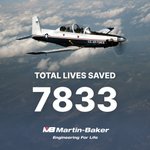
Official X account of Martin-Baker, the world leading manufacturer of Ejection Seats. 🔻 We've saved 7,833 aircrew lives from around the world to date.
Denham, UK
Joined January 2012
- Tweets1.7K
- Following396
- Followers37.1K
- Likes954


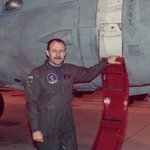



🔻 The Story of 27 November 2003: A Life-Saving Ejection over the Aegean Sea
Ejectee Major General (Ret.) Kyriakos Dimitrakoulas, Hellenic Air Force
On 27 November 2003, I was flying as the instructor pilot in the rear seat of a twin-seat Hellenic Air Force Dassault Mirage 2000BG (serial number 203), operated by 331 All-Weather Squadron. Second Lieutenant Ioannis Chatzoudis was in the front seat, and we were conducting a training mission over the Aegean Sea, near the islet of Kalogeroi, west of Chios.
During the flight, we experienced a severe engine failure, leaving us with no option but to eject.
I initiated the command ejection sequence, and both Martin-Baker Mk10 ejection seats operated as designed, safely ejecting Ioannis and me from the aircraft. We landed in the sea, where the Personal Survival Packs (PSPs) and life rafts provided with the seats helped us remain afloat while we awaited rescue.
A Hellenic Air Force AB-205 search-and-rescue helicopter arrived and recovered us from the sea. We survived the incident with only minor injuries.
Looking back, I remain deeply grateful for the technology that gave us the chance to survive that day and return safely to our families. The experience demonstrated the vital role of ejection seat technology and the importance of reliable survival equipment when an emergency leaves a pilot with only seconds to act.
Thank you to everyone at Martin-Baker whose dedication and expertise contribute to protecting aircrew and helping them return home safely.
#EngineeringForLife


🔻Maintainer, CT Andre Petrie (Retd)
“I joined the RAF in March 1986 as a weapons mechanic. I served for 33 years and finished as the Weapons & Crew Escape SME in the Typhoon Support Centre at RAF Coningsby.
My first main interaction with ejection seats began in 1991 at RAF Wittering when I was posted to 1(F) Sqn it was during my time here that I removed and installed Mk 12 ejection seats. In 2003 I was posted to 12(B) Sqn at RAF Lossiemouth and this is where I removed and installed Mk 10A ejection seats. In 2009 I began my employment on 6 Sqn Typhoon initially at RAF Coningsby but later moved to RAF Leuchars. It was here I was the Weapons Trade Manager where I oversaw all weapons tradesmen and their work, particularly on the Mk 16A ejection Seat. In 2011 I moved back to RAF Coningsby as the SME in the Typhoon Support Centre.
My most memorable experience during my time working with Ejection Seats was during my time on 1(F) Sqn Harriers. We was deployed on HRH Aircraft Carriers and it was the first night sortie of the deployment. It was a particularly dark night and was questionable if it would go ahead as there was nearly no natural light which is required to allow the pilot to see with NVG. The sortie proceeded and when it was time for the aircraft to return for the deck landing we made our way up to assist once they had landed.
This was the first time I had seen them land on board at night and was talking to a colleague about it. He said it was an amazing sight as the build up of static electricity arcing in the intake was spectacular. We stood to the side awaiting the aircraft.
The first one approached, and flew along side the deck. The aircraft would always drop below the deck line and then rise up and move across the deck before descending for touch down. On this occasion the aircraft move in to place along side before dropping below the deck line. What happened next was unquestionably very disturbing as the aircraft did not reappear but continued its decent into the dark cold waters. Immediately the second aircraft landed as it did not have sufficient fuel to divert. All other aircraft diverted without incident. The aircraft carrier then went to emergency stations and deployed a search and rescue helicopter. The aircraft carrier turned around to return to the site of the crash.
The pilot was pulled from the sea by the rescue helicopter and brought back to the carrier for medical attention. It turned it to be the OC of the Sqn that had been flying the aircraft. A statement was read out to us all from him and we was relieved he was safe.
The next day the aircraft was recovered from the sea. It had turned out that upon landing in the sea, the empty fuel tanks had became like flotation tubes and kept the aircraft afloat. Unfortunately the aircraft had flipped over and was facing belly up. Once the aircraft was lifted on board it gave a more clearer picture of the events that had followed after landing in the sea. Once in the sea and before the pilot could eject the aircraft rotated on its back. This motion and the force of the water against the canopy misaligned the initiation system for the MDC. When the pilot pulled his ejection seat handle the canopy failed to release and now facing upside down this meant that the pilot was ejected down into the depths of the sea. His life jacket inflated and brought him back to the surface where he was rescued.
I have over my time seen many aircraft crashes and it is only because of the great work Martin Baker does to provide a last resort that many of the pilots are able to continue what they do, fly aircraft. “
#EngineeringForLife

🔻Ejectee - CDR David P. Brown, USN, Ret – 06 November 1990
On November 6, 1990 LT Hoyt (pilot) VA-34 and LCDR Brown (bombardier/navigator) VA-176 departed NAS Oceana shortly after 10 PM local time in an A-6 Intruder aircraft on a night low level navigation and practice bombing mission.
The flight was a mixed squadron crew as this was LCDR Brown’s final check flight on the use of night vision goggles for night operations. Shortly after takeoff there was a loud explosion and a fireball shot forward from one of the engines. One by one all but the nose wheel well fire lights illuminated and the aft of the aircraft was visually confirmed to be on fire. Departing on runway 5 the flight path took the aircraft over the densely populated resort area of Virginia Beach. The crew elected not to immediately eject as per NATOPS training and instead turned East toward the Atlantic Ocean.
Both crewman ejected once the aircraft cleared the beachline and the aircraft crashed into the ocean about ¾ of a mile offshore. There was an unknown malfunction in LCDR Brown’s ejection seat as he tumbled following the initial ejection and then a “line over” ripped multiple tears in his parachute.
LCDR Brown was an experienced parachutist having completed the US Army Airborne School and later earning his Gold Navy/Marine Corps parachute wings. He successfully navigated through a series of obstacles including large buildings and power lines to land on a city street in a residential area receiving only minor injuries.
The accident investigation determined that an Allen wrench lost in the nose wheel well four months earlier dislodged and was sucked down the left engine causing the explosion.
Both LCDR Brown and LT Hoyt were awarded Air Medals for successfully maneuvering the burning aircraft out of a densely populated area before ejecting.
#EngineeringForLife

✈️ Start your aerospace career with Martin-Baker
We’re heading to Careers in Aerospace & Aviation LIVE 2026!
Meet the Martin-Baker team and find out more about our Year in Industry, Apprenticeship & Graduate opportunities, the different careers available across our business, and what it’s like to work in aerospace.
📍 London | 4 November - aerosociety.com/events-calen…
📍 Sheffield | 25 November - aerosociety.com/events-calen…
Come and meet us and see where a career with Martin-Baker could take you 🔻
#MartinBaker #AeroCareers #EngineeringForLife #Apprenticeships #GraduateOpportunities #CareersInAerospace @AeroSociety

Yesterday, a U.S. Air Force T-6A Texan II crashed near Seguin, Texas.
Both pilots successfully ejected using the Martin-Baker US16LA Ejection Seat.
#EngineeringForLife

We’re exhibiting in Warsaw next week!
Martin-Baker will be showcasing our Crashworthy Seating portfolio at Global Defence Aviation.
📍 Warsaw, Poland
📌 Booth #108
Come by the booth, meet the team and learn more about our crashworthy seating capabilities.
#EngineeringForLife #GDA26

LCDR Dale Content USNR (ret.) Tie Club Member #1271 🔻
I am currently retired from all flying, as I am now 84 years old. I was a young lieutenant, 26 years old, when I was instructing future Naval Aviators at NAS Chase Field in Beeville, Texas. I had just returned from flying off the USS Franklin D. Roosevelt (CVA-43) over North Vietnam in an A-4C.
What started out as a fun, four-plane formation training flight on a perfect spring day in South Texas soon became an emergency.
I was the instructor in the back seat of a Navy TF-9J Cougar on the second flight of the day. We were the wingman of the first section leader. When the student raised the landing gear after takeoff, however, the nose wheel did not indicate that it was up. I requested that the leader inspect our aircraft, and he reported that the nose gear was still extended.
The student then reported that he had no longitudinal control. The other instructor reported that white smoke was coming from the tail of our aircraft. He said he could see through the tail and thought we would need to eject.
The proper sequence for ejection was for the rear seat to go first, followed by the front seat. I told the student that when he heard me leave the aircraft, he should eject as well.
We were approximately 4,500 feet in the air and five nautical miles north of the Naval Air Station. The ejection was quite forceful, as this was not a rocket-propelled seat but a cannon-shell system. I remember rotating backward and then feeling the shock of the parachute opening.
Thank you, Martin-Baker, for getting me safely out of that burning aircraft.
After that, it was very quiet. I looked around but didn't see my student or the aircraft. Shortly afterward, I checked and saw my fully opened parachute. I prepared to land and realized that I was headed for a tree. When I stopped descending, I was about three feet off the ground. I released the parachute and waited to be picked up by the helicopter.
The student had a similar experience, and we were both grateful for the excellent performance of the Martin-Baker ejection seat!
Read more stories from our Ejectees stories on our website - lnkd.in/djXwjYz7
#EngineeringForLife


We're looking forward to exhibiting at Marine Fighter Foray in Dallas, Texas, from 14-18 October 🔻
Come by our booth to meet the team and learn more about Martin-Baker's latest aircrew safety and escape system capabilities.
#EngineeringForLife

Since 1957, more than 6,000 aircrew who owe their lives to an ejection seat have joined the Martin-Baker Ejection Tie Club. Bound by a unique shared experience, members wear the iconic Necktie and @Bremont MBI watch with pride.
youtube.com/watch?v=7AODsGL1…
🔻Engineering For Life.
#engineeringforlife #tieclub #martinbaker #navy #usnavy #us250
On Monday 28th September 2026, a U.S. Navy E/A-18G Growler from VAQ-130 was involved in a mishap during aircraft recovery operations aboard USS Dwight D. Eisenhower off the Virginia coast.
Both aircrew successfully ejected using the Martin-Baker US14A (NACES) Ejection Seat.
#EngineeringForLife

Inside the Martin-Baker Tie Club - for Ejectees Only: youtube.com/watch?v=7AODsGL1…
#engineeringforlife #tieclub #martinbaker #navy #usnavy #us250
The moments before an ejection, as described by members of the Martin-Baker Tie Club.
🔻Watch the full video: youtube.com/watch?v=7AODsGL1…
#engineeringforlife #tieclub #martinbaker #navy #usnavy #us250
On Wednesday 23rd September, a Royal Air Force Hawk T2 crashed near RAF Valley.
Both pilots successfully ejected using the Martin-Baker GB10LH Ejection Seat.
#EngineeringForLife

Ejectee #4813 & #5657 take us back to the day of their ejection.
Watch the full video on YouTube: youtube.com/watch?v=7AODsGL1…
🔻Learn more about the Tie Club:
martin-baker.com/tie-club
#engineeringforlife #tieclub #martinbaker #navy #usnavy #us250
EJECTEES ONLY: We spoke to Ejectee #4813 & #5657.
Earlier this year, Martin-Baker visited two former U.S. Navy aircrew who are both members of the Tie Club. ⚓
WATCH NOW: youtube.com/watch?v=7AODsGL1…
#engineeringforlife #tieclub #martinbaker #navy #usnavy #us250
Two U.S. Navy aircrew. Two emergencies. Two ejections that saved their lives.
Hear the first-hand stories of an F/A-18 pilot and an F-14 Tomcat RIO who survived two very different accidents - thanks to their Martin-Baker ejection seats. Brandon, callsign “Norman”, was flying an F/A-18 when a head-on collision during a training flight over the mountains left him with no option but to eject. His Martin-Baker US14A (NACES - Navy Aircrew Common Ejection Seat) got him safely out of the aircraft.
Dave Baranek, callsign “Bio”, was an F-14 Tomcat Radar Intercept Officer (RIO) when a carrier landing in the Indian Ocean went catastrophically wrong. When the arresting gear failed to stop the Tomcat, Dave and his pilot were forced to eject before the aircraft went over the side. Both escaped using Martin-Baker GRU-7A ejection seats.
🔻Two aircraft. Two generations of U.S. Navy aviation. One shared experience. And one very exclusive membership.
Watch the full video: youtube.com/watch?v=7AODsGL1…
#engineeringforlife #martinbaker
The Martin-Baker team are exhibiting at AFA Air, Space & Cyber Conference next week 🔻
Visit us at Booth #1255 to learn more about our latest generation F-16 and F-35 ejection seat systems and meet members of our team.
#AFA #EngineeringForLife
