

Software security @MSFT working on Post Quantum Crypto. Author. Co-host of the Azure Security Podcast.
Austin, TX
Joined May 2008
- Tweets4.6K
- Following155
- Followers4.3K
- Likes1.7K




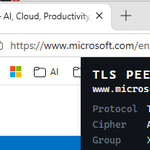

Now that Azure App Service is rolling out TLS 1.3 updates for PQC (azure.github.io/AppService/2…), you get X25519_MLKEM768 support for free! I made no changes, and this is what I see for the Azure Security Podcast:

1
2
190
Azure App Service, Azure Functions and TLS 1.3 PQC azure.github.io/AppService/2…

The Azure Security Podcast - Episode 134 - Post Quantum Crypto TLS 1.3 in Azure Front Door azuresecuritypodcast.azurewe…
1
114
Azure Front Door now Supports Post-Quantum Resilient Hybrid TLS 1.3 | Microsoft Community Hub techcommunity.microsoft.com/…

Michael Howard retweeted

If you are a CIO, CTO, CISO or director of engineering, you need to get a copy of this book for every single person in your company who builds software. The amount of IR reports coming out pointing to software supply chain and vibe-coded apps is crazy.

Michael Howard retweeted

Exclusive discount for my latest book (which also helps to prep for Exam AB-731: AI Transformation Leader). Use code YURI at Microsoft Press Store for 35% discount (offer valid until 11/30) microsoftpressstore.com/stor…


The Afterword was an awesome end-cap to the book, thank you for writing it!

Topic: The game got faster: an update to my afterword in Threat Driven Software Development
Threat Driven Software Development: amazon.com/dp/0135567386
1/ I wrote the afterword for this book by Michael Howard (@michael_howard), Lee Holmes (@Lee_Holmes), Sherrod DeGrippo (@sherrod_im) and Shawn Hernan. That was last December, before agentic development hit its stride and the frontier security model boom. It argued that security is an iterated game, not a one time negotiation. These are my own views.
2/ In Robert Axelrod's tournaments, tit for tat won by cooperating first and then answering each move in kind. I used it as an analogy for proportionate governance: make the secure path the fastest and time box every exception before it turns into culture. Most security failures I see are leadership and management failures in disguise.
3/ The game is the same, but it moves much faster now. Each round is a tool call. Every agent in my personal bot swarm has its own skills, access and dependencies. Trust has to be earned every round.
4/ Controls on each agent don't add up to fleet security. Pass work down a chain and each agent checks its own front door while nobody watches the hallway between.
5/ Log agents the way you'd log people: an identity, scoped credentials and logs it can't modify, tied to the delegation chain. Check authority outside the model, and approve high impact actions before they run.
6/ A violation is a reason to look closer. My recent post on detecting hijacked agents goes deeper: xitter.gq/assumebreach/status/21… Respond in proportion, and forgive fast once remediation is verified.
7/ Every dependency is a player too. A tool server shapes what your agent sees and does. An attestation tells you where it was built and nothing about whether it's safe.
8/ Assume breach is something you practice every round. Build a gameboard where the secure path is fastest.

3
189


When Bigger PQC Keys and Signatures Break Software Assumptions: techcommunity.microsoft.com/…

Michael Howard retweeted

Microsoft Senior Security Program Manager Karina Sirota Goodley joins the Microsoft Threat Intelligence Podcast to examine the ecosystem-wide challenges of preparing certificates and trust systems for post-quantum cryptography. msft.it/6011a0zbh
Karina discusses how Microsoft’s post-quantum certificate pilot brings certificate authorities together to test issuance, compatibility, performance, and lifecycle assumptions. The work shows how minor constraints or one unsupported component can disrupt an end-to-end trust chain.
Organizations can begin by inventorying certificates, keys, libraries, algorithms, hard-to-update systems, and vendor dependencies. Hear why industry testing and collaboration are critical to understanding cryptographic risk and preparing for what comes next.


Not gonna lie; my ninja git skills are slowly atrophying, and I am ok with that! I live in GitHub Copilot and I just tell it to push, pull, resolve, rebase, cherry-pick, and get me out of detached HEAD!
Michael Howard retweeted
Post-quantum cryptography readiness goes beyond protecting encrypted data. Authentication systems must evolve, too, and organizations should start preparing now. msft.it/6012aUw5n
Organizations can begin inventorying certificate dependencies, assessing vendor roadmaps, identifying long-lived infrastructure, and creating non-production test environments. Early testing can surface compatibility and process gaps before post-quantum authentication is required at scale.
Read the blog for practical guidance and learn how Microsoft’s PQC TLS Pilot Program supports eligible certificate authorities in controlled, non-production testing.

Post-quantum authentication: Why organizations should start testing certificate ecosystems now | Microsoft Security Blog microsoft.com/en-us/security…
1
141

Remote Desktop Protocol and PQC TLS 1.3 Hybrid
techcommunity.microsoft.com/…

4
258
This was my last edit in Threat Driven Software Development.
I updated chapter 12 after learning about Microsoft Quantum's work and MarkRuss' talk of accelerating the Quantum timeline. microsoft.com/en-us/security…

2
220
This was fun to work on - I wrote some of the PQC section. Nice to see the topic in the MDDR.

New Microsoft Digital Defense Report is out. Less talk about volume, more on how attacks are evolving and which gaps deserve your attention this year.
Explore the latest trends: msft.it/6011alEic

1
154
ICYMI, September 22, 2026—KB5124006 (OS Build 28000.3086) Preview, support.microsoft.com/en-us/…
[Cryptography] New! Post-Quantum Cryptography algorithm ML-KEM can now be used as a standalone algorithm for TLS key exchange, in addition to hybrid groups added previously.
You need to expand the 'Gradual Rollout' section, to see the text.