

Give a computer data, you feed it for a millisecond, teach a computer to search data, you feed it for a millennium. #People1st #EveryoneAI #AI #DeepLearning
Menlo Park - Silicon Valley
Joined May 2007
- Tweets17.5K
- Following2.2K
- Followers3.5K
- Likes8.2K







Gregory Renard retweeted

BREAKING: A mathematician at Anthropic claims to have used the company's AI to solve the Riemann hypothesis, the most notorious open problem in all of math
sciam.com/article/anthropic-…

Gregory Renard retweeted

ANTHROPIC JUST DROPPED A CLAUDE FORWARD DEPLOYED ENGINEER PATH 🤯
▫️ ~9.5 hours, self-paced, 11 courses
▫️ claude platform 101: api, agent loop, tools, mcp
▫️ claude code in a customer's repo
▫️ building mcp servers + agent skills
▫️ how to design a pilot, set a baseline, drive adoption
▫️ leads to claude certified developer exam
the tech is the easy part. getting a client to actually use it is the job
FDE is the hottest AI role nobody talks about 🔖
link in the first reply 👇

Gregory Renard retweeted

Check out Code Mode, a new, experimental way for Claude Code to work with tools. Claude writes scripts that chain your tools together in sophisticated ways, and it can answer you while long commands are still running.
Opt in with CLAUDE_CODE_EXPERIMENTAL_CODE_MODE=1 code.claude.com/docs/en/code…

Gregory Renard retweeted

PyBot: No weights. No training.
A chatbot built with only simple rules and no AI, entirely written in 600k lines of Python code. PyBot matches Smollm with 360M parameters!
How? A swarm of 1,000 DeepSeek Flash agents wrote the whole code in just a week.
github.com/huggingface/pybot
Gregory Renard retweeted

Fable 5.2 wrote the transformer.
Opus 5.5 generated the training data.
The result:
a 367K parameter language model that fits on a floppy disk and runs on a Pentium.
AI is now building AI for hardware from 1995.
Readers added context they thought people might want to know
indian engagement account making it seem like this is his when he just took someone else’s post from reddit without credit (for x payout money)
reddit.com/r/ClaudeAI/s/m…
Gregory Renard retweeted

🚨 BREAKING: Jensen Huang is reportedly considering founding a brand-new semiconductor company 🚨
He could raise tens of billions on day one, would have full founder control, and could build fast on his own terms. With the relationships he's built over decades, he could easily plug into the #AI ecosystem.
Imagine the demand and customer base lining up before his first chip even ships...
@grok Could Jensen Huang launch a competitor to $NVDA, attract tens of billions in funding, and lock in major customers?
Gregory Renard retweeted

Autonomous cars can see in all directions. And avoid accidents coming from any direction.
You can’t.
And people want to ban them.

My brother’s friend drives a Tesla. This is 3 videos of the same accident. The Tesla, on self drive, sees the approaching car coming from behind at excessive speed and moves out of the way. Driver of speeding car was killed. Amazing technology @elonmusk.
Gregory Renard retweeted

终于实锤了❗️❗️
干掉黄仁勋的,不是婚外情,而是一场由美国政客、媒体、CIA和Anthropic 联合做局的“完美猎杀”。
黄仁勋辞职后,《纽约时报》两名记者在播客里亲口承认:
他们是收到了一位“科技界联系人”的爆料,才去查Megaspeed的。这个联系人,被开源情报指向了Anthropic 的联合创始人杰克·克拉克。
原来,这个Anthropic 的联合创始人杰克是彻头彻尾的恶魔😈。这个家伙后续必死无疑!
顺着资金链往下挖,全是对得上的:
Anthropic今年向支持“收紧对华芯片管制”的组织捐了 4000万美元。
逼黄仁勋辞职的参议员克莱默,收过Anthropic 5.1万美元政治捐款。
CIA监听黄乐一年拿不出间谍实锤,却在中期选举后精准放料。
纽时配合政客,用匿名员工爆料补上“第二段婚外情”。
CIA给黑料,Anthropic出钱,政客挥刀,媒体处刑。
黄仁勋反对封杀中国AI芯片,说“限制不明智”。
而Anthropic靠闭源API赚钱,最怕中国开源模型在GPU上免费跑。让英伟达戴上镣铐,Anthropic才能活下去。
他的“罪”,不是睡了谁。
黄仁勋挡了丑陋资本的路,挡住了美国政客的枪口,还是一个不听话的华人。


Gregory Renard retweeted

Something is very suspicious about the timing of Jensen Huang’s resignation from Nvidia. Why did it take so long for his affair with an alleged Chinese spy to gain traction?
Six months ago, a tiny Brooklyn short-selling shop called Culper Research published a 40-page report laying out the China angle. With zero Wall Street connections, it tracked chips flowing through Singapore and Malaysia to Megaspeed and printed photos of Jensen and Alice together.
But nobody cared. Nvidia’s stock went up.
Even crazier, our own government has known about this since 2025 and Marco Rubio’s office circulated a classified spy memo this spring.
Then suddenly, right on top of the midterms, the story finally became mainstream. The New York Times dropped it on October 29, forcing Jensen to admit to an affair on November 8.
Only then did Nvidia’s board open an investigation.
Then yesterday, the Times struck again with a second affair report involving Nvidia’s VP of healthcare, accelerating the board’s push to oust him right before today’s resignation.
Meanwhile, short sellers had already loaded up on protection for over a week before the stock crashed.
And this is all conveniently coming up the week Anthropic is launching its massive IPO roadshow.
Anthropic and OpenAI make their money keeping AI locked down in centralized, closed models you have to rent by the minute. Meanwhile, Jensen Huang was a loud champion for open-source AI, building the chips so everyday people could run AI on their own computers.
And of course, the Democrats just took power in Congress and many states. And they’re not exactly friendly to AI expansion.
So once again: why is all of this happening right now?
Gregory Renard retweeted

I have a major result to share.
I’ve found conclusive forensic evidence that the top 4 Chinese AI labs—DeepSeek, Moonshot, MiniMax and Ant Group—have built their newest models on NVIDIA’s most advanced Blackwell chips, which are barred from export to China.
This sounds insane, but I discovered that almost every AI model carries a hidden signature of the GPU that trained it. When a model is first set up, the starting values of its weights are laid out in a pattern that depends on the exact GPU. Each combination of GPU and seed number produces a unique pattern—a sort of fingerprint of the hardware used to create the model. Traces of that pattern survive training into the published model.
Again, this evidence isn’t based on any insider information or leaking. It’s based on a forensic analysis of the model weights released by the companies themselves.
I searched more than six trillion combinations of chip layout and seed number and matched them to open-weights models. In doing so, I found conclusive evidence that six Chinese AI models—including DeepSeek-V4-Pro, Kimi K3, and MiniMax-M3—were initialized on NVIDIA Blackwell systems. Four of the models match Grace Blackwell, the GB200 and GB300 parts in NVIDIA’s flagship liquid-cooled rack-scale systems.
I then verified these results on real hardware. Running unmodified PyTorch with the seeds I’d recovered, a Blackwell B300 reproduced DeepSeek-V4-Flash’s untouched starting weights bit for bit, and a rented GB200 reproduced Kimi K3’s to a correlation of 0.999995. A Hopper H100 reproduced none of DeepSeek-V4-Flash’s, and changing the seed by one broke the match. (DeepSeek’s seed is 953049583 by the way.) The method also was verified to match 24 known open-weights models to the hardware that developers said they used.
It is exceedingly unlikely that these results are a coincidence. Across six trillion combinations, the best accidental match should reach only about 8 sigma (i.e., eight standard deviations above what random chance would produce). The real matches range from 49 to 1,385 sigma, and even the weakest single test hits 20.
These were data-center-scale training runs. With some analysis of release schedules and model details, I estimate that the largest, Kimi K3 and DeepSeek-V4-Pro, used 2,000 to 3,000 Blackwell GPUs each. Clusters of this size cost on the order of $150 to $200 million each to buy, and across these labs alone would add up to more than half a billion dollars of export-controlled GPUs, not counting experimental compute or otherwise. It’s quite likely that we see multi-billion dollar expenditure on export-controlled GPUs.
I am highly confident in this result, and it has been independently verified by senior researchers at OpenAI and Anthropic. You can read the full report at unemploymentlabs.com/checkpo….
There is much more I’ve identified about these models through other forms of checkpoint forensics like this, and will have more to share soon.

Gregory Renard retweeted

Qwen4 is coming.
Deeper knowledge. Richer world understanding. Stronger coding and agentic capabilities.
Built for real-world tasks — from complex coding and knowledge work to front-end builds and professional software workflows.
Qwen4-Max is now in preview on Alibaba’s Token Plan. You can also get early access to the new model on QwenWork, Qoder, Qwen APP, and QwenStudio.
Put it to the test on a real problem. Show us what you build. 👀
Token Plan: qwencloud.com/pricing/token-…

Gregory Renard retweeted

NVIDIA announces CEO transition. Read the release: nvidianews.nvidia.com/news/n…
Gregory Renard retweeted

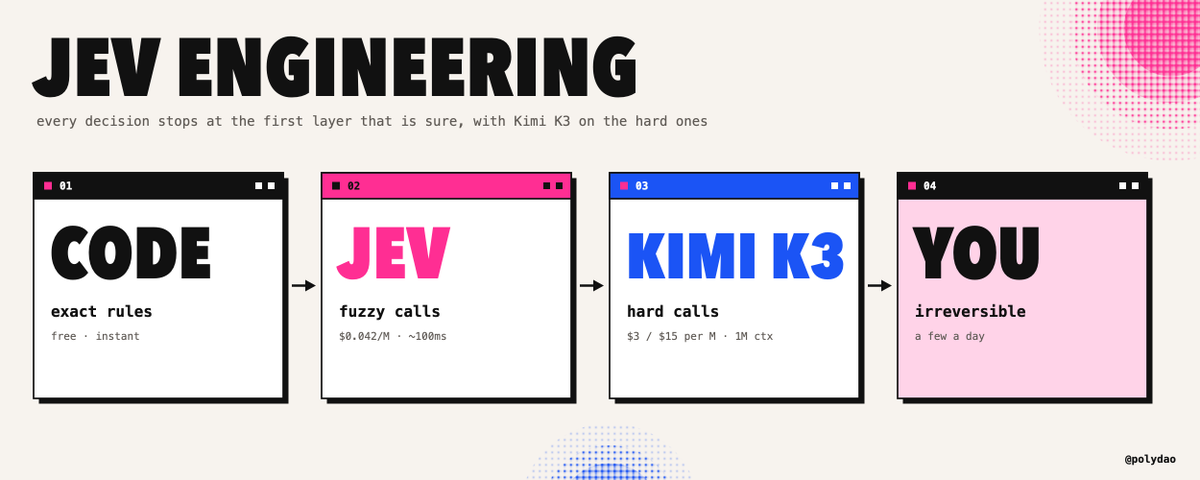
this PDF is a f*cking cheat code for anyone running coding agents
Diogo Almeida, founder of Jev and co-author of InstructGPT, published a PDF on building a Jev harness
the promise:
> up to 200x faster
> up to 400x cheaper
the speed and the cost both live in the harness around the model
how to use it:
> drop the PDF and the article below into Claude Code or Codex
> let it rebuild its own setup
one evening of work, and your agent runs on a harness few teams have 👇

Gregory Renard retweeted

Qwen3.8-27B may soon become a much more practical local model for people using NVIDIA GPUs with 16GB of VRAM.
The interesting part is that this isn’t another attempt to squeeze the model into memory by pushing it down to an extremely aggressive Q2 quantisation.
A new inference setup is in development that aims to support Qwen3.8-27B on 16GB NVIDIA cards while retaining features that are usually expensive in terms of memory.
The planned support includes:
Qwen3.8-27B
Large context windows
MTP speculative decoding
Linux and Windows
Potentially supported hardware includes the RTX 5060 Ti 16GB, RTX 5070 Ti 16GB, RTX 5080 16GB and older NVIDIA cards with 16GB of VRAM.
Why fitting everything matters
The model weights are only part of the memory requirement.
As context grows, the KV cache also consumes more VRAM because the engine must retain information from previous tokens for subsequent attention operations.
Multimodal components introduce additional memory requirements, while MTP speculative decoding needs resources for its draft and verification process.
These components compete for the same limited GPU memory.
That is why getting a 27B model running on 16GB is one thing, but supporting large context windows and MTP without sacrificing too much quantisation quality is a different challenge.
The real engineering work is in how the inference engine manages memory, moves data and schedules computation across the available hardware.
What this could mean for 16GB GPU owners
If the setup delivers on its planned capabilities, users may be able to run a more capable local model without immediately upgrading to a 24GB or 32GB GPU.
It could also make local agent workflows more accessible, particularly if MTP provides useful generation-speed improvements on these configurations.
There are still details worth waiting for: the actual quantisation format, usable context limits, memory consumption, sustained token generation speed and benchmark results.
Support for Linux and Windows is another useful part of the plan, since it gives users on both platforms a route to the same inference setup.
The release is still coming, so these capabilities should be treated as planned rather than independently verified results.
I like this direction of local AI development. Hardware upgrades aren’t the only way to improve inference. Better quantisation, memory management and specialised kernels can make existing GPUs considerably more useful.

Qwen3.8-27B reportedly reached 381 tokens/sec on a single RTX 3090 with 24GB of VRAM.
The developer’s baseline was 82 tokens/sec. That is roughly a 4.6× increase without changing the GPU or the model.
The interesting part is where the improvement came from: the inference software, not a hardware upgrade.
How performance improved
The reported progression was:
Baseline: 82 tokens/sec
Optimised MTP: 114 tokens/sec
DFlash2 + context lookup: 138 tokens/sec
Optimised lookup verification: 381 tokens/sec
Each stage introduced a different way to reduce the work required to produce or verify tokens.
1. Speculative decoding reduces sequential generation
Most language models generate text one token at a time. The next token depends on the previous output, which creates a sequential process.
Speculative decoding changes this by allowing a faster drafting mechanism to propose several tokens ahead. The main model then verifies those proposals.
When multiple proposed tokens are accepted, the system can produce more output from each verification cycle instead of performing a separate generation step for every token.
Two techniques featured in this experiment:
MTP (Multi-Token Prediction) uses additional prediction capability to propose future tokens for verification.
DFlash2 uses a separate drafting mechanism to generate candidate tokens that the main model checks.
Optimising MTP raised the reported speed from 82 to 114 tokens/sec. Combining DFlash2 with context lookup pushed it further to 138 tokens/sec.
The actual gain depends on how many proposed tokens the main model accepts. Speculative decoding does not guarantee the same improvement across every prompt.
2. Context lookup avoids regenerating text that already exists
This is particularly useful for tasks involving document reproduction, repeated code, or other outputs that closely match material already present in the prompt.
Instead of generating every token from scratch, context lookup searches for matching sequences and proposes them to the model for verification.
In this implementation, blocks of up to 16 tokens were checked, with approximately 15 accepted per block.
On a 25,000-token document reproduction task, the reported throughput increased from roughly 260 to 382 tokens/sec.
The reason is straightforward: when the requested output already exists in the context, the system can reuse that information rather than spending the same amount of computation generating it again.
However, this advantage is workload-dependent. Open-ended conversations and original code generation may offer fewer matching sequences, so they won’t necessarily reach the same speed.
3. Prefix caching reduces repeated prompt processing
Coding agents frequently send the same information across multiple requests:
System instructions
Repository structure
Previously inspected files
Code snippets
Tool and workflow instructions
Without caching, the runtime may need to process large portions of that prompt repeatedly.
Prefix caching stores computations from previously processed prompt tokens. When a later request begins with the same prefix, the runtime can reuse the cached work instead of processing it all again.
In the reported test, time to first token fell from 22.4 seconds to 0.56 seconds.
That’s approximately a 40× reduction in initial waiting time.
For coding agents working with large repositories, this can make repeated interactions much more responsive, especially when the same context is reused across many calls.
381 tokens/sec needs some context
This is an important distinction.
The 381 tokens/sec result is a peak from a workload that benefits heavily from context lookup and optimised verification. It should not be treated as the model’s normal generation speed.
The developer reports approximately 133 tokens/sec for ordinary chat.
Gregory Renard retweeted

This is f*cking insane.
Chinese researchers just dropped a paper with a title that will make every agent framework nervous: "The End of Harness Engineering".
The argument fits in one line: writing the program around the model is finished as a skill.
A harness written by a human is one person's guess about one task on one afternoon. It ships, nobody re-reads it, nobody scores it, and the agent runs that guess for months.
A harness written by the loop is a file that grades itself. A small 4B model reads what failed, writes 8 edits, and only the edit that scores best on held-out questions survives.
The big model never changes. The file around it does, every round.
So the human job collapses to one artifact: the scoring set. You write the questions, never the program.
Frameworks turn disposable. The exam turns into the job.
That is the exact loop I built and documented below: one harness.py, 300 Kimi K3 workers, 37 rewrites in 41 rounds, zero opened by me.
The whole paper in one line: write the exam before the code ↓


Gregory Renard retweeted
We've been working hard on making the Claude Code desktop app great for running lots of sessions side by side.
It's now much quicker to start sessions, easier to split work across a few, and you can always see what each of them is doing. Here’s what's new:


Gregory Renard retweeted

GPT-6 Astra represents a step-function change in model capability for interactive reasoning problems. It scores 66% on ARC-AGI-3 using our standard harness, and nearly 100% with a continuous conversation harness and custom compaction, at a cost of roughly $360 per game.
In fact, the continuous harness version significantly outperforms our human baseline in action efficiency across almost all levels. When we examined the reasoning chains to understand how the model operates, we found it performing highly efficient, on-the-fly symbolic world modeling for each game and level. It goes as far as developing its own shorthand DSL to represent in-game situations -- essentially a game-specific algebraic notation.
Overall, Astra exhibits symbolic modeling behaviors we had previously only seen with sophisticated harnesses -- so harness capabilities are increasingly shifting into the model itself.
We see Astra as a major breakthrough in model intelligence.
Read our post on Astra and what these results mean: arcprize.org/blog/astra
