

Professor UIUC @siebelschool @UofIllinois | Creator K Framework | Founder @fastxyz @rv_inc | Formerly @NASA. Logic, semantics, verification.
Champaign, IL
Joined June 2017
- Tweets2.3K
- Following496
- Followers14.5K
- Likes6K





Pinned Tweet
The reason I've been quiet recently.
Over the last two months I worked hard, using AI, on solving two open problems that my UIUC research lab was not able to solve over the last 7 years.
Finally, we proved them. Viva @AnthropicAI and @OpenAI!
Wouldn't it be nice to have a silver-bullet programming language, for the AI era, with the following properties:
1. Only allows provably correct programs, formally verified by construction, so AI cannot hack-reward them.
2. Each program is a mathematical theory, i.e., a specification, so we and our AI can reason about it as is, without any additional language formal semantics.
3. Each program/specification is efficiently executable, preferably faster than many conventional programming languages.
4. Intuitive for humans, allowing us the same level of assurance and formal verification capabilities with existing languages like C, Python, Rust, Java, etc., once those have a formal semantics.
The good news is that such a language already exists.
It is called K: kframework.org.
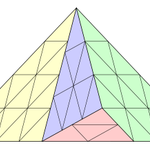
Had a lot of fun recently with Michael Beeson and our AI agents on solving the following problem:
A triangle is cut into a prime number P of congruent triangles iff P = 2, P = 3, or P ≡ 1 (mod 4).
By Fermat's Christmas Theorem, primes P ≡ 1 (mod 4) can be written as sums of two squares, e.g., 13 = 9 + 4.


Tiling a triangle into a prime number of congruent triangles paper: arxiv.org/pdf/2607.23453
1/6 @sgl_project is one of the most widely used LLM inference servers. We wrote 200+ properties it must always satisfy, from its docs, comments and code. Then searched for runs that break them.
Found 10 issues; several under private disclosure, the public ones below. 🧵
5/6 The higher-severity ones, including one-request "whole server goes down" crashes, are under coordinated disclosure with the maintainers via private advisories.
We'll post specifics as the fixes land. 🔒
6/6 Each issue is a counterexample to one of those properties, reproduced on a real SGLang server.
Prove code and find bugs yourself with
intentcomputing.org/
The next 2 years will get heated for cybersecurity. And I keep asking myself: how do we ship code fast at the speed of AI, yet reliably without having to check the code manually?
My research group built a dashboard to keep track of the state of the software stack.
It has two modes:
🌑 Dark: tracking all the latest incidents (76 code-flaw incidents in the last 13 weeks)
☀️ Light: tracking how much of our software is verified (it's small but growing)
Updated daily. Tell us what we missed and contribute.
stackstate.ai

1/4 A single 23-character command can freeze an entire Redis (@Redisinc, @antirez) server.
Redis and Valkey (@valkey_io) run much of the internet’s caching, queues, and sessions. We pointed our AI-powered formal verification kit at both: extract the intent, formalize the properties and invariants, then find and verify counterexamples.
It surfaced real, reproducible bugs in core software the internet runs on, including several memory-safety issues now under coordinated disclosure. A couple of the public ones below 📷
3/4 Valkey: with I/O threads enabled in cluster mode, a module’s key-extraction callback runs on an I/O thread instead of the main thread. That callback opens a module execution unit and touches state meant to be modified only from the main thread, so the two threads race on it. Confirmed with ThreadSanitizer.
github.com/valkey-io/valkey/…

4/4 Infrastructure this widely trusted deserves more than tests and luck. Specifying what software must guarantee, then mechanically hunting for violations, finds real, reproducible bugs in the systems the internet runs on.
This is what we are building at intentcomputing.org.
Grigore Rosu retweeted

Privacy can be thought of as a security property. It has to designed in, not bolted on.
The @Logos_network team stopped by to discuss the protocol design choices behind their L1 stack for anonymous, censorship-resistant & decentralized computing.
One area sparked our curiosity: why use a mix network over Tor?
🎙️ Giuliano Mega explains below
Grigore Rosu retweeted
We'll be kicking things off at Meridian this Wednesday with a value-packed chat about debugging Soroban contracts.
If you care about making Stellar safer or want to learn about latest dev tooling, stop by.
And to sweeten the deal, Aellison will trade a pastel de nata for your craziest Soroban bug story!
🗓️ Wednesday, October 28th
📌 Douro Stage at 5:00pm

New paper from my group.
We gave coding agents a formal executable semantics of the language plus check.intentcomputing.org, a kit of proof procedures, then asked them to prove the code they generate correct.
➡️ HumanEval: 164/164 proved, and all passed audit.
➡️ arxiv.org/abs/2609.39022
