

This is the official Twitter presence for Vito Technology, Inc. that developed the night sky app Star Walk! #GoStargazing with #StarWalk #AstronomyApp
Alexandria, VA
Joined January 2009
- Tweets20.2K
- Following444
- Followers40.8K
- Likes6.1K





✨ Venus Meets Spica on November 9!
On November 9, Venus and Spica — the brightest star in the constellation Virgo — will appear just 1°09′ apart. That's roughly the width of your little finger held at arm's length! 👀
🌅 Look toward the eastern horizon before sunrise. Venus will be easy to spot — it shines much brighter than any star nearby! Look for Spica glowing close beside it.
You won't need a telescope or binoculars to enjoy this beautiful pairing, though binoculars may help you spot Spica in the morning twilight.
📸 Note: Spica's brightness has been exaggerated in the image for clarity. In reality, the star will appear much fainter than Venus.
💫 Would you wake up early to catch this celestial duo?
#venus #spica #astronomy #nightsky #starwalk

This is what the Milky Way’s stellar nurseries look like in 3D 🌌
Using data from ESA’s Gaia space telescope, scientists created the most accurate 3D map yet of nearby star-forming regions in our galaxy.
The map is based on observations of about 44 million ordinary stars and 87 massive O-type stars, tracing huge clouds where new stars are born. It extends roughly 4,000 light-years around the Sun, giving us a new way to see the structure of our galactic neighborhood.
Instead of looking at the Milky Way as a flat picture, this visualization lets us actually fly through its stellar nurseries and see how the clouds are arranged in space.
The Milky Way suddenly feels a lot more three-dimensional. ✨
Video Credit: European Space Agency, ESA
A beautiful trio before dawn! 🌙✨
On November 7, the thin crescent Moon will shine near Spica, Virgo's brightest star, with brilliant Venus nearby. Look toward the eastern sky before sunrise! 👀
starwalk.space/news/spica-vi…

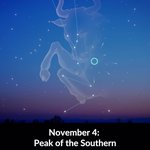
The Southern Taurids peak on November 4–5 🌠
Don’t expect huge numbers — the Southern Taurids provide only about 5–10 meteors/hour, but they are famous for slow, bright meteors and occasional fireballs.
The waning crescent Moon should interfere very little this year. Best time to watch: around local midnight, when Taurus is higher in the sky. And because the Taurids have a broad maximum, nearby nights can still be worth watching if the peak is cloudy.
Learn more about the Taurids:
starwalk.space/news/southern…

Did the Egyptians Hide a Secret in the Great Pyramid? 🏜️
Here's a coincidence that seems almost too perfect to be true!
⚡ Speed of light in a vacuum: 299,792,458 m/s
📍 Latitude passing through the Great Pyramid of Giza: 29.9792458° N
See it? The digits match exactly! 🤯
But does this mean the ancient Egyptians knew the speed of light thousands of years before modern scientists?
Of course not! 😄
📍 First, it's not the pyramid's exact latitude. The Great Pyramid is about 230 meters wide, so many different lines of latitude pass through it. The famous 29.9792458° N line crosses the pyramid slightly north of its center.
🌍 Second, latitude alone doesn't pinpoint a location. The line at 29.9792458° N circles the entire Earth, passing through countless other places. To identify the pyramid's exact location, you'd also need its longitude — which the viral claim conveniently leaves out.
📏 Third, the numbers depend on the units we use. Light travels at exactly 299,792,458 meters per second — but that's about 186,282 miles per second. The numerical match disappears when we switch units. The ancient Egyptians didn't use meters or our modern system of geographic coordinates.
✨ So, no hidden message from an ancient civilization — just a fascinating numerical coincidence!
💬 What do you think? A coincidence or something more? Share your thoughts in the comments!


Bored with the usual stars? 🤔 Try these deep-sky targets in November ✨
Here are four highlights:
❤️ Heart Nebula — a huge emission nebula in Cassiopeia shaped by young, hot stars.
🌀 NGC 1097 — a barred spiral galaxy with a bright core and a ring of intense star formation.
☁️ NGC 1333 — a dusty stellar nursery in Perseus filled with newborn stars.
👁️ Cleopatra’s Eye — a compact blue-green planetary nebula in Eridanus.
For darker skies, aim for the New Moon on November 9.
Explore all 12 November targets:
starwalk.space/news/november…


A cosmic lineup before dawn! 🌙✨
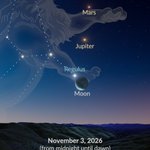
On Nov 3, the Moon passes close to Regulus, with Mars and Jupiter joining the scene. Look up before sunrise! 👀
starwalk.space/news/regulus-…

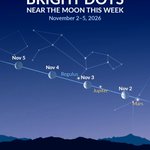
🌙 What’s that bright dot near the Moon?
On the mornings of November 2–4, follow the waning Moon as it passes reddish Mars first, then brilliant Jupiter and Regulus, the brightest star in Leo.
⏰ Head outside about 1–2 hours before sunrise. Jupiter will be the brightest dot in this group, while Mars stands out with its warm reddish color. The view will be higher in the sky at mid-northern latitudes. At mid-southern latitudes, the objects will appear lower, so find a spot with an open horizon.
✨ On November 7, look low in the eastern sky before sunrise for a thinner crescent Moon near dazzling Venus and Spica, Virgo’s brightest star.
In Australia and New Zealand, the Moon will appear closer to Venus on the morning of November 8, but it will sit lower above the horizon. A clear view toward the sunrise will help!
New Moon follows on November 8 or 9, depending on your time zone.
📱 Use Star Walk 2 to identify the bright dots and check when they rise where you live.
Which planet would get you out of bed early? 👇


A giant W, a distant galaxy, and a phoenix in the stars! 🌌
Explore 6 constellations to find in November, from north to south. ✨
starwalk.space/news/november…


Space has its own Halloween decorations. 👻🔭
A ghost, a witch, a skull, and even a witch’s broom — all real objects with wonderfully spooky nicknames.
The Ghost and Witch Head nebulae are clouds of dust illuminated by nearby stars. The Skull Nebula is a shell of gas shed by an aging star, while the Witch’s Broom is debris from a supernova explosion.
Their shapes emerge in astrophotographs. Our imaginations do the rest.
Swipe through — which one looks most like its name? 🧙
Learn more: starwalk.space/halloween-nig…


Space Events in November 2026 🌌✨
🌙 November 2 — Moon near Jupiter and Mars
☄️ November 4 — Southern Taurids peak
🌌 November 6–12 — Four-Galaxy Challenge
Can you spot four galaxies in one night? From the Southern Hemisphere, try finding the Large and Small Magellanic Clouds, our own Milky Way, and the Andromeda Galaxy. The dark skies around the November 9 New Moon make this a perfect time to try!
☄️ November 11 — Northern Taurids peak
🪐 November 13–22 — Four-planet parade
Mercury, Venus, Mars, and Jupiter will line up in the morning sky! Look east before sunrise to spot all four planets.
✨ November 16 — Mars near Jupiter
☄️ November 17 — Leonids peak
One of November’s most famous meteor showers reaches its maximum! The best time to watch is after midnight, when the Moon has set and the sky is darker.
☿ November 20 — Mercury at greatest western elongation
✨ November 22 — Mars, Jupiter, and Regulus
Reddish Mars, bright Jupiter, and bluish-white Regulus will form a compact, nearly isosceles triangle in the constellation Leo, easily visible to the naked eye.
🌕 November 24 — Full Beaver Supermoon
November’s Full Moon will be the first Supermoon since January 2026! It will appear slightly larger and brighter than an average Full Moon. Don't miss it around moonrise, when it can look especially impressive near the horizon.
⭐ November 25 — Moon, Aldebaran, and Betelgeuse
The nearly Full Moon will form a large, nearly equilateral triangle with Aldebaran and Betelgeuse. All three will be bright enough to see with the naked eye, even from a city!
🪐 November 28 — Four Jupiter moons on one side
A special treat for telescope owners! All four of Jupiter’s largest moons — Io, Europa, Ganymede, and Callisto — will appear on the same side of the planet. Use a telescope or good binoculars to catch this beautiful lineup.
🌙 November 29 — Moon and Beehive Cluster
🌙 November 30 — Moon near Jupiter
Save this calendar so you don’t miss the best nights for stargazing! 🔭✨


You Won’t Believe How the Sun Moves Through the Galaxy! ☀️
Earth takes one year to orbit the Sun. The Sun needs about 230 million years to complete one orbit around the center of the Milky Way. That’s one “galactic year.”
At roughly 4.6 billion years old, our star has completed only about 20 of these enormous orbits.
Nothing in space stands still. As the Sun moves around the galaxy, the planets keep orbiting the Sun. Earth’s yearly journey happens within a much larger journey through the Milky Way — both motions happen at the same time.
And the two orbits don’t line up: the plane of Earth’s orbit is tilted by about 60° relative to the galaxy’s disk. The familiar flat diagrams of our Solar System show only part of how we move through space.

🌔 An orange eye. A red supergiant. And the Moon… completing the triangle.
On the night of October 29–30, look for a spooky trio: the waning gibbous Moon, Aldebaran — the fiery eye of Taurus — and Betelgeuse, the orange-red star on Orion’s shoulder. Halloween is getting an early start. 👻
Together, they’ll form a large triangle in the sky. From some locations, the Moon will appear almost equally far from both stars. The shape depends on where you are and when you look.
🔭 No telescope needed — all three are bright enough to spot from a city under clear skies. Look from late evening on October 29 through the predawn hours of October 30, depending on your location.
Open Star Walk 2 to find the trio in your sky. And if you whisper “Betelgeuse” three times… you’re on your own. 😉
#StarWalk #Moon #Stargazing #Halloween2026

🌕 8 Incredible Craters Hiding in Plain Sight!
The Moon may look peaceful from Earth, but its surface tells a story of billions of years of cosmic collisions! ☄️
Let's take a closer look at some of its most fascinating impact craters:
🔸 Tycho (85 km) — Famous for its spectacular bright rays stretching across the lunar surface.
🔸 Copernicus (93 km) — Features impressive terraced walls and towering central peaks.
🔸 Aristarchus (40 km) — One of the brightest spots on the Moon!
🔸 Kepler (29 km) — A relatively small crater surrounded by a striking system of bright rays.
🔸 Plato (101 km) — Known for its smooth, dark floor covered in ancient lava.
🔸 Aristoteles (87 km) — A prominent crater nestled in the Moon's northern highlands.
🔸 Clavius (231 km) — A massive ancient crater with a remarkable chain of smaller craters inside.
🔸 Posidonius (95 km) — Features a fractured floor and a fascinating network of winding grooves.
🔭 Each crater is a window into the Moon's ancient past, preserving evidence of powerful impacts that shaped its surface.
✨ Which of these lunar craters would you love to explore up close?
🤖 Made with AI

Mars, Jupiter & the Beehive Cluster line up ✨
On Oct 26–27, the trio will form an almost straight line across the sky, with Mars nearly halfway between Jupiter and the Beehive Cluster.
🌟 Jupiter: mag −1.9
🔴 Mars: mag 0.9
✨ Beehive Cluster: faint and diffuse, so binoculars will help — especially with the nearly Full Moon nearby.
The lineup spans about 16° and is best seen late at night and before dawn on Oct 27.
Learn how to spot Jupiter in this noble company:
starwalk.space/news/jupiter-…


Halloween's Moon Arrives Early 🌕🎃
On October 26, 2026, the Full Moon lights up the sky, reaching its peak at 04:12 GMT (12:12 AM EDT) — just five days before Halloween!
👻 Did you know that a Full Moon on Halloween is actually pretty rare? Despite what horror movies might suggest, it happens, on average, only once every 19 years! The last Halloween Full Moon was in 2020, and the next one won't arrive until 2039.
🎃 So, no Full Moon on Halloween this year — by October 31, the Moon will already be waning. But at least we get a spectacular lunar show a few days early!
🧡 Want to see the Moon looking extra spooky? Catch it near the horizon around moonrise! It may appear huge and glow orange or red — not because of Halloween magic, but because of an optical illusion and the way Earth's atmosphere scatters light.
Have you ever seen a Full Moon on Halloween? 🌕

The Hunter's Moon Is Almost Here! 🌕🏹
The Full Moon will arrive on October 26, 2026. But you don't have to wait for the exact moment — the Moon will look full and bright from October 25 to 27!
🍂 Why is it called the Hunter's Moon? Traditionally, it's the first Full Moon after the Harvest Moon. In the Northern Hemisphere, this was the time when the harvest was over, fields were cleared, and hunters could use the bright moonlight to spot animals and prepare for winter.
🔺 There's a bonus in the night sky! On October 25–26, the nearly full Moon, Saturn, and the star Algenib will form a large, almost equilateral triangle. Look for bright Saturn near the Moon — spotting Algenib may be trickier because of the moonlight!

🌕 A Moon, a planet, and a star… can you connect the dots?
Around October 25, the almost full Moon will team up with Saturn and Algenib, a star in Pegasus, to form a giant triangle in the night sky!
📐 Each side will span roughly 15° — about one and a half fists held at arm’s length. That’s too wide for a typical binocular or telescope view, so enjoy the whole pattern with the naked eye.
🌏 Observers in New Zealand and parts of the South Pacific will get an especially neat view: the triangle’s three sides will be almost equal! From other locations, it may look slightly stretched. Its shape depends on where you are and when you look.
✨ Start with the Moon, then look for Saturn and Algenib. Algenib is the faintest of the three, so moonlight and city lights can make it harder to spot.
📱 Use Star Walk 2 to find the objects in your sky and see how the triangle looks from your location.
