

Pursuing trade and economic policies that put the American economy, the American worker, and our national security first.
🇺🇸
Joined January 2021
- Tweets1.5K
- Following45
- Followers121K
- Likes1.3K


Pinned Tweet
For decades, foreign governments have created, sustained, or contributed to structural excess capacity and production by pursuing industrial strategies built on wage suppression, illegal subsidies, non-market inputs, and other market-distorting practices.
Today, after lengthy investigations, Ambassador Greer has determined that the acts, policies, and practices of various economies designed to artificially support manufacturing exports are unreasonable and burden or restrict U.S. commerce and has proposed responsive action.
To submit public comments regarding today’s proposed action, click here: ustr.gov/about/policy-office…

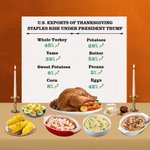
President Trump’s trade deals have delivered new market opportunities for American farmers and ranchers, covering a wide range of Thanksgiving staples from turkey and potatoes to pecans and corn.
Thank you to our hardworking farmers for feeding families from coast to coast and across the globe!

This year, President Trump successfully lowered trade barriers and opened new markets for American farmers, ranchers, and food manufacturers, including for the key ingredients that go into making Pumpkin Pie.

For decades, foreign governments have used a combination of industrial subsidies, wage suppression, export targeting plans, non-market economy inputs, and other market-distorting policies to boost domestic production untethered from market demand.
President Trump is proposing targeted tariffs to correct this problem and ensure a level playing for American workers.
With Section 301, President Trump is going country-by-country to eliminate the acts, policies, and practices that reduce U.S. industrial competitiveness and undermine our manufacturing workers.
Today, Ambassador Jamieson Greer invited public comment on a proposed modification to the Section 301 action regarding Brazil’s unreasonable acts, policies, and practices.
The proposed modification would provide greater leverage to obtain the elimination of Brazil’s harmful trade practices and strengthen the competitiveness of American farmers, workers, and businesses.
ustr.gov/about/policy-office…

Traveling across Arizona, Ambassador Goettman toured local copper and zinc mines, copper smelting and refinery facilities, and a micro steel mill. The ongoing investment in mines and American workers is reviving communities and showing how domestic critical mineral production reinforces U.S. national security and supply chains.
At the southern border, Ambassador Goettman toured the Mariposa Port of Entry and met with senior U.S. officials to discuss how strong border security and trade enforcement can strengthen our trade relationship with Mexico.


President Trump is securing trade deals covering nearly 40% of global GDP, advancing the long-term prosperity of the American people.
American First trade is unlocking new market access for American farmers, with corn and dairy exports up by double-digits in 2025 compared to 2024.
The Trump Administration continues to pursue fair and balanced trade with China, ensuring compliance of past commitments while unlocking greater market access for American farmers, workers, and manufacturers.
Since 1978, the OECD Steel Committee has served as a critical platform for governments, steel workers, and steel producers to discuss the challenges facing the global steel industry and identify collective solutions that ensure the long-term viability of market-oriented producers.
This week, the Steel Committee held its 100th meeting at the OECD, and USTR led the U.S. delegation with government, industry, and labor representatives.
The Trump Administration will continue working with Steel Committee members to address the adverse effects of global excess capacity, secure industrial supply chains, and ensure our steel workers and producers can compete on a level playing field.
Learn more: oecd.org/en/about/news/speec…

For nearly a century, the U.S. has banned imports made with forced labor. @POTUS is using the economic tools at his disposal to hold our trading partners to the same standard.
Watch Ambassador Greer’s virtual remarks to the @RBAllianceOrg’s Annual Conference on how the Trump Administration is eradicating forced labor from global supply chains and unlocking market access for American workers and businesses:
Thanks to President Trump’s dealmaking, Thailand will eliminate tariffs on 99% of goods and unlock market access for a full range of U.S. industrial and agricultural exports.
Thailand is now the 15th trading partner to accept U.S.-manufactured vehicles built to meet our safety and emissions standards.

President Trump Participates in a U.S.-Thai Trade Deal Signing xitter.gq/i/broadcasts/2evOBEqAY…

📰: "The manufacturing sector in the US is having a renaissance, not just in terms of output but more recently jobs."
@POTUS' economic and trade program is fast-tracking America's reindustrialization as companies continue to reshore jobs and expand their manufacturing footprint on U.S. soil.
Read in @FT: ft.com/content/ed1a39b6-15fc…


While the so-called “experts” continue to doubt the effectiveness of the America First trade agenda, the results speak for themselves:
🖊️ Signing trade deals covering nearly 40% of global GDP
💸 Marking fastest pace of U.S. economic growth in a year during Q3 2026
📈 Reaching all-time highs for U.S. exports in 2026
💰 Securing trillions in new investment on U.S. soil
🏗️ Delivering 10 straight months of manufacturing expansion
Read Ambassador Greer’s letter to the editor of the @WSJ dismantling false claims and outlining the strong economic gains fueled by @POTUS’ tariff and trade agenda: ustr.gov/about/policy-office…

Today, the Office of the U.S. Trade Representative, alongside the @USTreasury, held the first official U.S.-China Board of Trade meeting with our Chinese counterparts.
The Trump Administration looks forward to continuing our engagement with China as we work to establish fair and balanced trade between the two largest economies in the world.
The Trump Administration is establishing a U.S.-China Board of Trade to optimize bilateral trade in non-sensitive products and deliver results for American farmers, ranchers, fisherman, small businesses, manufacturers, and workers.
While robust tariffs remain in place to combat China’s unfair trading practices and defend U.S. interests, going forward, seeking balanced trade with China in key sectors and products can bring stability to this economic relationship.
Learn more about submitting public comments regarding the development of the U.S.-China Board of Trade and this new phase of U.S.-China trade relations: ustr.gov/about/policy-office…

President Trump will continue to use the economic tools at his disposal to defend domestic industries and workers.
Since the agency’s inception in 1963, nearly half of all U.S. Trade Representatives have been proud veterans of the U.S. military.
As a U.S. Air Force veteran, I am honored to carry on that legacy as the Trump Administration works to strengthen our industrial base and safeguard our economic sovereignty and national security.