

Rubin will #CaptureTheCosmos in exquisite detail starting in 2026 🌌 Funded by @NSF and @DOEScience. Para español: https://xitter.gq/t.co/JXSHsXeBwQ
- Tweets3.3K
- Following367
- Followers26.1K
- Likes1.5K




ALT Panoramic night sky with the Milky Way arching over a mountaintop observatory, with two nearby galaxies glowing at left.

ALT Dense star field with blue and orange stars, faint nebulae, and Carl Sagan quote: “Somewhere, something incredible is waiting to be known.”

ALT Colorful nebula and star field in pink, blue, and black, overlaid with the quote: “We are the universe experiencing itself.” —Carl Sagan

ALT Dense star field with bright blue stars and a Carl Sagan quote: “We are made of star-stuff. We are a way for the universe to know itself.”

ALT Star-filled deep-space image with faint interstellar clouds and countless distant galaxies. A Carl Sagan quote is overlaid: "That we understand even a little of our origins is one of the great triumphs of human insight and courage."

ALT Milky Way and starry sky seen through the open shutter of a telescope dome, with the dark interior framing the view.

ALT Milky Way and starry sky seen through the open shutter of a telescope dome, with the dark interior framing the view.

ALT Tiny-planet night panorama of an observatory under the Milky Way, with dense stars, glowing nebulae, and a faint green airglow.

ALT View from a corrugated metal roof over dry, rugged mountains and winding roads beneath a clear blue sky.

ALT Deep-space image filled with colorful galaxies; a dense orange galaxy cluster glows near the center against a black starry background. A blue ribbon-like galaxy weaves around the lower left edge of the cluster, stretched and warped by its gravity.

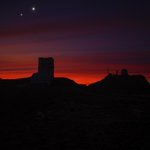
ALT Silhouetted observatory buildings on a mountain ridge at dusk beneath a orange and purple sky, with two bright planets above.

ALT Solar system diagram over a background of stars showing the orbits of Jupiter, Saturn, Uranus and Neptune as small blue rings, with a large teal elliptical arc highlighting the distant orbit of dwarf-planet candidate 2026 ED138.


ALT A close-up view of billowing cosmic gas clouds in soft peach-pink and powdery sky-blue. Near the upper center, warm pink gas meets cool blue mist, sliced by a jagged, snaking column of dark dust like a tear in the cloud. The lower half settles into textured, dusky blue and charcoal dust. Several bright, ice-blue stars surrounded by soft halos and a dusting of fine pinpoint stars sparkle across the velvety, glowing mist.

ALT Deep-space view packed with colorful distant galaxies, centered on a bright, distorted spiral galaxy pair in collision.

ALT Wide star field packed with stars and distant galaxies, crossed by faint dusty bands; a tiny object near the top is boxed in white.

ALT Wide starfield with pink and blue nebulae, including the Lagoon and Trifid Nebulae, with three white numbered boxes marking regions.

ALT Colorful nebula in a dense star field, with a glowing pink core, blue gas clouds, and dark dust lanes branching outward.

ALT Pink and white glowing nebula filled with stars, with wispy gas clouds and dark dust lanes swirling across space.

ALT Pink and blue nebula clouds fill a star-dense sky, threaded with dark dust lanes and scattered bright stars.

ALT A stunning night sky showcasing the vibrant, colorful Milky Way galaxy arching above a boot-shaped observatory on a hill, with countless stars and cosmic dust visible in the clear atmosphere.

ALT Vast star field with numerous bright stars and distant galaxies of various shapes, sizes, and colors. On the left, a ghostly haze of galactic cirrus drifts like cotton candy.

ALT A wide, panoramic view of a dense field of countless tiny, pinpoint stars filling the entire frame like fine dust. Wispy, faint, grayish-brown clouds of galactic cirrus drift across the scene, creating a patchy texture over the dark background. Several brighter stars stand out across the field, most notably a large blue star on the upper right surrounded by a glowing halo, along with a few other scattered blue and orange stars. A white rectangle at upper center highlights a specific area.

ALT Observatory perched atop a rocky mountain with layered hills fading into the distance under a golden sunset sky.

ALT Sunset casting warm orange light over high desert mountains with an observatory perched on a ridge at left.

ALT Rubin Observatory perched atop its mountain summit site on Cerro Pachón. The observatory is boot-shaped at lower left with long white service building extending left and silver dome sticking up. The dome's vertical slit is open, revealing the telescope in the blackness within. The night sky is peppered with the pinpricks of stars. The Little Beehive Cluster of stars is a denser collection of pinpricks to the upper right of the observatory.

ALT Illustration showing smooth ocean air flowing over a mountain, with turbulence forming on the mountain's opposite side. Two insets show the impact of turbulence on an image of a star: without turbulence the star is sharp, while with turbulence it's blurred. Text reads "A site chosen for steady air. Smooth, stable air flows in from the ocean..then gets disrupted by mountains, creating turbulence."

ALT Large observatory with open dome on rocky terrain under a pink and purple twilight sky.

ALT A large boot-shaped observatory on the left and small cylindrical dome on the right, both perched on rocky hills under a vibrant pink and purple sunset sky.

ALT Boot-shaped observatory building against a gradient sky transitioning from orange up to deep purple.

ALT White astronomical observatory dome with closed shutter against a pink and blue twilight sky with pink sunset clouds.