

Product Developer Human Biology, Medicine & Health Technology Host of The Active Site podcast
Joined October 2014
- Tweets3.4K
- Following76
- Followers34.2K
- Likes413




Wall squats lowered the top blood pressure number by 9.5 points, and one session a week kept it 6.6 points below the start.
Inactive adults with a top (systolic) blood pressure between 120 and 140 mmHg, none of them on blood pressure medication, did wall squats at home three times a week for 4 weeks, then were assigned to 3, 2, 1 or no weekly sessions for 4 more weeks. After the first month, systolic pressure was 9.5 mmHg lower than in a control group that did not train. People who kept training three times a week fell further, to 13.7 mmHg below their start. The once-a-week group, who went from 130 to 123 mmHg, stayed 6.6 mmHg down. People who stopped rose back toward the control level, ending 3.9 mmHg below their start, no longer different from people who had never trained. Readings were already drifting upward on one or two sessions a week.
A pooled analysis of 270 earlier trials found isometric holds such as wall squats lowered top blood pressure by 8.2 points, more than aerobic exercise plus weights (6.0), weights alone (4.6), or aerobic exercise (4.5).
Wall squats are a static hold. The muscle contraction raises pressure in the artery for a short bout, and repeated sessions appear to lower resting resistance in the vessels.
The trial had 100 adults, 20 per group, and lasted only 8 weeks. Whether one session a week can hold the benefit for months was not tested.
References
1. Swift HT, et al. BMJ Open Sport Exerc Med. 2026;12(3):e003172.
2. Edwards JJ, et al. Br J Sports Med. 2023;57(20):1317-1326.

Sources:
Swift et al., BMJ Open Sport Exerc Med 2026: doi.org/10.1136/bmjsem-2025-…
Edwards et al., Br J Sports Med 2023: doi.org/10.1136/bjsports-202…
doi.org/10.1136/bmjsem-2025-…

362
Each weekly serving of seafood in pregnancy went with a 25% lower chance of a baby having both colic and eczema.
Mothers in Massachusetts reported their diet early and midway through pregnancy. At about 6 months they reported colic symptoms, an eczema diagnosis, or both in the baby. Among 1,324 mother-infant pairs, 61 babies, 4.6%, had both. Average seafood intake was 1.6 servings a week. Before any adjustment, 5.9% of babies in the lowest quarter of seafood intake had both, against 2.7% in the highest quarter. After adjustment, each weekly serving of fish and shellfish went with 25% lower chance of the pair. Each step up on a Mediterranean diet score went with a 15% lower chance. Colic alone and eczema alone did not move, and nuts, dairy and eggs were flat for the combined outcome.
US advice already favors low-mercury fish in pregnancy, and this pattern fits that advice without proving it.
A possible reason is that seafood and a Mediterranean-style pattern supply long-chain omega-3 fats and other anti-inflammatory foods at a time when the infant immune system is being set. The fact that only the combined outcome moved may mean this pattern marks a more allergy-linked form of colic, not ordinary crying.
This was observational. Diet and infant outcomes were reported by mothers, and people who eat more fish differ in other ways that statistics may not fully remove.
References
1. Oken E, et al. JAMA Netw Open. 2026;9(10):e2638472.

Sources:
Oken et al., JAMA Netw Open 2026: doi.org/10.1001/jamanetworko…

Driving LDL near 40 shrank soft artery plaque in 51 of 52 patients.
Adults with newly found coronary disease who had never taken a statin were randomly assigned to atorvastatin 40 mg, or to rosuvastatin 40 mg plus ezetimibe 10 mg, and had CT scans of the whole coronary tree for 18 months. Soft plaque shrank on both regimens, and it shrank in 98% of patients on the pair (51 of 52), against 77% on atorvastatin alone (39 of 51). Average soft-plaque volume fell 28.2% when LDL dropped 65%, to 42.5 mg/dL, and 20.0% when LDL dropped 38%, to 69.5 mg/dL. The lower a person's LDL went, the more soft plaque shrank. Hard, calcified plaque grew about the same in both groups.
This was a secondary analysis of 104 patients, about 4 in 5 of them men. The scans measured plaque. Whether the extra shrinkage means fewer heart attacks was not tested.
A likely reason is that soft plaque is mostly lipid. When LDL in the blood falls far enough, that lipid can leave the wall faster than it is deposited, so the soft volume shrinks even as some of what remains hardens.
Both drugs were high-intensity regimens, so the comparison cannot isolate the statin from ezetimibe. The finding applies to people starting treatment with early, stable disease, not to everyone with long-standing atherosclerosis.
References
1. Mortensen MB, et al. JAMA Cardiol. 2026.

Sources:
Mortensen et al., JAMA Cardiol 2026: doi.org/10.1001/jamacardio.2…

After 65, about 60 minutes of brisk activity a week went with a 20% lower risk of coronary heart disease, a drop that took 330 minutes a week in people under 65.
More than 80,000 UK adults wore a wrist tracker for a week and were followed for a median of almost eight years, during which 3,764 developed coronary heart disease. Meeting the 150-minute weekly guideline went with 28% lower risk in people 65 and older, against 15% in those younger. Older adults who packed their activity into one or two days, the so-called weekend warriors, had 28% lower risk, similar to those active through the week, while the pattern was weaker and not significant in midlife. Older adults also reached a given benefit at about half the movement intensity.
This fits an earlier analysis of the same UK cohort, which found that weekend-warrior activity lowered heart attack risk about as much as spreading it through the week.
A likely reason is the starting point. Fitness and muscle fall with age, so the same walk is a bigger relative effort at 70 than at 45, and a bigger stimulus for the heart and blood vessels.
This was observational, and older adults who stay active may already be healthier in ways the tracker cannot see. One week of tracking stood in for years of habits. In older adults the benefit curve may have bent back at very high volumes, so more was not always better.
References
1. Chen J, et al. J Am Heart Assoc. 2026:e052019.
2. Khurshid S, et al. JAMA. 2023;330(3):247-252.

Sources:
Chen et al., J Am Heart Assoc 2026: doi.org/10.1161/JAHA.126.052…
Khurshid et al., JAMA 2023: doi.org/10.1001/jama.2023.10…

387
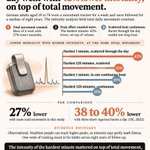
People whose single hardest minute of movement each day was more intense had 42% lower mortality, even after accounting for how much they moved in total.
More than 65,000 German adults aged 19 to 74 wore a hip movement tracker and were followed for a median of eight years, during which 1,634 died. More total movement went with 27% lower mortality. On top of that, the intensity of the most active minutes of the day mattered, and the shorter the window, the stronger the link: 42% lower mortality for the hardest single minute, against 31% for the hardest two hours. When those minutes had to come in one continuous bout, the links were weaker, 29% and 17%, so scattered bursts through the day tracked better than one long session.
This echoes a UK tracker study in people who did no formal exercise, where about three short vigorous bursts a day, such as fast stair climbing or hurried walking, went with 38 to 40% lower mortality.
A possible mechanism is that short, hard efforts push the heart, lungs and muscles close to their limits, which is the signal that builds aerobic fitness, one of the strongest predictors of how long people live.
This was observational. Healthier, fitter people can reach higher peaks, so peak intensity may partly be a marker of fitness rather than a cause of it. One week of tracking stood in for habits across eight years, and the pattern differed by how much people moved overall.
References
1. Fromherz P, et al. BMC Med. 2026;24(1):636.
2. Stamatakis E, et al. Nat Med. 2022;28(12):2521-2529.

Sources:
Fromherz et al., BMC Med 2026: doi.org/10.1186/s12916-026-0…
Stamatakis et al., Nat Med 2022: doi.org/10.1038/s41591-022-0…

1
347
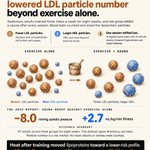
Adding 15 minutes in a sauna after each workout cut LDL particles more than eight weeks of exercise alone did.
In a trial, 47 sedentary adults who did not use saunas were randomly assigned to exercise three times a week, the same exercise followed by a 15-minute sauna, or no change. Blood tests counted and sized lipoprotein particles. Compared with exercise alone, the sauna group ended with fewer LDL particles, a lower LDL concentration, fewer of the triglyceride-rich VLDL particles, and larger HDL particles. In a separate group of regular sauna users, a single 30-minute session lowered triglycerides and raised ketones afterward.
An earlier report from the same trial found that the sauna group's top blood pressure number was 8 points lower than the exercise-only group's, and their fitness was higher on a treadmill oxygen test. Long-running Finnish cohorts have linked frequent sauna use with fewer deaths from heart disease.
A possible mechanism is heat stress acting like extra exercise. Heat raises heart rate and blood flow, triggers heat-shock proteins, and pushes the body to burn more fat, which may speed clearance of triglyceride-rich particles that later become LDL.
The trial was small, and the new report says which way each marker moved but not by how much. Particle number is a risk marker, and no heart attacks or strokes were counted. Saunas are not advised for people with unstable heart disease or very low blood pressure without medical advice.
References
1. Laukkanen JA, et al. Mayo Clin Proc. 2026. Published online November 12, 2026.
2. Lee E, et al. Am J Physiol Regul Integr Comp Physiol. 2022;323(3):R289-R299.
3. Laukkanen T, et al. JAMA Intern Med. 2015;175(4):542-548.

Sources:
Laukkanen et al., Mayo Clin Proc 2026: doi.org/10.1016/j.mayocp.202…
Lee et al., Am J Physiol Regul Integr Comp Physiol 2022: doi.org/10.1152/ajpregu.0007…
Laukkanen et al., JAMA Intern Med 2015: doi.org/10.1001/jamainternme…
doi.org/10.1016/j.mayocp.202…
471
Arginine in your diet may decide whether your immune system can see cancer.
Cells display fragments of what is inside them on a surface protein called MHC class I, and killer T cells read that display to find cells that are infected or turning cancerous. Arginine, an amino acid found in meat, fish, dairy, nuts and beans, often runs low inside tumors and during infections. In cells, low arginine cut MHC class I production. In mice, an arginine-poor diet led to more colon tumors and weaker defense against influenza and SARS-CoV-2, while extra dietary arginine raised MHC class I levels, reduced tumors and improved infection outcomes.
The mechanism is unusually specific. The genes for MHC class I lean on arginine codons that depend on a small set of transfer RNAs, and when arginine runs short those transfer RNAs drop, so cells stop building the protein. Changing those codons without changing the protein removed the effect, and the benefit disappeared in mice unable to put MHC class I on their surface.
This builds on earlier work showing that higher arginine helps T cells survive longer and fight tumors better in mice.
All of this is cells and mice. Whether arginine works this way in people has not been tested, and tumors can also feed on amino acids, so this is a reason for human trials, not a reason to start taking arginine.
References
1. Wu Q, et al. Cell. 2026;189(19):6012-6023.
2. Geiger R, et al. Cell. 2016;167(3):829-842.

Sources:
Wu et al., Cell 2026: doi.org/10.1016/j.cell.2026.…
Geiger et al., Cell 2016: doi.org/10.1016/j.cell.2016.…
doi.org/10.1016/j.cell.2026.…
GLP-1 drugs prevented type 2 diabetes about a third better than metformin.
In adults with prediabetes and obesity, starting a GLP-1 drug instead of metformin went with a 31% lower risk of type 2 diabetes over about three years. The study, a conference abstract presented this month and not yet peer reviewed, used health records from 104 institutions. About 128,000 people who started a GLP-1 drug were matched with the same number who started metformin, on age, health conditions, medications and lab values. Over follow-up, 25.1% of the GLP-1 group developed diabetes against 37.0% on metformin, and the GLP-1 group was about 1.5 times as likely to return to normal blood sugar. Heart failure, stroke, heart attack and atrial fibrillation were all less common, and deaths from any cause were 41% lower.
For context, the landmark 2002 prevention trial found metformin cut new diabetes by 31% against placebo, and an intensive lifestyle program cut it by 58%.
The likely mechanism is weight. GLP-1 drugs mimic a gut hormone that curbs appetite, slows stomach emptying and boosts insulin release after meals, and they usually cause far more weight loss than metformin, which mainly reduces glucose output from the liver.
The size of the death gap is a warning sign. In a large randomized trial of semaglutide in people with heart disease, deaths from any cause were 19% lower, so a 41% gap here suggests the groups differed in ways the matching missed, such as insurance, access or overall health. The records did not show dose or whether people kept taking the drugs, and diagnoses came from billing codes. Only a randomized trial can settle this.
References
1. Serra VDSB, et al. Circulation. 2026;154(suppl 1):8911.
2. Knowler WC, et al. N Engl J Med. 2002;346(6):393-403.
3. Lincoff AM, et al. N Engl J Med. 2023;389(24):2221-2232.

Sources:
Serra et al., AHA Scientific Sessions 2026 (Circulation suppl): doi.org/10.1161/circ.154.sup…
Knowler et al., N Engl J Med 2002: doi.org/10.1056/NEJMoa012512
Lincoff et al., N Engl J Med 2023: doi.org/10.1056/NEJMoa230756…
doi.org/10.1161/circ.154.sup…

2
367
Lifting weights eased depression for about two out of three people.
A new pooled analysis of 80 randomized trials covered 6,123 people with an average age of 57, most of them living with an illness. Compared with doing nothing, someone who lifted had about a 65 in 100 chance of ending up less depressed, where 50 in 100 would be a coin toss. Against other active programs such as aerobic exercise, stretching, relaxation or health education, lifting still came out ahead, though the edge was smaller, about 56 in 100. In people with a mental illness, that edge grew to about 61 in 100.
An earlier review of 33 trials reached a similar conclusion in 2018.
Several mechanisms are plausible. Training raises growth factors in the brain, dampens inflammatory signaling, improves sleep, and gives a measurable sense of progress as weights go up. Which of these matters most is not known.
Results varied widely between trials, and nobody can be blinded to whether they are lifting. The most carefully run trials showed a smaller benefit, about 59 in 100. Lifting may help alongside therapy or medication, but it is not a substitute for care in moderate or severe depression.
References
1. O'Sullivan D, et al. JAMA Netw Open. 2026;9(11):e2644254.
2. Gordon BR, et al. JAMA Psychiatry. 2018;75(6):566-576.

Sources:
O'Sullivan et al., JAMA Netw Open 2026: doi.org/10.1001/jamanetworko…
Gordon et al., JAMA Psychiatry 2018: doi.org/10.1001/jamapsychiat…

2
428
A daily drink of three common fibers lowered androgens and restored ovulation in women with PCOS within 12 weeks.
In a Canadian study, women with PCOS ate the same calories as women without it but less fiber, about 20 grams a day against 25, and those eating the least had higher insulin resistance and testosterone. In a trial in Iran, 20 grams a day of a fiber called resistant dextrin for three months lowered free testosterone and made cycles more regular.
A new Science trial from Beijing gave women with PCOS a blend of inulin, resistant starch and beta-glucan or a look-alike placebo drink for 12 weeks. Androgens, the male-type hormones that drive many PCOS symptoms, fell in the fiber group, and ovulation and menstrual cycles improved.
The mechanism runs through the gut. The fiber fed a bacterium called Bacteroides xylanisolvens, which converts the androgen androstenedione into a much weaker compound, and other gut bacteria break that down further. Women with more of this bacterium had lower androgens. The same fibers are in oats, barley, onions, garlic, cooled potatoes and green bananas.
This was one 12-week trial at a single hospital in China, the three fibers were given together, and the bacterium's role was confirmed only in mice.
References
1. Qi X, et al. Science. 2026;394(6824):eaed8952.
2. Cutler DA, et al. Food Sci Nutr. 2019;7(4):1426-1437.
3. Gholizadeh Shamasbi S, et al. Eur J Nutr. 2019;58(2):629-640.

Sources:
Qi et al., Science 2026: doi.org/10.1126/science.aed8…
Cutler et al., Food Sci Nutr 2019: doi.org/10.1002/fsn3.977
Gholizadeh Shamasbi et al., Eur J Nutr 2019: doi.org/10.1007/s00394-018-1…

3
467