

creative technologist x tastemaker | 2x fdr | 1 exit | worked w/10+ teams | writting → https://xitter.gq/t.co/s8rNRpTAFS | altac → @0xDragoonLab | early @0xPolygon
Dubai / SF
Joined February 2022
- Tweets359
- Following709
- Followers44
- Likes399
Dragoon | Deep retweeted

design hiring is broken
finding a good design job has become a full-time job in itself. and honestly, going through it myself has made me realise just how broken design hiring has become.
→ you can spend years building products, working with founders, leading design, building teams, shipping real things, and creating measurable business impact.
→ you can have the experience, the portfolio, the case studies, and the ability to actually make things happen.
→ yet somehow, finding the right opportunity can feel harder than building the products themselves.
→ too many hiring processes seem optimised for filtering people out rather than understanding what they can bring to the table.
→ apparently, your X followers, post impressions, and industry popularity are becoming part of the hiring criteria too. nothing wrong with having an audience, but social media influence isn't a substitute for business impact, actual experience, or the ability to think independently. sometimes the personal brand is doing a lot more heavy lifting than the actual work.
→ too many hiring managers prioritise big company logos on CVs over actual work, problem-solving ability, and independent thinking.
→ endless interview rounds. generic assignments. vague job descriptions. unrealistic expectations. hiring decisions based on keywords, pedigree, or how well someone performs in an interview.
and somewhere along the way, actual design thinking, ownership, judgment, and business impact get lost.
→ then there's ATS filtering, geographical bias, time zone preferences, and hiring systems that can reject experienced people before an actual human ever looks at their work.
→ somehow, where you live, which companies you've worked for, how your CV is formatted, or whether you match an arbitrary checklist can carry more weight than what you've actually built.
and perhaps the biggest problem is the lack of human judgment.
a portfolio is more than a collection of polished screens. a CV is more than a list of keywords. experience is more than years spent at recognisable companies.
understanding someone's thinking, taste, ownership, adaptability, and ability to solve problems takes actual judgment. no automated filter or standardised interview process can fully replace that.
i'm not looking for just another job title or a place to fill a seat.
i want to work with people who care about what they're building.
→ teams that value design as a business advantage, not a service department.
→ founders who understand the importance of product thinking and creative judgment.
→ people who trust designers with ownership instead of micromanaging every decision.
→ ambitious products solving meaningful problems.
environments where craft, strategy, and execution actually matter.
→ a culture that values good people, independent thinking, and meaningful work.
i've spent years working across web3, fintech, defi, ai, saas, and design-led products. i've helped build products from zero, shaped brands, led design initiatives, worked closely with founders, and contributed to products with real users and business outcomes.
i know what i bring to the table, and i'm still excited about building what's next.
so yes, i'm open to the right opportunity.
particularly senior product design, design leadership, creative direction, or founding design roles with ambitious teams building in web3, ai, fintech, and technology.
i'm being selective, not because i think i'm above any opportunity, but because the next chapter should be meaningful for both sides.
if you're building something interesting and believe design should have a real seat at the table, i'd genuinely love to connect.
sometimes the right opportunity starts with a conversation. feel free to dm: )
Dragoon | Deep retweeted
this is something i've been very intentional about while building shelf, and it's something i've continued doing throughout every version.
i've stayed deeply involved in every decision. the architecture, every interaction, every pixel, user behaviour, product flows, and even the smallest details.
being close to the entire process has helped me understand patterns, question assumptions, catch friction, and see things that are easy to miss when you're only looking at features.
i've always believed that building a great consumer product requires more than shipping quickly. you need to understand why people behave the way they do and keep translating those observations into better product decisions.
that's how i've been building Shelf, and that's exactly how i intend to keep building it.
try shelf → getshelf.company


When you’re building a consumer app, you need near photographic memory of every decision, every pixel on the app, and every data trend.
If you delegate key design decisions, you will not be able to understand when new patterns emerge at a sufficient speed to iterate and react to user needs. And you also won’t be able to explain those decisions in any defensible way to regulators, users, and the media.
The world moves fast; you need to move faster.
Dragoon | Deep retweeted
i'm a little late to sharing this, but i've been running neura since 2025.
sharing a look into the brand strategy, identity, creative direction, work and experimentation behind neura.
you might not know it, but i've been behind quite a few viral experiments, trends and creative pieces you've probably come across. some travelled far beyond what i expected. i never really cared about the attention or making them about me. the work and the exploration always mattered more.
neura is an extension of that curiosity.
i've been exploring ai with pretty much every model, experimenting with different workflows, and building a personal library of creative images, visual directions and ideas along the way.
i've already shared a few things on the website, but there's a lot more sitting in my personal library. i'll be sharing more of those experiments, explorations and creative work soon.
in the meantime, visit neura.consulting to explore our work and more.
RT @0xDragoonLab: i know a few people on this list. i respect their work, and this isn't personal. but there's a larger conversation here t…
This quoted post is unavailable.
Dragoon | Deep retweeted
we don't need more tools to make more things. we need the imagination to create what doesn't exist yet. that's what mainarc is about: expanding human creativity, challenging what's possible, and shaping what comes next.

Dragoon | Deep retweeted
there are only a handful of genuine founders left in crypto.
people who actually believe in what they're building, care about their users, stand by their values, and give a damn about the culture they're creating.
the rest have turned founding into a game of extracting grants, raising funds, chasing incentives, and finding increasingly creative ways to run away once the money dries up.
some of the things happening behind closed doors are beyond what you'd imagine.
crypto doesn't have a shortage of capital, narratives, or opportunities.
it has a shortage of leaders / founders / people with principles.
Dragoon | Deep retweeted
i play tennis regularly, watch way too much tennis, and apparently now build tennis games too.
had this idea and decided to vibe-code it with @claudeai, a little experiment born out of my love for the sport.
built to serve aces, not server bills. 🎾
Dragoon | Deep retweeted
building shelf is making me think about product design in a completely different way.
one of the most interesting parts of building Shelf isn't just building and shipping features. it's understanding why people do what they do and designing around that.
i spend a ridiculous amount of time thinking about small human behaviours. why do people take screenshots rather than save the links?
why do we save things we never go back to?
why do we remember the context of something and forget its name?
why do we abandon systems that were designed to make us more productive?
and why do so many products just expect you to change your behaviour in order to use them?
these questions in turn govern the way i approach almost every decision on shelf.
i don't want to design a workflow for an ideal user. i want to understand how real people behave when they're busy, when they're distracted, when they're curious, when they're overwhelmed and when they just plain don't want to think about another app.
that's where psychology becomes part of product design. i also think creative thinking is very much misunderstood in software.
it's not just about coming up with odd interfaces or adding in some clever interaction. it's finding a different way to deal with an existing problem.
sometimes that means introducing a new interaction. sometimes it means removing an entire step. sometimes it means challenging an assumption that everyone else has just accepted for years.
my process normally starts with the questions rather than the features.
i look at the behaviour, map out the underlying problem, challenge the obvious solution, play around with various approaches and then go through the architecture, the interactions, the edge cases and the details.
i'm constantly moving between the big picture and the smallest interaction. because a great product isn't the product of one brilliant idea. it's the product of hundreds of decisions.
that's what i'm enjoying most about building shelf.
thinking like a designer, questioning like a researcher, approaching problems like a product person and building like an engineer.
i don't want shelf to be technically impressive in any way but behaviourally disconnected. i want the technology, the psychology and the experience to feel like one coherent product.
the aim isn't to get people to understand the software better. it's to get the software to understand people better.
that's the kind of product thinking i'd like to keep exploring with shelf.
try it here → getshelf.company
Dragoon | Deep retweeted
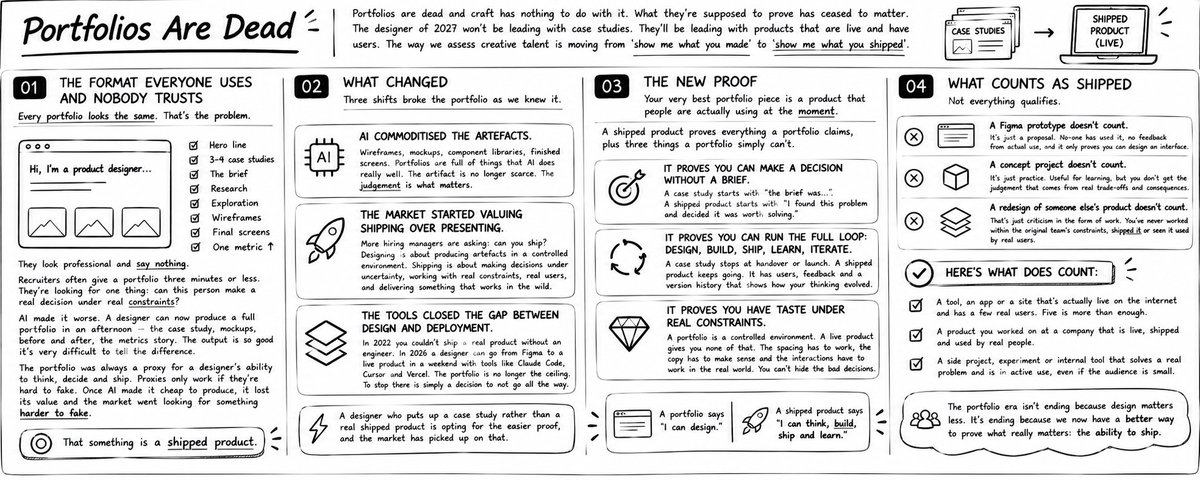
design is moving beyond the canvas.
i've been exploring this shift through gridform, mainarc and shelf. building products has become a much bigger part of my design practice.
the interesting part isn't that ai can generate interfaces or write code. it's that it expands what a designer can take responsibility for.
from identifying the problem to shaping the system, directing intelligence and shipping the experience.
i think we're entering an era where designers won't just shape the interface of a product. they'll have a much bigger role in shaping the product itself.
worth reading.


Dragoon | Deep retweeted
i've always been fascinated by the idea of an arc.
everything has one. an idea, a person, a piece of art, a civilization, a company. nothing meaningful exists in isolation. everything is part of a larger movement, shaped by the things that came before it and the things yet to come.
what interests me is not just the individual pieces, but the invisible connections between them. the patterns, the contradictions, the decisions, and the moments that change the direction of everything.
that's where the name mainarc comes from.
the main arc is the bigger story. the one you don't always see when you're too close to the details.
i'm building mainarc around this idea. exploring the relationship between intelligence, creativity, technology, human judgment, and how we think about the future.
because creating has never just been about making things. it's about seeing possibilities that don't exist yet, deciding which ones matter, and having the conviction to bring them into existence.
perhaps the most interesting work isn't creating something new, but understanding how everything connects to what comes next.
mainarc.xyz/

Dragoon | Deep retweeted
builderlab is rethinking how organizations operate with intelligence.
as i'm building mainarc ( mainarc.xyz ), i'm exploring the other side of this shift: how organizations think, create, and make decisions with intelligence.
the future of work isn't about giving people more ai tools. it's about redesigning how people, intelligence, and systems work together.
we're moving from using ai to building organizations around intelligence.

Bring your business into the conversation with Builderlab, built on @buzzdotxyz.
Join the chat: block.xyz/inside/builderlab-…


Dragoon | Deep retweeted
i'm building gridform ( gridform.app ) as an agentic creative studio that can help you with a lot of things, but this is exactly one of the directions i'm pushing it toward.
a space where you, your AI agents, and your team can think, explore, collaborate, and create together.
not just making design faster, but rethinking how creative work gets done.
also, really appreciate the work from @jsngr and @vinvan . i'm currently using @usewonder, and the @aibek_design team is doing some great work in this space.
exciting times for creative software.
try it here: gridform.app


we design and build @mainframe inside of Mainframe
here's our full frontend and backend running on our canvas
Dragoon | Deep retweeted
trust isn’t a feature. it’s the foundation of shelf.
i think a lot about how much a person should trust the software they give their memories to.
personal screenshots. private conversations. financial information. unfinished ideas. work documents. photos.
over time, shelf could hold an intimate picture of someone’s life. that’s a responsibility i don’t take lightly.
privacy shouldn’t be bolted on after the features are built. it should shape the architecture, infrastructure, data model, and product decisions from day one.
that’s why i believe in building shelf local-first.
your memories should live on your machine. your personal information shouldn’t become someone else’s business. and using ai shouldn’t automatically mean sending everything to a remote server.
i don’t want people to pay for a product with their data just because they aren’t paying with money.
there’s a difference between building something intelligent and building something that knows too much about its users without giving them control.
i want shelf to become smarter, but never at the expense of privacy.
software is moving toward understanding more about us than ever before. but just because technology can access something doesn’t mean it should.
sometimes the best product decision is not collecting something in the first place.
sometimes it’s keeping processing on-device.
sometimes it’s giving people control, instead of another permission screen. intelligence without trust is just surveillance with a better interface.
i want people to save things in shelf without wondering where their data is going, who’s processing it, or what they’re unknowingly giving away.
personal memory is deeply personal.
if i’m asking people to trust shelf with pieces of their lives, protecting those pieces is part of the product itself.
not a marketing claim. not a checkbox. not a feature on the roadmap. trust is the foundation everything else in shelf has to earn.
download and try shelf → getshelf.company
Dragoon | Deep retweeted
unilend finance / archived · 0→1 brand design, product design, creative design ops.
Dragoon | Deep retweeted
hubble exchange / archived · 0→1 brand design, product design, creative design ops & art direction.
