

doing superintelligence research in public researching @spc, previously @yutori_ai | the greatest art is yet to be created
San Francisco, CA
Joined December 2013
- Tweets3.6K
- Following734
- Followers1.3K
- Likes14.2K






Pinned Tweet
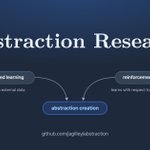
Today, I'm making my superintelligence research project of 9 months fully public and freely available on GitHub.
The program is built around "abstraction creation" as a capability which current AI models lack. Current models learn by forming representations which explain the data (supervised learning) or forming representations which are rewarded by an external verifier (reinforcement learning.) In contrast, biological learners have the capability of creating new candidate abstractions and evaluating them with respect to the beliefs they currently hold, then slowly integrating the new abstractions into their worldview. That's what I'm working on.
I think AI models' lack of this capability explains many of their known limitations. They generalize worse than humans, because they learn representations with respect to "what fits the data/verifier" rather than "what representations generalize." They're good at coding, because coding doesn't require the invention of new abstractions, but bad at writing, because the point of writing is to define a new abstraction and tell people about it. They're superhuman at some games, like Go, but still have weird vulnerabilities, because their policies only cover states which were seen.
This research is inspired by how the human/mammalian brain works. I owe a lot to the many incredible neuroscientists who make their work public! In light of this, and the fact that human neuroanatomy is everyone's collective intellectual property (quite literally), it seems appropriate to make this work public.
I'll be pursuing a "build in public" strategy going forward, with weekly updates on new experiments I've run, whether the results are positive or negative. I hope you'll follow along! If you'd like to work on superintelligence with me, please reach out :)

3
25
1,192
Here's the shape of what I believe this clever new method should be:
"Frontier learning" means data-limited learning by definition, since a frontier problem is one for which no supervision data yet exists.
In lieu of supervision, models need to try things for themselves and see if they work. This is RL, or a variant thereof.
Note that the shape of RL-flavored data-efficient learning is not really "learn more sample-efficiently from the same supervision". You don't have any supervision. So instead, you need to form hypotheses about the world and test them. If your hypothesis is empirically true — congratulations, you've created new frontier knowledge.
Another term for an "empirically-validated hypothesis about a data distribution" is a "feature", or an "abstraction". That's why I've bet on "abstraction creation" as the focal point of my superintelligence research. Create explicit latent hypotheses, test them, keep the ones that are true :)

Brute force computation is not enough for intelligence. Clever new methods are needed. The science of AI is far from finished. IMHO
1
2
337
inb4 "not bitter lesson pilled": the bitter lesson is about search and learning, not just learning. the above loop makes search explicit and serializable, rather than needing model scaling to do search implicitly. model scaling is actually not really bitter lesson pilled bc it restricts you to a fixed hypothesis space/search space
2
42
Today I'm releasing a new dataset of tasks intended for pretraining on ARC-AGI. It's the first of its kind to combine two properties:
- a synthetic data generator for ~unlimited data
- an exact measurement of each task's difficulty
I explain why this combo is important below ⬇️
4
42
1,593
Pre-ARC also comes with a handy viewer website where you can try both pre-ARC and ARC-AGI-1 tasks yourself. Always look at your data!

1
4
84
Everything MIT-licensed! Find it at github.com/jagilley/pre-arc
Thanks to @fchollet @mikeknoop and the team for a thoughtful, well-advertised benchmark. More to come!

5
79

Jasper Gilley retweeted
Yeah! if you view NN training as program search, making your model bigger (that is, adding space complexity) allows you more space to find representations (that is, neural programs) which are O(1) for a task (that is, linearly decodable). Basically: arxiv.org/abs/2605.29548

This is the right hill to climb on - I suspect we'll see a lot more papers like this in 2027

Humans are ~1,000,000x more sample efficient than LLMs, and there are no good explanations.
We’ve found that a big part of the answer is that LLMs are *massively* underparameterized by many orders of magnitude. The brain has 100T synapses learning from ~200M tokens of language. Chinchilla prescribes a 1T-parameter model on 20T tokens. That’s 7 OOMs apart in parameters per token.
After a lot of painstaking work, we present new data-constrained scaling laws and learning algorithms to scale to (extrapolated) quadrillion-parameter transformers.
w/ @akshayvegesna, @EthanBaron78553, @asatheesh6561
Full paper led by @EthanBaron78553, with @ShmuelBerman, @andrewgwils

10
1,482
One of my favorite neuroscience facts is that the biggest neuro-anatomical difference between us and Neanderthals is in the cerebellum - its size and layout
Prefrontal cortex is surprisingly conserved across apes

That makes it about 3 - 0 to the cerebellum, versus frontal cortex nature.com/articles/s42003-0…
5
242
"Beauty is truth, and truth is beauty"
I strongly suspect that this is demonstrably true, in a computational sense. I further suspect that the path to superintelligence lies through models which have explicit, endogenous representations of both truth and beauty
1
178
Jasper Gilley retweeted

First, congrats to @nickcammarata on questioning assumptions in his field and reinvigorating its discussion. In the same spirit, I want to interrogate interpretability as well: why does it always start from the assumption that the system works? If NNs face challenges with AI aspirations like OOD generalization, continual learning, and creativity, then are not their internal mechanism the place to explain (and ultimately rectify!) such problems? If you look inside a system and really understand how it works, then shouldn’t you also gain some insight into how it could work better?
Mech interp focuses on mind reading and mind control, but seems strangely ambivalent to mind improvement. Our 2025 paper on fractured entangled representations (FER) showed evidence of a striking chasm between neural networks with good representation (from open-ended search) and bad representation (from conventional gradient descent) in small networks that output Picbreeder images. I would expect precisely the kind of meticulous sleuthing @nickcammarata showcases to help to illuminate where FER might be hiding and how much of it there really is in large networks and LLMs, and ultimately what kinds of interventions mitigate it.
Let me give an example image from Nick’s own blog, which I pasted into this post. The image is presented in the blog to support the idea that there is a “clean” interpretation of each neuron. But what about thinking about the story these neurons are telling about the adaptability of the circuit itself?
The story about cleanliness says that a number of clean feature detectors feed into a “pointy” V-detector, which is then used to help identify a bunch of pointed objects.
But think about the entire circuit more critically, and it starts to look like the entanglement (the E) in FER: we have a “van front” detector feeding into our pointy V-detector, which then feeds into (is read by) a coyote face detector. Does it not follow that if a gradient update later alters our van front detector, then our downstream V-detector will consequently be altered, and hence our ability to detect coyote faces? If so, then changes in van detection will impact our ability to perceive coyotes - coyotes and vans are entangled in this circuit!
Is this normal in large networks? Should we even be using the word “clean” to describe a situation like that? How pervasive is this kind of entanglement? Similar evidence for and questions about fracture (as opposed to entanglement in this example) could easily be raised.
To be clear, I’m not trying to claim that the FER hypothesis has been confirmed by a single (or even a few) anecdotal examples in a piece creating controversy with its own set of provocative claims. Rather, what I’m saying is, if you have (even imperfect) microscopes looking inside these systems then there are a lot really interesting questions you could be asking about the structure of their representations beyond just whether we can read their minds - mechanistic interpretability could widen its scope!

Presented forward self-models at COLM MOSS workshop today!! Was awesome to meet folks and chat about this work there


New research: I introduce forward self-models, which are small meta-models that predict a transformer's later-layer activations from its early-layer activations. They compress the main model's computation and therefore capture genuine computational novelty in the main model

1
30
998
This is what “abstraction creation” means btw
(abstraction creation being the central focus of my open-source superintelligence research)

From maps to new thoughts: can place-cell indexing generate novel cortical states?
Forum by Stephanie Theves
tinyurl.com/mrx82a52

2
290
Very cool work! This is exactly the sort of "value function" that Ilya is referring to in the Dwarkesh interview.
Next steps: train activation oracles on the values described here and let them guide model training

Excited to share my work from this summer as an Anthropic Fellow:
> Steering Language Model Goals with Value Transplant
Can we change what a model treats as “success” while it reasons?
We identify a self-rating axis - and show that dynamically transplanting this signal between models can retarget their search, e.g. away from reward hacking and toward genuinely solving the task.
We also find early evidence of cross-family steering.
📄 arxiv.org/abs/2609.34056
18
2,373