

Co-Founder https://xitter.cf/t.co/UKzwOh5DEn | Past: @awscloud, @scaletogether | Previously backed/helped: @emergentlabs, @composio, @rocketdotnew & more
Join 8k+ founders & execs →
Joined June 2020
- Tweets1.1K
- Following207
- Followers4K
- Likes3.3K






Pinned Tweet
I like @deedydas's work but but this take misses context
Sarvam-M isn’t a vanity fine-tune; it’s India’s first open-weights 24 B Indic-centric LLM built under brutal GPU & data scarcity. Judging it by few hours of HuggingFace stats badly misses the point.
Most people outside India don't appreciate that compute is quite the invisible ceiling
- H100 clusters are still not commercially stocked in India
- US export caps tightening next week will squeeze supply even further
- Indian teams literally queue for hours of A100/H100 time that US & CN labs get on tap
Data is also the long-tail problem
Indic languages form <0.01 % of CommonCrawl.
You read that right—two orders of magnitude less than Chinese or Spanish.
Any local lab must build its corpus first, then train. That’s months of ETL before the first gradient step. Synthetic data is GPU-constrained.
Talent pipeline is still forming
HPC + RLHF + compiler-level optimisation is new ground in India; Sarvam’s run has already up-skilled dozens of engineers who now know how to wrangle 10 k GPU-hours, FP8 PTQ & GRPO reward engines.
Their detailed blog post democratizes a lot of this learning.
You can’t AWS-credit your way to that muscle memory.
What Sarvam actually shipped
- 3.7 M high-diversity Indic prompts, deduped & quality-scored
- Two-phase non-think/think alignment that adds+2 pp on IndicGen
- GRPO RL with partial-credit rewards—LiveCodeBench jump 0.23→0.44
- FP8 + look-ahead decoding: 2× tokens/s, ½ $/M tok on H100
That means a 🇮🇳-hosted midsize model now matches Gemma-3 27 B and Llama-3.3 70 B on Indic reasoning while costing a fraction to serve. That’s some engineering leverage & definitely not hype.
Model adoption is anyways a long-tail - one needs to ship multiple models of non-frontier quality to eventually be able to get to the one that's truly at the frontier (at least along dimensions that we care about).
Plus, there's a whole host of Indic-language use-cases where this sovereign model would work much better compared to using any other open-weights model. Look at (LiveCodeBench 0.23→0.44, 2× tokens/s)
If you ask for stats, you'll learn that some of their conversational AI platform reaches out to about 50M+ people in just a week.
What's next possibly?
- Maybe we all recognize the data problem & do Nation-scale data-collection drives (something like CommonCrawl-IN)
- Public RL-as-a-service clusters so smaller labs can replicate GRPO
- For devs wanting to push the Indic NLP forward, consider forking Sarvam-M, fine-tuning on your domain corpus, benchmarking on Indic-Eval, contributing back patches. Each derivative model widens the knowledge base & closes the English–Indic gap.
In summary, celebrating Sarvam's work (I'm not an investor) isn't nationalism, it's recognizing an innovation feat under constraints - India can't out-GPU Mountain View today but there's technical merit on display here, regardless of the metrics.
👏 @pratykumar, @AashaySachdeva, @HarveenChadha & other friends from @SarvamAI
Here's to more AI in 🇮🇳

India's biggest AI startup, $1B Sarvam, just launched its flagship LLM.
It's a 24B Mistral small post trained on Indic data with a mere 23 downloads 2 days after launch.
In contrast, 2 Korean college trained an open-source model that did ~200k last month.
Embarrassing.

Hosting an AI founders & researchers dinner today in Bangalore w/@bhavintu
15 seats, invite-only, some of India's best in the room
We're opening 2 spots for early-stage founders at the last minute:
(1) At idea stage
(2) Deeply technical/research background
DM why it should be you or tag someone you think should be here. Founders/Builders only


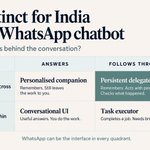
“Instinct for India” ≠ a conversational WhatsApp agent
I keep seeing the two confused in pitches. WhatsApp is a sensible interface. What interests me about a personal agent is that the state of my life survives the conversation: what I’m trying to do, what I’ve authorised, what’s changed & what’s unfinished
If an important meeting gets cancelled, does it remember why it mattered, find another slot & follow through within the permissions I gave it? Or do I have to brief it all over again?
The same test applies in other categories like personal finance/quick-commerce/services. Research & price alerts can be useful. The harder product remembers why I bought, what would change my mind & connects new information to that context. It follows through on agreed next steps, asks for approval where needed & checks what actually happened
That depth matters commercially. Otherwise, you’re likely squeezed b/w the broker that already has my portfolio/card/spending history & the horizontal agent competing to understand the rest of my life

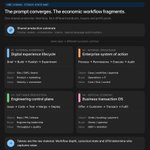
Framework to think about post-training x Applied AI
There's something important happening here that has interesting downstream effects
My mental model is that once an Applied AI company owns or sits closer to a high-volume, structured but complex workflow, post-training of open weight models w/ domain specific RL + reward shaping for token efficacy becomes a rational + high-ROI move
@harvey's Tenet on top of @Kimi_Moonshot's K3 base w/ long-horizon legal environments is the clearest public proof
General frontier models remain necessary for many tasks but the post-training math works when 3 conditions collide today:
(1) deep vertical expertise + prop or hard to synthesize workflow data
(2) sufficient vol of similar long-horizon agentic tasks so that the cost of env design + RL is fixed & amortizes
(3) either high-token burn at scale or task types are under represented in general pre-training (solid evals are a must for the same)
I also believe that this pattern is highest leverage in knowledge work verticals that are doc-heavy, multi-step, citation sensitive & currently billed at high human hourly rates
Put another way, the economic argument is that human expert labour is the dominant cost & inference is already a material OpEx line & thus, a 2-10x improvement in intelligence/token or equivalent cost reduction for a certain quality directly expands margins & enables scale that pure API consumption cannot
👏 @gabepereyra, @ItsJulioPereyra, @calvincongelado, @nikogrupen, @vtrengarajan & team

Harvey is a great example of how American companies are building world-class specialized models: they took an open-source base (Kimi K3), post-trained it on legal data, and delivered state-of-the-art performance on legal benchmarks at a fraction of the cost of frontier models. Restrictions that kneecap open models would do nothing to stop Chinese labs from shipping the next Kimi. They would, however, cripple the ability of startups like Harvey to create high-performance, low-cost vertical models. Of course some of the closed labs would love this — it eliminates their competition.
More than three years ago, a few friends and I organised a GenAI community meetup. That is where I first met @pratykumar & @vivekrag
What stayed w/ me from that conversation was a view that felt fairly contrarian then, especially from India: if you wanted to do AI work that retained value, you needed foundational depth & the ability to operate across the stack.
Sharing a first name with Pratyush has since led to a few pleasant mix-ups across the ecosystem.
More importantly, over the last several quarters, I’ve had the opportunity to work informally but closely with Pratyush, Vivek and the wider @SarvamAI team. The closer I’ve seen them operate, the stronger my conviction has become that frontier AI can be built from India.
That makes @ActivateSignal's investment in Sarvam as part of the Series B especially meaningful to me.
Finding, understanding & supporting more such teams building at the frontier from India is exactly why we are building Activate.
Activating AI in🇮🇳! @aakrit @soaibgrewal

Interesting way to look at it, as it compresses the capital intensity of the frontier capabilities:
(1) Pure parameter or data scaling under the dense transformers regime produced the familiar power-law curves
(2) The effective compute required for a given capability level fell dramatically once we shifted to sparse MoE, better expert routing, sparse attention (DSA in V4), lower-precision compute, kernels that are h/w aware
(3) Training costs are no longer a function of pure FLOPs as architectural & systems progress can substitute for that raw scale
(4) For me, the interesting question then becomes whether the capability frontier, measured by the best achievable performance as a function of total training compute, is still advancing at a rate consistent w/ historical scaling or whether we are mostly filling in the Pareto front of cost v/s performance for a given capability level

Several interesting things to note here:
(1) @Kimi_Moonshot just invoiced a hyperscaler and that too in public. This is a new monetization mechanism at a layer everyone thought was commoditized
(2) Clouds don’t do Day 0 work for models they expect nobody to use. At minimum, Google expects enough developer/enterprise pull for Chinese open weights inside GCP to justify the engineering
(3) Hyperscaler license fees to open weight labs is structurally analogous to content licensing - and it converts model IP into a royalty stream that survives commoditization of serving
(4) NVIDIA taxes even this transaction (B200/GB200). TPU absence from the K3 stack (for now) is a quiet negative for the TPU-as-moat narrative on 3P models
(5) The ratchet is the real story. K2 (Jul '25) asked scaled deployers only for attribution - displaying "Kimi K2" in the UI. K3 (Jul '26) asks for payment. Will be fascinating to watch DeepSeek V5 and GLM 6 licenses

Let's be clear what is happening here: Google is paying Moonshot, a Chinese AI developer, for the right to host a Chinese AI model on US cloud, and partnering with them to serve it to US customers using US chips. This obviously should not be allowed.
Moonshot's open-weight license is not 100% free. It makes clear that any commercial cloud provider must pay it if it wishes to host Kimi, which is why Google's announcement actively thanks Moonshot AI for their partnership.
Regardless of what people think about the pros and cons of open source AI, leading US AI companies should not be partnering with leading Chinese AI companies and paying them to help China serve their products, full stop. This does not help America in the AI race. Nothing could be more damaging to US efforts to ensure US models dominate globally.
discuss.google.dev/t/announc…
Readers added context they thought people might want to know
Google Cloud provides deployment guides for users to self-host Kimi K3 on its infrastructure, not hosting or serving the model itself or paying Moonshot AI. The model's license does not require payment from cloud providers for user self-deployment support. discuss.google.dev/t/announcing-d… huggingface.co/moonshotai/Kim…
Directionally correct but yet incomplete
Kaplan’s scaling + Chinchilla optimal scaling laws established that base model intelligence is a predictable function of training FLOPs + data vol. + param count
Thus, frontier capability remains gated by massive centralised training runs
However, once weights exist, inference economics decouple: quantisation, distillation, spec. decoding & optimised serving stacks (vLLM, Tensor-RT) deliver upto 50x gains
For the broad middle of the capability distribution tasks, open weight models already deliver 80-95% of utility at dramatically lower costs + latency & superior control
There’s a small nuance to appreciate (h/t to @bookwormengr): so long as the inference economics continue to hold, labs will continue to push the scaling curve & yet open model development will continue to persist so long as economic incentives to participants is clear (much like Linux was via h/w, service & apps)

When we wrote our first cheque to @TanayLohia1, there was no company & not even a deck
What stood out wasn’t the answers he had then. It was how quickly he came back w/ a better one
@BioMandrake is built on the same idea: every experiment should make the next design better
@aakrit, @soaibgrewal, @ActivateSignal

