

18Plus4NDC is a network of social democrats with a mission to educate and orient young people about the principles and values of the NDC. #TheYoungAppeal
Ghana
Joined July 2021
- Tweets6.1K
- Following142
- Followers13.4K
- Likes7.1K




18Plus4NDC retweeted

A high-level African Union (AU) Commission delegation led by Chairperson Mahmoud Ali Youssouf paid a courtesy call on President John Dramani Mahama, the incoming AU Chairperson, in Accra today.
Mr Youssouf welcomed the opportunity to discuss key continental issues with the President. The delegation pledged full support to President Mahama as he assumes the AU Chairmanship in January.
They recognised his leadership and significant contributions, especially his advocacy for reparative justice and commitment to reforming Africa's financial institutions.
The delegation expressed strong confidence that President Mahama's leadership would make a substantial positive impact on the AU and shape its future direction constructively.
A key topic was achieving financial self-reliance for the African Union. Citing ECOWAS as a successful model with a 0.5% levy to cover costs, President Mahama urged AU member states to fully implement the Union’s 0.2% levy on eligible imports.
"It’s not government money to the AU; it’s the people’s money. Government is only a collecting agency," President Mahama stated.
They thanked President Mahama for supporting the AU's efforts to achieve financial independence, especially through the proposed 0.2% levy on eligible imports to fund the Union's work.
President Mahama pledged to engage other African leaders to secure their full support for the levy’s implementation.
He briefed the delegation on the Accra Reset Initiative, which seeks to advance Africa's sovereignty and resilience by enhancing vaccine production, increasing access, and strengthening health systems across the continent.
He reiterated the need to address Africa's debt portfolio by exploring effective debt treatment approaches and creating sustainable mechanisms to manage the continent's debt burden.
The two leaders also discussed regional security and intra-African relations. Chairperson Youssouf commended President Mahama for his ongoing efforts to bridge divides between ECOWAS and the Alliance of Sahel States (AES).
He also praised President Mahama's leadership in advancing the AU's reparations agenda worldwide.


18Plus4NDC retweeted

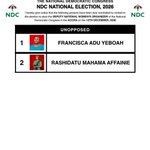
NDC NATIONAL WOMEN’S ORGANISER RACE 2026: ABIGAIL MENSAH VERSUS BETTY KROSBI MENSAH – TWO WOMEN, ONE NATIONAL MANDATE
The battle for the National Women’s Organiser position of the National Democratic Congress (NDC) is gradually taking shape, with two women officially listed to contest the position in the party’s December 2026 internal elections.
They are Abigail Akwambea Elorm Mensah and Betty Nana Efua Krosbi Mensah.
The two candidates bring different political backgrounds, experiences and leadership records to the contest. One has spent years within the national women’s leadership structure of the NDC, while the other has served as a Member of Parliament and occupied public-sector leadership positions.
This is not simply an election to determine who becomes the next National Women’s Organiser. It is also an opportunity for the NDC to consider the direction, organisation and future of its Women’s Wing.
The question is straightforward: What kind of leadership does the party want for its women?
1. ABIGAIL AKWAMBEA ELORM MENSAH: THE PARTY STRUCTURE EXPERIENCE
Abigail Akwambea Elorm Mensah is not a newcomer to the national political administration of the NDC.
Her involvement in the party’s political structures includes parliamentary and national executive contests.
In 2016, she contested the parliamentary election as the NDC parliamentary candidate for Fanteakwa South Constituency in the Eastern Region. Although she did not secure the parliamentary seat, that contest marked an important stage in her political journey.
She subsequently moved into the national women’s leadership structure.
At the NDC’s 2018 internal elections, she emerged as the First Deputy National Women’s Organiser. She retained her place in the national women’s leadership structure following the party’s 2022 Women and Youth Conference, where Dr Louisa Hannah Bissiw retained the National Women’s Organiser position.
Abigail’s experience within the party’s national women’s administration is therefore one of her most significant credentials.
She has served in that capacity since 2018, giving her years of exposure to the organisation, administration and mobilisation of the NDC Women’s Wing.
Educational and professional background
Abigail has an academic background spanning business administration, accounting, taxation and law.
Her qualifications include:
•Higher National Diploma in Accounting from Koforidua Polytechnic.
•Bachelor of Science in Business Administration from Methodist University College.
•Master of Commerce in Taxation from Pentecost University Graduate School.
•Bachelor of Laws (LLB) from the University of London.
She is also a member of the Ghana National ADR Practitioners Association and has reached the final level of the Chartered Institute of Taxation, Ghana.
In February 2025, President John Dramani Mahama appointed her Chief Executive Officer of the Microfinance and Small Loans Centre (MASLOC).
She currently holds that position alongside her political profile as Deputy National Women’s Organiser of the NDC.
Her professional experience in financial management, budgeting, taxation, institutional administration and policy implementation adds another dimension to her public-service background.
Her political significance
Abigail’s strongest identifiable political credential is her experience within the NDC Women’s Wing itself.
Having served as First Deputy National Women’s Organiser since 2018, she has had considerable exposure to the party’s internal organisation and the challenges associated with maintaining a national political structure.
Her previous parliamentary candidature also demonstrates that her involvement in the party extends beyond occupying an appointed national executive position.
However, the central issue for delegates will be what she intends to do differently if given the opportunity to lead the entire Women’s Wing.


18Plus4NDC retweeted
NDC STARTS REGIONAL ELECTIONS TODAY: 16 REGIONS, A NEW LEADERSHIP BATTLE AND THE ROAD TO 2028
The National Democratic Congress (NDC) begins another important phase of its internal reorganisation today, Friday, November 13, 2026, with the Regional Youth and Women’s Conferences taking place across the country.
The main Regional Executive Elections will follow on Saturday, November 14, with the exercise forming part of the party’s broader restructuring ahead of the 2028 General Elections.
Following the successful completion of the constituency executive elections in October, attention has shifted to the regional level, where party delegates will elect executives responsible for coordinating the NDC’s activities across the 16 regions for the next four years.
THE ASPIRANT NUMBERS: WHAT WE KNOW SO FAR
Available regional reports indicate considerable competition for regional executive positions.
Here are the reported figures:
1. Greater Accra Region – 77 aspirants
2. Ashanti Region – 65 aspirants
3. Oti Region – 46 aspirants
4. Bono East Region – 46 aspirants
5. Bono Region – 44 aspirants
6. Volta Region – 36 aspirants
The six regions account for a reported 314 aspirants.
These figures cover the various regional, youth and women’s executive positions as reported by the respective regional election authorities and media outlets.
Figures for the remaining ten regions are yet to be independently confirmed.
THE CONTESTS AND WHAT LIES AHEAD
Greater Accra has attracted 77 candidates contesting 15 executive positions, with more than 1,200 delegates expected to participate.
In Ashanti, 65 aspirants are contesting various positions. The breakdown includes 48 candidates for the main regional executive positions, 11 for the youth wing and six for the women’s wing.
Oti has 46 aspirants contesting 15 executive positions, while Bono East has also cleared 46 aspirants to contest its regional positions.
In Bono, 44 candidates are in the race, with approximately 424 delegates expected to participate.
The Volta Region has 36 aspirants contesting various positions, although six candidates are going unopposed.
THE ROAD TO DECEMBER 19
The regional elections are another significant milestone in the NDC’s internal electoral calendar.
The next major event will be the National Youth and Women’s Conferences scheduled for December 12, followed by the National Delegates Congress on December 19, 2026, when national executives will be elected.
The regional elections will therefore help shape the party’s leadership structure and organisational direction ahead of the national congress.
BEYOND THE ELECTIONS
The real test will not end with the declaration of results.
The incoming regional executives will inherit the responsibility of strengthening constituency structures, improving grassroots mobilisation, resolving internal disagreements and maintaining communication between the national leadership and party members.
They will also be expected to consolidate the party’s organisational machinery as the NDC prepares for the 2028 electoral contest.
For the aspirants, the campaign is about securing delegates’ confidence. For the delegates, it is an opportunity to determine who gets to lead their respective regions.
Peaceful elections, transparency, credible results and acceptance of the outcome must remain central to the exercise.
The NDC is not simply electing regional officers. It is renewing the leadership structures that will carry its political and organisational responsibilities into the next four years.
The regional battle begins!
Who wins?
#NDCDecides
#NDCRegionalElections2026
#NDC2028
#TheYoungAppeal
#KW #NDCCongress2026

18Plus4NDC retweeted
GH¢200 – Dr Kwame Nkrumah
Ghana’s first President and a leading figure in the African independence movement.

18Plus4NDC retweeted
GH¢100 – Kofi Annan
Ghana’s celebrated diplomat and former Secretary-General of the United Nations.

18Plus4NDC retweeted
GH¢50 – Theodosia Salome Okoh
The Ghanaian artist and designer who designed Ghana’s national flag.

18Plus4NDC retweeted
GH¢20 – Dr Ephraim Amu
A renowned Ghanaian composer, musicologist and educator, remembered for composing the patriotic song Yɛn Ara Asaase Ni.

18Plus4NDC retweeted
GH¢10 – Justice Annie Jiagge
A pioneering Ghanaian female jurist. She became the first Ghanaian woman to serve as a judge and the first woman judge in the Commonwealth.

18Plus4NDC retweeted
GH¢5 – James Emmanuel Kwegyir-Aggrey
An influential Ghanaian educator, missionary and advocate of education.

18Plus4NDC retweeted
GH¢2 – Cardinal Peter Porekuu Dery
A distinguished Ghanaian Catholic clergyman and former Archbishop of Tamale.

18Plus4NDC retweeted
GH¢1 – Agnes Oforiwa Tagoe-Quarcoopome
A celebrated Makola market woman, reportedly the first Makola woman to open a bank account with the then Standard Bank of West Africa.

18Plus4NDC retweeted
NEW GHANA CEDI NOTES
The newly launched Ghana Cedi Heritage Series, unveiled on Thursday, November 12, 2026, features eight distinguished Ghanaians on the front of the new banknotes.
Here are the faces on each denomination:
GH¢1 – Agnes Oforiwa Tagoe-Quarcoopome
A celebrated Makola market woman, reportedly the first Makola woman to open a bank account with the then Standard Bank of West Africa.
GH¢2 – Cardinal Peter Porekuu Dery
A distinguished Ghanaian Catholic clergyman and former Archbishop of Tamale.
GH¢5 – James Emmanuel Kwegyir-Aggrey
An influential Ghanaian educator, missionary and advocate of education.
GH¢10 – Justice Annie Jiagge
A pioneering Ghanaian female jurist. She became the first Ghanaian woman to serve as a judge and the first woman judge in the Commonwealth.
GH¢20 – Dr Ephraim Amu
A renowned Ghanaian composer, musicologist and educator, remembered for composing the patriotic song Yɛn Ara Asaase Ni.
GH¢50 – Theodosia Salome Okoh
The Ghanaian artist and designer who designed Ghana’s national flag.
GH¢100 – Kofi Annan
Ghana’s celebrated diplomat and former Secretary-General of the United Nations.
GH¢200 – Dr Kwame Nkrumah
Ghana’s first President and a leading figure in the African independence movement.
A few important details:
•The new notes are expected to enter circulation on December 1, 2026.
•Existing notes will remain legal tender.
•The exercise is an upgrade, not a redenomination. The value of the cedi has not changed.
#TheNewCedi #TheNewEconomy #BankOfGhana #November


18Plus4NDC retweeted
A NEW CEDI FOR A NEW ECONOMY: GHANA TURNS A PAGE IN ITS ECONOMIC STORY
Ghana has unveiled a new chapter in the history of its national currency. But beyond the redesigned banknotes, enhanced security features and celebration of our national heritage lies a bigger question: Is Ghana also ready for a new economic direction?
Today, Thursday, November 12, 2026, President John Dramani Mahama is leading the official unveiling of the Ghana Cedi Heritage Series at the Bank of Ghana’s headquarters in Accra.
The launch, themed “The Cedi, Our Future: Secure, Designed to Last,” comes at an interesting moment in Ghana’s economic journey. It coincides with the presentation of the 2027 Budget Statement and Economic Policy by Finance Minister Dr Cassiel Ato Forson, which is expected to outline the government’s much-anticipated New Economy agenda.
The timing is politically and economically significant.
Ghana is not simply introducing redesigned banknotes. The government is positioning itself to move from economic stabilisation towards investment, industrial expansion, job creation and sustainable growth.
THE NEW CEDI: MORE THAN A CHANGE OF DESIGN
The Heritage Series represents an upgrade to Ghana’s existing banknotes, which have been in circulation for more than two decades.
According to the Bank of Ghana, the new notes incorporate enhanced security features, improved durability and redesigned elements that celebrate Ghanaian history, culture and national identity.
The eight denominations are GH¢1, GH¢2, GH¢5, GH¢10, GH¢20, GH¢50, GH¢100 and GH¢200.
One notable development is the reintroduction of the GH¢2 banknote, which adds another option to the existing currency denominations.
The improved notes are expected to offer stronger protection against counterfeiting and withstand the demands of everyday transactions for longer periods.
This is important because currency management comes at a cost. Banknotes that are frequently damaged or rendered unusable must be replaced, placing additional financial demands on the central bank.
However, Ghanaians must understand one important distinction: This is not a redenomination of the Ghana Cedi.
The new notes do not change the purchasing power of the currency, remove zeros or increase the value of money in people’s pockets.
Existing banknotes will remain legal tender and circulate alongside the Heritage Series. The public is therefore not required to rush to banks to exchange old notes.
The Bank of Ghana is expected to introduce the new notes into circulation in phases, with commercial banks preparing their ATMs and cash-handling systems ahead of the rollout.
FROM ECONOMIC STABILISATION TO THE NEW ECONOMY
Perhaps the most interesting aspect of today’s events is the connection between the new currency and the government’s New Economy agenda.
President Mahama has announced an investment programme of more than US$9 billion aimed at driving growth in productive and job-creating sectors between 2027 and 2030.
The ambition is clear: Ghana must move beyond managing economic difficulties and begin creating the conditions for businesses to grow, industries to expand and young people to find meaningful employment.
For years, Ghanaians have been confronted with difficult economic realities, including rising living costs, unemployment, currency depreciation, high borrowing costs and the challenges of doing business.
Economic stabilisation is necessary, but it cannot be the final destination.
A country cannot celebrate improved macroeconomic indicators while the ordinary citizen continues to struggle to afford basic necessities.
The real test of economic recovery is whether the benefits eventually reach households, markets, farms, factories and workplaces.
That is where the New Economy agenda must prove its worth.
#NewCedi #NewEconomy #GhanaEconomy
⤵️


18Plus4NDC retweeted
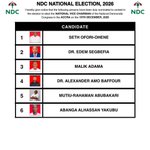
NDC NATIONAL CHAIRMANSHIP 2026: FOUR ASPIRANTS, FOUR POLITICAL JOURNEYS, ONE PARTY TO LEAD
Four prominent party members have successfully submitted their nomination forms to contest the position of National Chairman.
facebook.com/share/p/1CP234e…
Who wins?
#NDCDecides #TheYoungAppeal


18Plus4NDC retweeted

1. Edwin Oko Vanderpuye
2. Mustapha Ghande
3.Fiifi Kwetey
4.Joseph Yasmin
5.Ako Gunn
6. Okai Mintah
7.Dr. Sammy Ayerh
8.Kojo Dankwah
As the Lord Lives !!!!


18Plus4NDC retweeted

Nii Lantey Vanderpuye ❤️🫶
NDC NATIONAL CHAIRMANSHIP 2026: FOUR ASPIRANTS, FOUR POLITICAL JOURNEYS, ONE PARTY TO LEAD
Four prominent party members have successfully submitted their nomination forms to contest the position of National Chairman.
facebook.com/share/p/1CP234e…
Who wins?
#NDCDecides #TheYoungAppeal

