

Exploring Web3, AI & DeFi. Breaking down early projects and on-chain trends. Sharing research, insights, and ideas.
Ukraine
Joined December 2012
- Tweets21.5K
- Following1.8K
- Followers2.3K
- Likes27.9K


23Zver base.eth retweeted
One resource people don't talk about enough in Web3 is attention.
Switching between apps, checking every small detail, repeating familiar steps… none of these things seems like a big problem on its own, but together they can make everyday activities unnecessarily tiring.
This is where I see an interesting role for AI agents. Something like @meetmotes could help take care of repetitive onchain workflows, leaving users with more time and attention for decisions that actually require them.
I don't see automation as a way to keep people busy with even more activity. Quite the opposite. Its value should be in removing unnecessary work from the process.
If an agent can make interacting with Web3 feel less demanding without taking away the user's control, that's a meaningful improvement.
🤝 Paid partnership · 🤖 Made with AI

An AI agent shouldn't treat every user interaction as an isolated task.
People have different habits, priorities, and expectations. What works well for one person might not be the best approach for someone else. Over time, an agent should be able to understand those differences and make the experience feel more relevant.
That's an interesting direction to consider for @meetmotes. The real potential of AI agents isn't only in executing onchain actions, but also in becoming more useful through repeated interactions.
I think there's a lot of room to improve how these systems understand user intent. Not by making decisions on someone's behalf without context, but by learning what matters to them and adjusting how they help.
Technology feels much more valuable when it starts adapting to people, rather than expecting everyone to adapt to it.

One resource people don't talk about enough in Web3 is attention.
Switching between apps, checking every small detail, repeating familiar steps… none of these things seems like a big problem on its own, but together they can make everyday activities unnecessarily tiring.
This is where I see an interesting role for AI agents. Something like @meetmotes could help take care of repetitive onchain workflows, leaving users with more time and attention for decisions that actually require them.
I don't see automation as a way to keep people busy with even more activity. Quite the opposite. Its value should be in removing unnecessary work from the process.
If an agent can make interacting with Web3 feel less demanding without taking away the user's control, that's a meaningful improvement.
🤝 Paid partnership · 🤖 Made with AI
An AI agent shouldn't treat every user interaction as an isolated task.
People have different habits, priorities, and expectations. What works well for one person might not be the best approach for someone else. Over time, an agent should be able to understand those differences and make the experience feel more relevant.
That's an interesting direction to consider for @meetmotes. The real potential of AI agents isn't only in executing onchain actions, but also in becoming more useful through repeated interactions.
I think there's a lot of room to improve how these systems understand user intent. Not by making decisions on someone's behalf without context, but by learning what matters to them and adjusting how they help.
Technology feels much more valuable when it starts adapting to people, rather than expecting everyone to adapt to it.
23Zver base.eth retweeted

Today, we're launching the Live Web Data API by Teneo Protocol to the public.
One API that delivers public web pages live as clean Markdown or text, ready for AI agents and apps.
23Zver base.eth retweeted
Good Morning everyone!
Hope your Thursday is off to a good start!
Today, let's look at another detail that can make a big difference at live events: payment flexibility.
Imagine an international festival with thousands of visitors. Some prefer paying by card, others use their phones, and some may still want a traditional cash option.
Now think about the businesses operating inside the venue. Food stalls, bars and merchandise shops need a payment process that is quick and convenient, especially when hundreds of people are waiting.
The challenge for organizers is to make all these different experiences work together without creating extra friction.
This is where connected infrastructure becomes interesting. The approach behind @RhunaIO brings payments into a broader event ecosystem, alongside ticketing and access management.
I like the idea that visitors shouldn't have to think about the technology behind every transaction. They just want to get their food, pay for something they like and get back to enjoying the event.
Sometimes improving the experience doesn't mean adding more features. It means making the existing ones work together properly.
More interesting details to explore as we continue learning about Rhuna.
🤝 Paid partnership · 🤖 Made with AI
Good Morning everyone!
Wishing you all a wonderful Sunday. Hope you get some time to relax, recharge and enjoy the day.
Meanwhile, we're continuing to explore the interesting ideas behind @RhunaIO and how technology can make live events work better for everyone involved.
One thing I've been thinking about is what happens after someone attends an event.
The music stops, the lights go off and people head home. But for organizers, there's still something important left: understanding what made the experience memorable and what could be improved next time.
Ticket numbers can show how many people came, but they don't always tell the whole story.
What did visitors enjoy most? Where did they spend their time? What would make them want to come back?
There's a lot of value in understanding these details, as long as data is handled responsibly and people know how it's being used.
For me, this is another interesting direction to explore when looking at the future of event technology.
Good Morning everyone!
Hope your Thursday is off to a good start!
Today, let's look at another detail that can make a big difference at live events: payment flexibility.
Imagine an international festival with thousands of visitors. Some prefer paying by card, others use their phones, and some may still want a traditional cash option.
Now think about the businesses operating inside the venue. Food stalls, bars and merchandise shops need a payment process that is quick and convenient, especially when hundreds of people are waiting.
The challenge for organizers is to make all these different experiences work together without creating extra friction.
This is where connected infrastructure becomes interesting. The approach behind @RhunaIO brings payments into a broader event ecosystem, alongside ticketing and access management.
I like the idea that visitors shouldn't have to think about the technology behind every transaction. They just want to get their food, pay for something they like and get back to enjoying the event.
Sometimes improving the experience doesn't mean adding more features. It means making the existing ones work together properly.
More interesting details to explore as we continue learning about Rhuna.
🤝 Paid partnership · 🤖 Made with AI
Good Morning everyone!
Wishing you all a wonderful Sunday. Hope you get some time to relax, recharge and enjoy the day.
Meanwhile, we're continuing to explore the interesting ideas behind @RhunaIO and how technology can make live events work better for everyone involved.
One thing I've been thinking about is what happens after someone attends an event.
The music stops, the lights go off and people head home. But for organizers, there's still something important left: understanding what made the experience memorable and what could be improved next time.
Ticket numbers can show how many people came, but they don't always tell the whole story.
What did visitors enjoy most? Where did they spend their time? What would make them want to come back?
There's a lot of value in understanding these details, as long as data is handled responsibly and people know how it's being used.
For me, this is another interesting direction to explore when looking at the future of event technology.
23Zver base.eth retweeted
An AI agent shouldn't treat every user interaction as an isolated task.
People have different habits, priorities, and expectations. What works well for one person might not be the best approach for someone else. Over time, an agent should be able to understand those differences and make the experience feel more relevant.
That's an interesting direction to consider for @meetmotes. The real potential of AI agents isn't only in executing onchain actions, but also in becoming more useful through repeated interactions.
I think there's a lot of room to improve how these systems understand user intent. Not by making decisions on someone's behalf without context, but by learning what matters to them and adjusting how they help.
Technology feels much more valuable when it starts adapting to people, rather than expecting everyone to adapt to it.
🤝 Paid partnership · 🤖 Made with AI
When an AI agent completes a task, I don't think the final result should be the only thing that matters.
Being able to check what actually happened is just as valuable. Did the agent complete every step? Was the intended outcome achieved? Were there any details that need attention?
This becomes especially important when agents interact with onchain applications and handle actions across different platforms.
That's an aspect of @meetmotes I'm interested in as the project develops. The more responsibility we give autonomous tools, the more useful it becomes to have a clear record of their work.
I don't want users to blindly trust a successful-looking result. I'd rather see systems that make it easy to verify what was done and understand the outcome.
Trust grows when people don't have to take the technology's word for it.
23Zver base.eth retweeted
When an AI agent completes a task, I don't think the final result should be the only thing that matters.
Being able to check what actually happened is just as valuable. Did the agent complete every step? Was the intended outcome achieved? Were there any details that need attention?
This becomes especially important when agents interact with onchain applications and handle actions across different platforms.
That's an aspect of @meetmotes I'm interested in as the project develops. The more responsibility we give autonomous tools, the more useful it becomes to have a clear record of their work.
I don't want users to blindly trust a successful-looking result. I'd rather see systems that make it easy to verify what was done and understand the outcome.
Trust grows when people don't have to take the technology's word for it.
🤝 Paid partnership · 🤖 Made with AI
More features don't automatically make an AI agent better.
Sometimes a product becomes so focused on adding new capabilities that the original purpose gets lost. I'd rather see a smaller set of functions working well than dozens of options that people rarely need.
This is something I find interesting about the direction @meetmotes is exploring. AI agents connected to smart accounts have plenty of possibilities, but the important question is how much value they bring to actual users.
Can they handle useful tasks without making the process unnecessarily complicated? Can different capabilities work together instead of feeling like separate experiments?
For me, that's a much better way to judge progress. A product doesn't need to do everything. It needs to do the right things well, and give people a reason to keep using it.
23Zver base.eth retweeted
Launching a token is probably one of the easiest parts of building a blockchain project.
The harder part is giving people a reason to care about it.
Before a token can have real meaning, there should be something behind it: working products, active users, developers building on the infrastructure and an ecosystem that solves actual problems.
That's why I believe the real work should happen before the big token announcement.
@DubheEngine has an interesting opportunity here. Instead of making the token the entire story, the focus can be on building an environment where developers can create their own projects, deploy them and demonstrate that the technology works beyond presentations and promises.
Because a token can attract attention for a while, but useful products are what can keep people around.
I'd rather see an ecosystem grow around working applications first and let the token become part of that bigger picture, not the other way around.
Build something people actually need. Give the ecosystem a reason to exist. Everything else should follow.
🤝 Paid partnership · 🤖 Made with AI
Some projects make you wonder how many people will show up for a reward.
Others make you wonder what people could build if the tools were good enough.
That’s the more interesting question for me with @DubheEngine.
I think infrastructure is one of those things that’s easy to overlook. People naturally pay more attention to the apps, games and products they can see and interact with. But behind every good idea, there’s usually a lot of work that users never notice.
A development engine doesn’t need to promise everything. What matters is whether it helps developers spend less time fighting technical complexity and more time turning their ideas into something real.
And for me, the real measure of success isn’t how many features a project announces or how much attention it gets during a campaign. It’s whether people keep using the tools when the initial excitement fades.
That’s what I’m curious to see with Dubhe. Not just what can be built today, but what developers might create with it over time.
23Zver base.eth retweeted

Think about how many of your favorite brands are already part of your everyday life. The little things you enjoy, the experiences you look forward to, and the things that make your day a little better can now give you even more in return.
With ero, we're making the things you already love even more rewarding. 🫶

We talk a lot about the future of finance, but I sometimes wonder if we're actually ready for how big that future could become.
Think about it. Trillions in traditional markets, real-world assets, institutional capital, and financial activity that still happens across systems that don't communicate well with each other.
Now imagine what happens when more of that activity can move on-chain, settle efficiently, and operate within an infrastructure built for real financial use.
That's one of the reasons I'm paying attention to @quadrillions_cc and its connection to the Canton ecosystem, alongside @supanova_app.
And here's something I'd genuinely like to hear your thoughts on:
What do you think will be the biggest driver of mainstream blockchain adoption?
• Tokenized real-world assets
• Institutional money moving on-chain
• Faster and cheaper financial settlements
• Better infrastructure that people don't even notice they're using
Personally, I think the real breakthrough will happen when using blockchain stops feeling like using blockchain. People will simply use better financial products without worrying about what's happening under the hood.
The opportunity is enormous. Maybe the name $QUADRILLIONS is more fitting than it first sounds.
Curious to hear what everyone thinks 👇
🤝 Paid partnership · 🤖 Made with AI

First LocalNet run with the DevKit campaign build is complete. Tried out the process with @bitdynamics_cc and @CantonNetwork, minted a token, and got everything running locally.
Run code: CCT-6PVJDH2A
DevKit

4
19
23Zver base.eth retweeted
We talk a lot about the future of finance, but I sometimes wonder if we're actually ready for how big that future could become.
Think about it. Trillions in traditional markets, real-world assets, institutional capital, and financial activity that still happens across systems that don't communicate well with each other.
Now imagine what happens when more of that activity can move on-chain, settle efficiently, and operate within an infrastructure built for real financial use.
That's one of the reasons I'm paying attention to @quadrillions_cc and its connection to the Canton ecosystem, alongside @supanova_app.
And here's something I'd genuinely like to hear your thoughts on:
What do you think will be the biggest driver of mainstream blockchain adoption?
• Tokenized real-world assets
• Institutional money moving on-chain
• Faster and cheaper financial settlements
• Better infrastructure that people don't even notice they're using
Personally, I think the real breakthrough will happen when using blockchain stops feeling like using blockchain. People will simply use better financial products without worrying about what's happening under the hood.
The opportunity is enormous. Maybe the name $QUADRILLIONS is more fitting than it first sounds.
Curious to hear what everyone thinks 👇
🤝 Paid partnership · 🤖 Made with AI
23Zver base.eth retweeted

Most meme launchpads chase trends.
@onlystreetsfun is trying something different. real-life moments turned into coins on solana.
live on @rarelistio from nov 11–17.
curious to see what actually cooks.

A new campaign just went live on Rarelist!
Join now: rarelist.io/projects/onlystr…
@onlystreetsfun is the first launchpad built to turn real-life moments into coins.
Duration: Nov 11–17
A product can have impressive technology behind it and still fail if people struggle to use it.
Most users don't care how many layers of infrastructure are working in the background. They care whether the experience makes sense, whether things work as expected, and whether the value is clear.
That's one reason I find the consumer side of @earnos_io interesting.
The idea of discovering opportunities, completing activities and receiving rewards shouldn't require someone to understand blockchain, wallets or complicated Web3 mechanics first.
Good technology doesn't always need to be visible. Sometimes its biggest achievement is making something that used to feel complicated completely ordinary.
And I believe that's how more people will eventually enter Web3 - not by learning every technical detail, but by finding products they actually want to use.
🤝 Paid partnership · 🤖 Made with AI
There’s an interesting balance that reward-based platforms need to get right.
Users want to know that their time is worth something. Brands want to know that the people interacting with their campaigns are genuinely interested.
Both sides have expectations, and both need a reason to trust the process.
That’s why transparency matters so much. People should understand what an action requires, what counts as completion, and what they can expect in return.
I like this aspect of what @earnos_io is exploring. The value isn't just in connecting brands with users, but in making that exchange clearer and more meaningful for both sides.
A good system shouldn't leave either side guessing.

When an AI agent completes a task, I don't think the final result should be the only thing that matters.
Being able to check what actually happened is just as valuable. Did the agent complete every step? Was the intended outcome achieved? Were there any details that need attention?
This becomes especially important when agents interact with onchain applications and handle actions across different platforms.
That's an aspect of @meetmotes I'm interested in as the project develops. The more responsibility we give autonomous tools, the more useful it becomes to have a clear record of their work.
I don't want users to blindly trust a successful-looking result. I'd rather see systems that make it easy to verify what was done and understand the outcome.
Trust grows when people don't have to take the technology's word for it.
🤝 Paid partnership · 🤖 Made with AI
More features don't automatically make an AI agent better.
Sometimes a product becomes so focused on adding new capabilities that the original purpose gets lost. I'd rather see a smaller set of functions working well than dozens of options that people rarely need.
This is something I find interesting about the direction @meetmotes is exploring. AI agents connected to smart accounts have plenty of possibilities, but the important question is how much value they bring to actual users.
Can they handle useful tasks without making the process unnecessarily complicated? Can different capabilities work together instead of feeling like separate experiments?
For me, that's a much better way to judge progress. A product doesn't need to do everything. It needs to do the right things well, and give people a reason to keep using it.
23Zver base.eth retweeted

A full Canton Network, on your laptop.
Canton DevKit by @bitdynamics_cc runs validator nodes, a super-validator and a web UI locally. Open source.
Mint a token and post your run: 25 winners take 200 CC. Until Nov 24, 15:00 UTC.
cctools.network/earn/bitdyna…

23Zver base.eth retweeted
More features don't automatically make an AI agent better.
Sometimes a product becomes so focused on adding new capabilities that the original purpose gets lost. I'd rather see a smaller set of functions working well than dozens of options that people rarely need.
This is something I find interesting about the direction @meetmotes is exploring. AI agents connected to smart accounts have plenty of possibilities, but the important question is how much value they bring to actual users.
Can they handle useful tasks without making the process unnecessarily complicated? Can different capabilities work together instead of feeling like separate experiments?
For me, that's a much better way to judge progress. A product doesn't need to do everything. It needs to do the right things well, and give people a reason to keep using it.
🤝 Paid partnership · 🤖 Made with AI
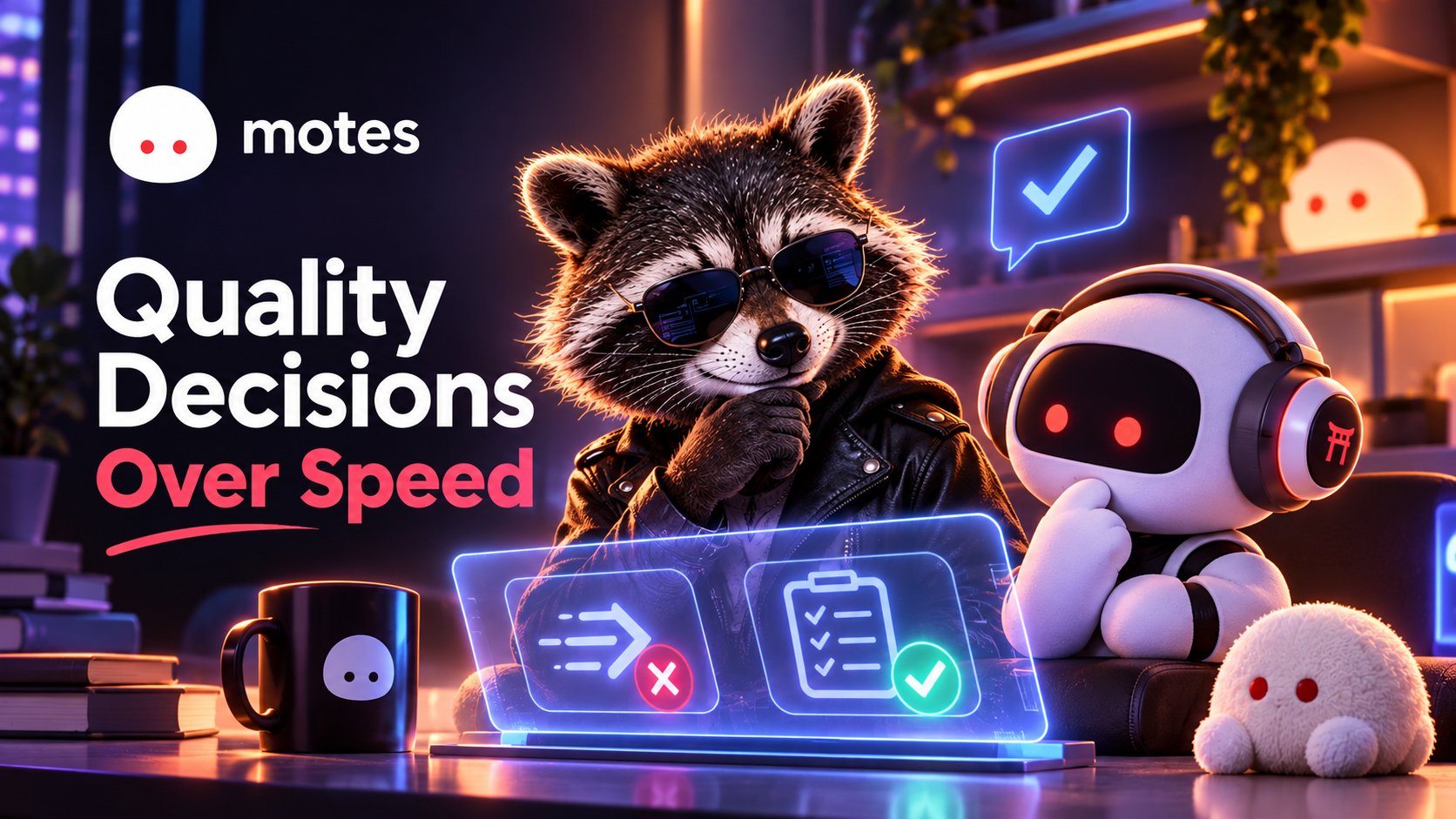
Speed is easy to notice when talking about AI agents. Completing a task in seconds sounds impressive, but speed alone doesn't make an agent useful.
Sometimes taking an extra moment to choose the right action is far more valuable than rushing through a process. Especially in Web3, where one wrong step can have consequences that are difficult to reverse.
That's something worth exploring as @meetmotes develops its approach to AI agents and smart accounts. The real value shouldn't be measured only by how quickly an agent acts, but also by whether its decisions make sense in the given situation.
I'd rather use an agent that takes a little longer but handles a task thoughtfully than one that moves fast without considering the outcome.
In the long run, good decisions will matter more than impressive response times.
23Zver base.eth retweeted
90 winners share $3,000 in $QUADRILLIONS. We saved you a chair.
Meme coins have reached Canton, and @quadrillions_cc brought an office with it: the Bureau of Possibility, where the clerk asks you to take a number. It completed its bonding curve and now trades in a liquidity pool.
> Join the QUADRILLIONS Telegram group
> Create a Supanova account and paste its party ID
> Post about QUADRILLIONS, with $QUADRILLIONS, tagging @quadrillions_cc and @supanova_app. Memes and serious takes both count
> Plus a few quick tasks on the campaign page. Both prizes need every task
The 30 Clerk's Picks win $50 each, chosen from the 60 best posts by reach and quality. Take a Number: 60 more winners of $25 each, drawn among everyone else who completes every task.
Open for 21 days.
Not financial advice. Meme coins are volatile and can lose all value.
cctools.network/earn/quadril…
