

One time lecturer, one time writer on European politics, now retired, walking the dog and doing a little harmless blogging
Huddersfield UK
Joined July 2011
- Tweets5K
- Following1.8K
- Followers1.8K
- Likes6.1K




This photograph of mine, taken a good few years ago, shows the Lisbon monument commemorating Gago Coutinho and Sacadura Cabral's first aerial crossing of the South Atlantic in 1922. I particularly like the pigeon perched at the end of the wing, hitching a lift. I'm reminded of the Gordon Lightfoot lyric: “You can't jump a jet plane / Like you can a freight train.” Says who?

4
161
Another example of what can be achieved through a combination of an unsophisticated camera, a semi-skilled photographer and a modicum of luck. I took this forty years ago - in Doncaster, I think - but you couldn’t do it these days: the all-too-smart camera would produce a perfect exposure and a forgettable image.

39
610
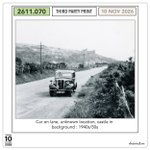
When I was young, I used to dream about changing the world or writing the definitive book on the lives of the great British brewers. But as I have got older, my dreams have changed. Now, as I drift off to sleep each night, I think about my plans to complete the catalogue of my collection of old photographs. Given the boxes and drawers full of lost and abandoned old photos, you might say it is an impossible task. But then again, so was changing the world. Here's catalogue number 2611.070: it's the stuff of dreams.

The photograph is from more than forty years ago and shows the steps leading up to Fitzalan Square in Sheffield from Bakers Hill. In the early 1980s, I commuted by bus and train between Sheffield, where I lived, and Doncaster, where I worked. Many a night, I would race up those steps in a mad dash to catch my bus home. Just looking at the photograph now makes me feel out of breath!

It was twenty years ago today (well, in fact, it was twenty years ago yesterday, but that doesn’t have the same musical ring to it) that I uploaded the first post to my News From Nowhere blog. Since then, there have been 3,230 posts and 3,913,493 visits. That first post featured a picture of the village of Burton Salmon in Yorkshire, and I’m reprising it for this special anniversary. If you want to know what I was doing in Burton Salmon back in 2006, you’ll have to become the 3,913,494th visitor to the blog.

Street scenes like this one - which I photographed in France half a century or so ago - are wonderful reflections of everyday life. Nobody is posing, and no Sunday best clothes are on display; all you have is life in all its variety and confusion. There is no subject, and that itself is the subject. There is no story being told - which is a story in itself. That's life.

I've been taking photographs for a long time. Here's one from sixty years ago, taken when I was still at school in Halifax. Some ran, some jumped, and others held the tape measure to see how far they had travelled. I just stood there and took photographs.

It was such a long time ago. I look at the photograph now and search for myself. I find the hint of a look, the corner of a dream, and the start of a story. Yes, it is a photograph of me, but it is also a photograph of time itself.

A few weeks ago, I mentioned that the view from Halifax, looking up the hillside towards the church of St Thomas on Claremount Road, is one that I have photographed again and again over the last six decades. The same is true of the view in the opposite direction: on so many occasions, I have stood amongst those stone gravestones and taken pictures looking down on Halifax. Here is one from 2009, when the church was still an active place of worship rather than the sad building it is today.

Another of my Sheffield photos from the early 1980s. When using black-and-white film, cut out the grey middleman and concentrate on shapes and outlines - a fancy way of saying I didn’t get the exposure right!

This was among some photographs of mine from the late 1980s, and I must confess that I had completely forgotten what it was or where I had taken it. A quick reverse image search provided the answer: "The image shows a historic bronze water pump spout in Bruges, Belgium, featuring a grotesque or Green Man face and water-spitting dragons or serpents".

The start of a new month - where will it lead us? If this photograph is anything to go by, it will lead us to Firth House in Rastrick.

25
379
This week, Sepia Saturday is celebrating Halloween with ghosts as its theme. In many ways, this is a suitable theme for lovers of old photographs, because so many early photos were linked in one way or another to ghostly phenomena. My photograph shows my Uncle Frank’s parents, Frank and Clara Fieldhouse, at the seaside. Whether the ghostly couple following them are the result of spirits, double exposure, or AI is up to you to decide.

1
21
413
You need an old camera, slow film, and a decent downpour to get a good night shot. Modern digital cameras are hopeless: they sharpen the focus, bring up the shadows, and tone down the glare, leaving you with something about as dramatic as a soggy digestive biscuit. Luckily, when I took this photograph of Commercial Street in Halifax back in the 1960s, my camera was old, my film was slow, and it had rained for days.

I took this photograph in Sheffield more than forty years ago. After all this time, I’m not certain where it was taken - possibly around Kelham Island. The exact location does not matter; it is the starkness of the scene that grips the imagination, accentuated by the photograph’s black-and-white composition. The shapes possess a beauty of their own - a kind of industrial cubism - that is both attractive and meaningful.

This map may not mean much to most people, but it shows Northowram, the village where I grew up. It is dated 1920, although it may be based on data from a decade earlier. What is surprising is not the amount of development in the past 70 years, but how much occurred in the 30 years between the map’s publication and the 1950s, when I was growing up in the village.

For as long as I can remember, I have been in love with images. They offer the ultimate freedom of expression and interpretation, allowing you to explore a moment, place, emotion, or expression in detail. They let you freeze time and make the transient permanent. Images are magical.

Here’s a fun diversion for a miserable Monday morning: take a photograph of a famous Calderdale building, ask a friendly AI bot to turn it into an architectural drawing, and then ask people to guess which building it’s supposed to be. I’ll post the original photograph - and the location - at the end of the day, in case you want to guess.


The Dutch painter Piet Mondrian was one of the founders of the art movement known as Neoplasticism. His palette was limited to the three primary colours - red, blue, and yellow - along with black, white, and grey. The result was art composed of lines and shapes. As far as I know, Mondrian never visited Halifax, but it is hard not to feel that he might have found inspiration there after looking up at the ceiling of Borough Market.
