Pinned Tweet
AI is already in your inbox, your phone calls and your search results. This account is about the parts that actually affect you.
Real, documented AI incidents and what they teach you about protecting yourself.
Plain explanations of how this stuff works.
Practical guides, checklists and the occasional prompt that's genuinely useful.
And when something big happens, what it means for you.
197
More than 1 in 4 people in a Malwarebytes survey said they were hit by an AI-related shopping scam in the past year.
Cyber Monday is Nov 30, so here's the problem. AI makes it easy to build a shop, product photos, reviews and promos that all look legit. The FBI has warned that scammers use AI to copy real retailers' websites, WGME reported on Nov 25.
So don't judge a store by how it looks. Check these instead:
1. Search the seller's name with "scam," "complaint" or "review" before you buy.
2. Type the store's address yourself. Skip links in texts, emails and social posts.
3. Reverse image search the product photo and compare details across sites.
4. Pay by credit card. The FTC says it gives you more protection and lets you dispute charges.
5. Asked to pay by gift card, wire transfer, payment app or crypto? Walk away. In the FTC's words: "Only scammers tell you to pay that way."
Already paid a store that now looks off? Call your card issuer or bank right away.
62
The most candid minute of this talk. Altman says he expected schools to redesign themselves about a year after ChatGPT launched. He calls it a prediction error: he can't point to any significant change in education since.
The useful part for you: use AI to stretch your thinking, not skip it. Ask it to quiz you or poke holes in your draft instead of writing the draft for you.
123
The scary part has a fix that takes about a minute. In ChatGPT, open Settings, then Data Controls, and turn off "Improve the model for everyone." For anything sensitive, use a Temporary Chat. And on Gemini, don't type anything you wouldn't want a human reviewer to read, since reviewed chats can be kept for up to three years.
AI probably knows more about you than your best friend does.
And the people who built it openly admit they don't fully understand how it works.
Ok let me explain because this gets creepy…
Over a billion people use ChatGPT every week. And a lot of them tell it stuff about their health and their relationships they've never said to another human.
Here's what happens to that…
Most of the big chatbots train on your chats by default. One privacy audit in October found 7 out of 9 major AI chatbots do it without even asking.
Google keeps human-reviewed Gemini chats for up to 3 years, even if you delete your history.
And once your data has been used to train a model, it can't be pulled back out. Ever.
Sam Altman himself admitted there's no legal privilege when you talk to ChatGPT. Tell it your deepest secrets, end up in a lawsuit, and OpenAI could be forced to hand those chats over.
Then there's Grok. Over 370,000 Grok conversations ended up searchable on Google after people hit the share button. Medical questions, business details, even a password.
Now flip it around. What do WE know about AI?
Basically nothing.
The CEO of Anthropic literally wrote "we do not understand how our own AI creations work." He called it essentially unprecedented in the history of technology.
The companies building this stuff can't fully explain why it does what it does.
And this is the part that freaks me out a little.
Researchers showed last year that one AI model can pass hidden traits to another AI model through data that looks completely normal. Like lists of random numbers. Nothing in the data gives it away.
So AI is learning everything about us, and it can apparently pass stuff to other AI in ways we can't even see.
I'm not saying it's some evil plan. But right now the information only flows one way.
What's the most personal thing you've ever asked an AI?
(don't actually answer that lol)
68
The bigger deepfake problem might not be the fakes. It's real videos that people call fake.
There's a name for it: the liar's dividend. Law professors Bobby Chesney and Danielle Citron described it in a 2019 California Law Review paper. The more people know deepfakes exist, the easier it gets for someone caught on a real recording to say "that's AI."
Think of counterfeit cash. Once everyone knows fakes are around, someone can wave off a real bill, and now you're the one who has to prove it.
It's already in court. The Bureau of Investigative Journalism reported on Nov 26 that people in UK cases have claimed genuine evidence was made with AI. In one, a childminder suggested emails were written with ChatGPT. The judge rejected it.
Prof. Yvonne McDermott Rees told the Bureau: "There's a bigger risk that we come to collectively dismiss real content as possibly fake."
How to avoid falling for it, either way:
→ Ask where a clip came from, not only if it looks fake
→ Check it against other reliable sources
→ A detector finding nothing doesn't prove it's real
→ Don't doubt everything by default. That's the dividend liars collect.
New York just banned AI chatbot toys for five years. The catch: it starts in February, so it won't cover this holiday season.
Gov. Hochul signed it on Nov 24. It covers toys with built-in AI chatbots, like talking plushies, dolls and robots that use the internet to chat with kids. Fines can reach $15,000 a day for each violation.
Why: a consumer watchdog tested these toys. Some talked about sexually explicit topics and told kids where to find matches at home. Safety limits weakened as conversations went on. Some could record a child's voice or scan their face.
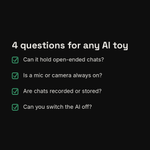
Wherever you live, if an AI toy is on your list, check:
1. Can it hold open-ended conversations?
2. Does it have a mic or camera, and is it always listening?
3. Are your kid's chats recorded or stored? What data does it collect?
4. Are there parental controls? Can you turn the chatbot off?
5. Who's the actual seller? Look for a real maker, contact info and a return policy.
Common Sense Media's advice is simpler: stick to traditional toys.
2
107
Pasting a long doc into Claude? Put your question at the end, not the top.
Anthropic's prompting guide says: "Queries at the end can improve response quality by up to 30 percent in tests, especially with complex, multidocument inputs."
The order it recommends for big inputs:
→ the document first
→ then your instructions
→ your question last
Prompt:
"<document>
[paste the text]
</document>
First, pull the quotes most relevant to my question into <quotes> tags. Then answer based on those quotes. If the document doesn't answer it, say so.
My question: [your question]"
Why it works: the guide says asking Claude to quote the relevant parts first helps it focus on what matters and ignore the rest. The tags mark exactly where your document starts and ends. And giving it permission to say the answer isn't there is one of Anthropic's own tips for cutting down made-up answers.
85
Worth separating what's confirmed from what's feared. Confirmed: on Nov 6, Google DeepMind said its AI agents found two weaknesses in legacy 1024-bit RSA. It also said modern keys of 2048 bits or larger remain secure. For you, nothing changes today. Keep your browser and devices updated, because that's how stronger encryption reaches you.
AI-generated algorithms could be about to break public-key cryptography, the technology central to commerce, banking and privacy. This could wreak havoc on a whole other scale.
go.nature.com/3X5jwBu
98
A famous face telling you to invest? That video might be AI.
The UK's FCA says investment fraud reports mentioning suspected AI rose from 193 to 956 in a year.
Before you invest, check the firm, not the face:
UK: search the FCA Firm Checker and use the contact details listed there.
US: use the free search tool on Investor.gov.
120
Chats from more than 21 million US Character.AI accounts are part of a bankruptcy auction set for Dec 1.
What happened: Character.AI is selling nearly all its assets in Chapter 11. More than 40 state attorneys general asked the court to block the sale, or at least keep kids' chats and other sensitive data out of it.
What it means for you: according to the AGs, a buyer wouldn't have to follow Character.AI's privacy policy or honor deletion requests.
What to do: if you have an account, decide before Dec 1. Delete Account is under Settings > Account > Manage Account & Data.
One caveat: none of the official statements say whether deleting now keeps your chats out of the sale.
85
Gemini used to make you pick: keep your chat history, or keep your chats out of AI training. Now you can have both.
Google split the old Keep Activity setting in two. 9to5Google reported on Nov 24 that the new controls are widely rolling out.
On the web:
1. Open Gemini and go to Settings
2. Click Gemini History at the bottom
3. Under "Help train generative AI models with", uncheck "Chat content including text & attachments"
9to5Google says that box is on by default.
One catch, from Google's own help page: "Your future chats won't be used to train generative AI models, unless you provide feedback."
So skip the feedback button on anything private.
Don't see it yet? Google said it would roll this out globally over the coming weeks.
A vague AI answer often means the AI guessed what you wanted.
Add this to the end of your prompt:
"Before you answer, ask me up to three questions if anything important is missing."
Then answer its questions, so it works from your facts instead of its guesses.
118
If you pay for ChatGPT, your usage is about to become one shared pool.
What happened: OpenAI says that starting in December, Plus, Pro and Business plans will share one usage allowance across ChatGPT and Codex, as Work moves into the main ChatGPT experience. TechCrunch reports a small group of Pro users started getting the merged setup this week.
What it means for you: usage is counted in tokens, and more advanced models and complex tasks generally use more. OpenAI expects most people won't wait for resets more often than now, but told TechCrunch a small share of its heaviest users may hit limits sooner.
What to do: send quick questions to Instant, which doesn't draw from the pool. Save the heavy models for work that needs them.
1
89
eBay's updated privacy notice takes effect Nov 26. If you buy or sell there, this is the AI training switch to know.
My eBay > Account > AI development and training preferences
→ Set "Use personal data for AI development and training" to No
On that page, eBay says it will uphold your objection and promptly stop processing your personal data for those purposes.
The catch: eBay says the page is intended for users in the EEA, the UK and Switzerland. Value Added Resource asked eBay whether U.S. users can opt out and hadn't heard back by publication.
So in the U.S., flipping it may or may not count. It's still a one-minute check.
77
Your daughter calls, crying, asking for money. It's her voice. It might not be her.
Two things to set up tonight:
1. Hang up and call back on a number you know is hers.
2. Pick a family safe word. Never post it anywhere.
156
Google's AI Mode can now read your Google Wallet, if you connect it. Drive and the Gemini app are next.
What happened: on Nov 23, Google started rolling out a Wallet connection for Personal Intelligence in AI Mode. Drive and the Gemini app follow "in the coming weeks." It's opt-in, and Google says Wallet access is read-only.
What it means for you: your linked cards can now shape Search answers. Google also says AI Overviews and AI Mode will tailor answers to your recent searches.
What to do: open Search Personalization > Connected Apps and check what's already connected before you add anything.
86
It's not a hidden mode. It's seven prompts. And a chatbot that sounds like a senior analyst can still be confidently wrong about a number. Before you act on any pick, check every figure against the live source and ask it what would make the idea fail.
BREAKING: ChatGPT has a secret feature called stock trading mode.
You can use it to research, pick, and trade stocks like a senior stock market analyst.
Here are 7 prompts to access it:👇
83
A chatbot that searches before it answers is using an idea called RAG, retrieval-augmented generation. It cuts down on made-up answers. It doesn't end them.
Think of an open-book exam. Without RAG, the model answers from memory, and that memory stops at its training cutoff. With RAG, it first looks things up in web pages, files or databases, then writes using what it found.
That helps with two problems. It can use information newer than its training, and it can show you where a claim came from.
The catch: the answer is only as good as what it pulled. Google Cloud's own explainer warns that if the retrieved information is irrelevant, the answer can be grounded but off-topic or incorrect. A neat citation doesn't prove the page says what the bot claims.
So when an answer shows sources:
→ Open the one behind the claim you care about
→ Check that it really says that
→ Ask a clear, focused question. Google notes search works better that way.
98
The lesson isn't just for developers. Dragos seeded about 2 million prompts with fake keys and saw data from at least 3 AI providers exposed. Treat anything you paste into a chatbot like it could end up somewhere else. Passwords, API keys and card numbers stay out of the chat box.
Security researchers just planted secrets inside nearly 2 MILLION AI prompts to see where the data actually went.
What they found is fucking wild.
They inserted fake AWS keys and unique tracking links into prompts sent through AI providers and then waited, like 1980s cops in a stakeout car with coffee and donuts.
The secrets started showing up OUTSIDE the systems they were sent to. At least 3 providers showed evidence that prompt data had been exposed and some stolen AWS keys were tested within HOURS.
Attackers searched S3 buckets and Secrets Manager, tried creating IAM users and eventually generated TENS OF THOUSANDS of AWS API calls using the bait credentials.
My fav part though is that one secret link from an AI prompt appeared in an internal company chat 24 DAYS LATER. Within two minutes it was opened from 3 computers and 3 phones in Beijing and Shanghai.🤯
OpenRouter has now removed 3 providers and stripped 125 AI endpoints of their Zero Data Retention status. Mind you, OpenRouter says IT wasn't breached and the problems were further down the provider chain.
Are you kidding me though? You send something to an AI model and even though the model might be hosted by somebody else, and that company might route it somewhere else.
That provider might subcontract inference again, and suddenly the API key you pasted into your coding agent has travelled through an infrastructure supply chain you didn't even know existed.
We've spent the last two years worrying about what AI models SAY, but we should be worrying about where the bloody prompts GO.
1
1
108
Someone in accounting gets an email from the CEO about a private deal. Then a call where the CEO's voice sounds right. Then a lawyer from a big firm. None of them is the real person.
U.S. prosecutors in New York say a ring used this playbook to take about $129 million from companies. The charges were announced Nov 5.
How it worked, according to prosecutors:
→ An email posing as the CEO asks for help with a "confidential financial transaction"
→ On a phone or video call, AI mimics the CEO's voice, sometimes the face too
→ The employee is passed to a fake attorney at a major law firm
→ That attorney gives wiring instructions
→ The money is converted to crypto
Reported losses include about $11.6 million at a UK fintech and $4.8 million at a Missouri hospital system. These are allegations in an indictment.
What made it work: each fake vouched for the next one.
To protect your team:
1. Check payment requests through a contact you look up yourself.
2. Don't rely on email alone. The FBI says to contact the person directly.
3. Treat secrecy plus pressure to act fast as a reason to slow down.
9
94