

The epicenter of AI and health at MIT | Now on BlueSky: https://xitter.cf/t.co/Sl6P9xLUH5 | Follow us on LinkedIn and Instagram.
Cambridge, MA
Joined November 2019
- Tweets2.5K
- Following389
- Followers7.6K
- Likes4K


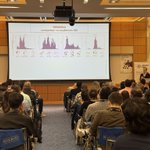




Industry talk #2! Danaher’s Andrey Tovchigrechko talks about how his team used @boltz_bio’s BoltzGen to design beta-zipper mini binder interfaces while using agentic tools to optimize the in silico pass rate in BoltzGen. #MoML2026

How are industry experts using ML in their research? @ByteDanceSeed_’s @chengyenhsieh presents on Protein Autoregressive Modeling: Taking initiative from the hierarchical nature of proteins, PAR generates backbones by forming a global topology & performing refinements. #MoML2026

Up next, @YaleMed’s @MarkGerstein talks about building world models to predict protein folding pathways 🧬 #MoML2026

Starting now, @ISTAustria’s Alex Bronstein talks about developing a general inference time optimization framework that can maximize log-likelihood and incorporate external constraints while eliminating dependence on diffusion length and removing initialization bias. #MoML2026

How can we improve target discovery for better drugs? @omenndarlingbio’s @idmjky talks about how EVOLVEpro demonstrates the usefulness of language models in optimizing protein function. He also introduces MESSI, for immunogenicity aware binder design.

Now hearing from @FU_Berlin’s @CecClementi on the short-sightedness of GNNs and potential solutions. She introduces a framework for efficiently and accurately simulating biomolecular complexes. #MoML2026

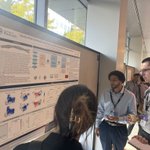
Poster Session I is in progress! Top 4 posters will be up all day! Who do you think will win the Best Paper Prize? 👀 #MoML2026
#MoML2026 Top 4: @PaulSharoubeem presents Electro-Prot, 6.7M-parameter encoder-decoder transformer trained on 162,980 APBS calculated fields to predict Poisson-Boltzmann potentials at arbitrary points around a protein!

#MoML2026 Top 4: @Northeastern and @broadinstitute’s Yikun Zhang presents on MolSAGE, a framework that accumulates and and reuses experience across tasks to build state-of-the-art drug models efficiently!


MIT Jameel Clinic for AI & Health retweeted

Can we design proteins from motion? Check out SPINET, our cellular sheaf-based inverse folding network: arxiv.org/abs/2609.34153
Curious how it works? Stop by poster #40 at the #MoML conference tomorrow (Oct 14) organized by @AIHealthMIT to meet co-first author Jens Lundsgaard! – at Shorewood Hills, WI

👀 Next up: @pas_saro and @NoahBGetz from @boltz_bio present on their approaches to maximizing performance on structure and affinity prediction in the Boltz model series, and their work on using BoltzMol-1 to identify a target inhibiting DNA damage repair. #MoML2026


How can dynamic biomarkers improve patient care? @cityofhope’s Andrea Bild shares how evolutionary models can transform cancer therapeutics.

MIT Jameel Clinic for AI & Health retweeted

Posting my talk tomorrow at MoML 2026 at @MIT (organized by @AIHealthMIT lectures.gersteinlab.org/sum… New slides on World Modeling for drug dev. & its integration with @daifengwang's drug repurposing


#MoML2026 is underway! #JameelClinic faculty lead @BarzilayRegina opens the conference with a presentation on the state-of-the-art in molecular modeling.

We're excited to hear from @YaleMed's @MarkGerstein on Wednesday, Oct. 14 for #MoML2026! <20 tickets left!
🎟️ Register now before tickets are sold out: moml.mit.edu/

How do you communicate risk to a patient? To kick off #BreastCancerAwarenessMonth, we're excited to share that @Hadassah_Med has started using Mirai in clinical trials to assess breast cancer risk + how women feel about personalized risk assessment, w/ Tanir Allweis @ the helm 🧵

Allweis, who was a '25 Visiting Professor @AIHealthMIT and the current Chair of the Dept of Breast Surgery @Hadassah_Med believes that understanding women's attitudes towards AI-based risk assessment is key to understanding how best to communicate risk to patients. 2/3