

Founder https://xitter.gq/t.co/uMuX33Lo82
Boston, MA
Joined March 2023
- Tweets200
- Following107
- Followers1.9K
- Likes133




Billionaire founder-CEO Brad Jacobs explains to my MBA students why he's grateful for everything in life.
A wonderful Thanksgiving message!
"I have a thing called tinnitus, where I have this ringing in my ear. Some people go to therapy to deal with it, or they go to the Mayo Clinic to try to cure themselves."
"But I love it. Right now I'm hearing it. I love hearing that ee-ee-ee. I feel special. I feel blessed. I feel like I have the sounds of the universe ringing in my ears."
"My approach to life is to try to embrace it so deeply and to really feel grateful that I actually can breathe, because I'm not going to be able to breathe forever, to feel grateful that my heart works, because that won't last forever."
Thank you, @jack_watson_hfw. We have been fortunate to work with and learn alongside some remarkable business builders over the years.
We share some of these conversations through our newsletter, which we aim to keep highly curated and focused on building, owning, and supporting businesses over decades. You can explore past editions and subscribe here, if of interest:
us17.campaign-archive.com/ho…
Happy holiday season to you and yours.
1
166
Home Depot co-founder & billionaire investor Ken Langone on the best gift he ever received: unconditional love from his parents.
"Whenever I stuck my neck out to do something constructive, I knew they'd be there for me if I failed."
"I'd be getting a hug from Mom and I'd grab her hand and pull her in and hug her, and she'd just melt."
"That's what I'm talking about. You can't replace that."
A wonderful reminder about what matters this holiday season.
This is one of the main lessons I try to teach my students:
Selling too early can be much, much more expensive than holding too long.
In 2007, Philips Electronics owned 16.2% of TSMC. By 2008, they had sold all their shares for ~$8.5 B. Today, that same stake would be worth $550 B.
Stanford University once owned 0.68% of Google. By 2005, they sold all their shares for ~$340 M. Today, that same stake would be worth $17 B.
Peter Thiel owned 2.5% of Facebook before its 2012 IPO. That year, he cashed out most of his shares for ~$1 B. Today, his pre-IPO stake would be worth $39 B.

Sequoia's Doug Leone has a confession every investor still needs to hear:
"We owned 20% of Nvidia and sold."
"We were the first investor in Apple and sold."
"We owned 10% of Google and sold."
Then the line that still stings: "If we hadn't sold Google, that would be half a trillion dollars."
This is Sequoia, arguably the greatest venture firm ever built, and even they couldn't stop themselves from ringing the register too early.
The hardest discipline in venture isn't finding winners. It's holding them when every rational instinct says "take the gain."
The asymmetry is brutal: your downside on a winner is capped at your position. Your upside is uncapped. Yet the psychological pressure to sell, the LP calls, the markups, the "responsible portfolio management", pushes in the other direction every single time.
Most VCs optimize for a good fund. The legends optimize for one position they never sold.
Full breakdown here: HOW TO SUCCEED AS A SEQUOIA INVESTOR
productmarketfit.tech/p/how-…
2
25
5,276
Basically, you do nothing.
A 50% price decline doesn't tell you anything about the long-term prospects of a company:
Amazon was down 93% in the early 2000s.
Home Depot was down by 66% in 1985, 53% in 1987, 70% in 2003, 70% in 2009.
Netflix has been down by more than 70% four different times.
Costco was down 70% from 1992 to 1995.
Meta fell by 50% in 2012 (post-IPO) and then again by 75% from 2021 to 2022.
Starbucks was down 50% in 1998, 1999, and 2008.
The list goes on...

1
7
1,202
Netflix co-founder and long-time CEO (and current Anthropic board member) Reed Hastings called Netflix's IPO in 2002 "one of our big mistakes."
Here's what he told my MBA students when we hosted him in class recently:
"[Going public] allowed Blockbuster to read the financials, and they were like, 'Wow, this business works.'"
"What we should have done is realized that eventually, competition from the incumbent's gonna be a big deal, and the longer they underestimate us, the better."
"So we should have kept all the business press away about how successful we were."
Here's my full interview with Reed (with a transcript) for those interested:
worldlypartners.com/in-conve…

2
586
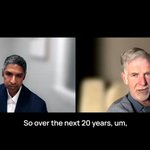
Netflix co-founder & Anthropic board member Reed Hastings gave my MBA students this advice for navigating a job market that he believes could become dominated by AI:
"Over the next 20 years, AI will eat up a bunch of jobs.... At that point, society will reorganize itself. Maybe it'll be universal basic income, maybe it'll be retirement at 50 and then you get on social security."
"I think we'll have a lot of money because the economy will be very strong, but you don't want to be in the first 20% to get made redundant. You'd rather be in the 80% that are still working."
"And I think the key to that is AI skills. Every organization is going to hold on to people who are AI sophisticated. So that will be the thing that keeps you employed in the difficult transition phase."
I recently hosted Reed in my MBA class as a guest speaker. Here's the full discussion for those interested: worldlypartners.com/in-conve…
3
1,767
Reed Hastings studied AI at Stanford in the '80s before co-founding Netflix.
Now he serves on the board of Anthropic. He says that with more compute, AI could become superhuman:
"In the '80s, there were neural nets around, but because the amount of computation was small, they couldn't do anything interesting."
"30 years later, the computation had expanded one millionfold, and with a million times more computation, it started to get interesting."
"Now we probably need another millionfold expansion for it to be superhuman."
2
857

Thanks @ApplePodcasts for naming our Formula 1 episode one of the Best Episodes of 2026!
apple.co/2026review
11
860
Reed Hastings (Netflix co-founder & Anthropic board member) on why frontier AI companies may have an enduring competitive advantage:
"OpenAI has the biggest compute scale, and right behind it is Anthropic."
"The bigger the compute gets, the smarter the AI gets, and if those power laws continue to hold, then it's a real scale business for the leading-edge intelligence."
"And just as you pay up to hire the best employees and pay up to get the best doctors, I think you'll pay up to get the best AI a lot of the time."
I hosted Reed as guest speaker in my MBA class two weeks ago. Here's our full conversation for those interested: worldlypartners.com/in-conve…
499
Sequence of returns = mathematically irrelevant for buy-and-hold investors.
Consider two funds, A and B, which post the same yearly returns in a different order.
Over 10 years, both generate the exact same cumulative return, turning $1 into $2.70.
(Graph from: worldlypartners.com/sequence…)

2
3
575
Numerous studies have shown that fund flows are correlated with past performance.
This means that by Year 7 (or much sooner), Fund B would be facing redemptions, while Fund A would be enjoying substantial inflows.
1
1
119
And yet those whose pile into Fund A after six years of positive returns will end up losing 70% of their money in the remaining four years.
Patients investors, on the other hand, (who stay put in either Fund A or B) will end up with the same wealth outcome: $2.70 for every $1 invested.
(Graph from: worldlypartners.com/sequence…)

83
Brad Jacobs and his team have created fantastic value over time.
If you had invested alongside them in their three prior public companies (United Waste, United Rentals, and XPO), reinvesting the proceeds from one to the next, you would have turned $1 into $311 from 1992 to 2025.
That's 10x the S&P 500 over the same period.

But the path to 311x was not smooth (as is typical of the best multi-decade investments).
Check out those drawdowns:
-87% from 1998 to 2002
-59% in 2011
-61% from 2015 to 2016
-65% from 2018 to 2020
-58% from 2021 to 2022
1
492
Brad joined my MBA class to discuss the temperament required for multi-decade compounding and his playbook for consolidating industries.
Here's the interview for those interested:
worldlypartners.com/in-conve…

2
291