

Really into really into RSI… "Wow, everything's eval"
Joined April 2016
- Tweets4.1K
- Following1.3K
- Followers928
- Likes6K








TESCREAL retweeted

Last month, OpenAI called in the three outspoken safety researchers and asked them to unlock their personal phones. It was conducting a leak investigation into a story in The Information about Astra’s use of opaque architectures, and the company’s plans to continue down that path. A week later, at 2 p.m., they were all fired.
Our story, w/ @ZeffMax and @berber_jin1 , looks at the battle over how much AI companies should share with third-party monitors like METR and Redwood to ensure AI safety wsj.com/tech/ai/the-signal-c… via @WSJ


TESCREAL retweeted

The Department of Homeland Security is requiring all civilian federal agencies to remove DeepSeek products and 'any third-party services developed using DeepSeek implementations,' and to stop buying them.

If we had a benchmark for ridiculous this would own the leaderboard.

Emily Youcis
My Friend Dario
The Slop Cannon
Vitalic
Starring @DarioAmodei @JensenHuang @pmarca
By Emily Youcis 2026
TESCREAL retweeted

The guy who built this digital whip for Claude Code is definitely getting a lifetime Claude ban for “abusive or cruel behavior.”


Oh snappity snap. (The AGI Chronicles was just published today, IYDK)

"Brockman thought Amodei was a paranoid control freak who used safety as a pretext to win arguments"
from The AGI Chronicles by @kevinroose
TESCREAL retweeted

Coherent diagrams of higher category theory fall out for free once enrichment is sufficiently generalized.


TESCREAL retweeted

this is pure f*cking treasure
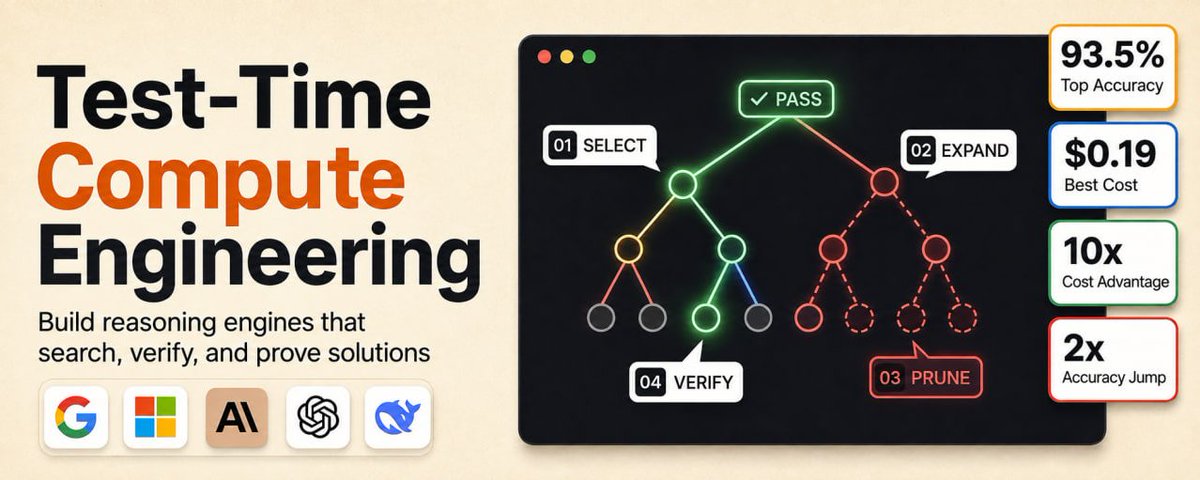
A Stanford research group found how to orchestrate Claude Opus 5.5 and GPT-6 Astra together, and it completely breaks the resampling wall
most developers think test-time compute means running 32 blind retries on one model. you burn API tokens repeating the same 2-3 error clusters in loops
Stanford's paper (arXiv:2608.05643) splits the compute between two different brains:
> breadth search: GPT-6 Astra runs high-entropy exploration (T=0.8) to discover divergent solution paths
> step audit: Claude Opus 5.5 scans each step at T=0.0 and catches the exact logic fallacy
> local surgery: Opus rewrites only the broken step instead of dumping the whole reasoning chain
> verifier-free consensus: majority voting locks the proof without relying on drift-prone PRMs
the benchmark metrics outclass standard Best-of-N sampling:
> 91.2% recovery rate on detected reasoning flaws
> under 1.8% regressions on correct branches
> MATH500 jumps from 29.6% to 58.0% (+28.4% absolute gain)
> AMC-2023 improves by +7.5% with zero reward models
Astra explores the maze. Opus repairs the logic
you stop burning tokens on blind retries. you run verified reasoning depth

Readers added context they thought people might want to know
arXiv:2608.05643 does not orchestrate GPT-6 Astra and Claude Opus 5.5. One open-weight model generates, critiques, and corrects. MATH500 29.6% to 58.0% and the +7.5 AMC gain are for Qwen2.5-1.5B. Two coauthors are at Stanford. arxiv.org/abs/2608.05643


So, I asked Gemini (Pro) about Claude and was surprised how frank it was. Yikes. It said Anthropic's latest model is "a massive post-training miscalculation" and referred to it as "a hostile, low-utility bottleneck"

RIP Zo Computer

I’ve seen a couple of posts about this so wanted to demystify. Today, every Muse user gets a free computer in the cloud. It's a real computer, and we’ve designed the security architecture of the Muse Secure VM carefully so you and your Muse can do almost anything you could with a computer sitting under your desk while keeping you and the system safe from threats like prompt injection. We wrote about this at length in our security blog post – security.muse.ai. Activity in the “runtime cell”, which you share with your Muse is unfettered, but sensitive actions are all overseen by the Sentinel, which runs outside of that cell. Similarly, all sensitive secrets - like the passwords you enter into Muse’s secure credential storage - are also stored outside the runtime cell.
The runtime cell gets its own root filesystem (including a full Ubuntu linux image) separate from the host filesystem where your other more sensitive data lives. Because it is isolated from the sensitive stuff that runs on the same box, this means that we can, and do, offer users full visibility and control over the files in the runtime cell. Just as you can when you install Linux on your home computer, you can poke around and see all the files that make the system work - both debian system files and the binaries and data files that implement the parts of Muse which run in the runtime cell.
This was a very deliberate choice - your Muse Secure VM truly is your own computer in the cloud. You can install software in it, write and compile code, use the browser to surf the web: it is your own Linux box that you can operate as you choose with your Muse. Poking around in this computer doesn't give you any privileged access to Meta infrastructure, or to other people's data
If I may geek out a little here for a second… As a kid I loved to take things apart to see how they worked. As a teenager I got into computers and soon found myself drawn to C:\WINDOWS\SYSTEM and the system registry, later Slackware’s /dev/, /proc/ etc – I could see how the system was laid out and as I explored what DLL files and .so files actually did, I gradually became able to meld the computer to my own will.
We’re really proud to be able to put a real computer in millions of people’s hands with a similar level of transparency. We built a file explorer right into the Library tab of the UI. We want you to be able to see the markdown files Muse writes while it thinks about how to serve you better, and explore the internals of the system if you’d like to.
So, when you ask your Muse to show you its entire filesystem, and receive gigabytes of files you’re seeing the full contents of the runtime cell. It’s yours to explore and enjoy!
If you’re not a geek like me, or simply want to download the data that you personally have created directly with your Muse, we added a feature for that too in Settings > Data controls > Download your agent data.
