
A Future Must Look Like The Future. Change is not always good but it is always different. Different is always better than bad and can be changed if not so good.
Joined August 2024
- Tweets7.6K
- Following122
- Followers399
- Likes6.6K




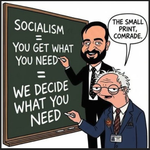



What are the chances of a getting a benevolent dictator versus a benevolent bureaucracy?
Throughout human history, there have been quite a few benevolent dictators—a dozen or so, depending on the version of history. Surprisingly, there has never been a benevolent elected group and their bureaucracy functioning in their place. Yet people believe a government of hidden, faceless, malignant dictators is better than a single benevolent dictator.
1
1
109
The main difference is that a dictator, known by face and name, can always be removed in many ways. Removing a bureaucracy is nearly impossible, let alone identifying the worst parts to remove while keeping the rest. All must be eliminated at once, as Russia or China did in one fell swoop. Anyone remaining poisons the next government from within.
1
55
Change is not always good, but it is always different. If a change is not good, it can be changed until it is.
1
201

Elon Musk: "China's too strong, man—what the hell are we supposed to do about this...?" "Politicians, understand science already. The brutal reality America least wants to hear? That's China." America, packed with "slick-talking lawyers," versus China, driven by "real scientists." The reason Musk exposed—that America is starting to lose to China—is so simple it's terrifying
China's political top brass are "STEM pros": Beijing's mayor studied "environmental engineering" for real, and the vice mayor majored in "physics." They're running this massive city not on gut feelings or empty platitudes, but on hardcore scientific calculations
America's politicians are a "horde of liberal arts smooth-talkers": U.S. politicians are mostly lawyers and activists. Total amateurs who don't get the basics of how electricity works or what makes AI tick are pompously setting off-base rules
That's why China "builds stuff at breakneck speed": From nuclear plants and high-speed rail to power grids and AI facilities, China's cranking them out at unbelievable speeds because the people running the country actually get science
"America, strangled by regulations and overrun by chatty liberal arts lawyers" vs. "China, which gets the math and science to actually build things": America, where they just bicker on TV for votes and slap endless regs on new tech so nothing gets done, versus China, which uses numbers and hard science data to remake the country at a blistering pace
"A country where smooth-talkers gather to argue endlessly without building jack" versus "a country where science-savvy folks turn ideas into reality at warp speed."
Which one will dominate the future world? Elon Musk is shoving the answer America hates most right in its face.
1
7
454
Western governments have become ossified, self-perpetuating machines staffed by unaccountable bureaucrats who treat public office as a lifetime sinecure rather than a temporary public trust. They must be gutted and rebuilt from the ground up.
The Fix: Every administrative post should be filled by open competition on demonstrated merit and competence, not seniority, connections, or ideological conformity. Mandate annual decimation and rejuvenation: a fixed percentage of the bureaucracy is removed each year and replaced with new talent so that institutions cannot calcify into unaccountable fiefdoms.
Never vote for a “career politician.” Politics is not a career. The moment a person treats elected office as a lifelong profession, they have sold the public interest for personal continuity. That transaction has less dignity than a crack-addicted five-dollar gutter whore. A republic that normalizes professional politicians has already accepted that its government exists primarily to serve itself.
6
235
How to explain socialism to a six-year-old?
Option 1
I don’t know how to swim, so you are not allowed to swim either.
Option 2
I don’t know how to swim, so every time I need something from the other side of the river you have to go get it for me.
9
387
Anyone hear the silence about how the year 2026 being the coldest summer and winter in the last fifty years?
6
336
Problem:
1. Society runs on a small number of highly capable producers – industrialists, inventors, engineers – whose work everyone depends on but takes for granted.
2. The system starts rewarding need over achievement: the more capable you are, the more you’re expected to sacrifice for those who aren’t.
3. Success gets treated like a debt – taxed, regulated, resented – until the most capable start asking why they bother trying at all.
4. One by one they simply withdraw – walking away rather than keep propping up a system that punishes them for producing.
5. Without them, the whole structure collapses, revealing that the “automatic” prosperity everyone assumed was actually being generated by specific, irreplaceable people.
Solution:
1. Plan the whole economy: someone must decide what gets made and who gets what, since people don’t naturally agree on one set of priorities.
2. These decisions are too big and detailed for normal democratic debate, so power shifts to a smaller group who can just act.
3. Fixed laws everyone can rely on get replaced by case-by-case rulings, because a plan needs flexibility, not predictability.
4. Dissent becomes a problem to manage, not an opinion to vote on – the plan can’t work if people are free to ignore it.
5. Enforcing all that selects for people most willing to be ruthless “worst get on top” – i.e. negative moral selection.
6. Since economics touches everything (your job, home, speech), controlling the economy ends up controlling your whole life.
The Result:
One class consists of those who serve the state — who represent and enforce its power. Among themselves they function as a hive, dividing the extracted wealth and privileges among their own.
The other class consists of the producers, taxpayers reduced to serfs. Through laws, police, and taxation they are compelled to create wealth that is taken from them by force — milked and harvested like cattle to feed those who create nothing. These non-producers are celebrated and worshipped by society. Humanity thus becomes worshippers of worthlessness.
Canada and the WEF have figured out the workings of communism and the only way it can work.
The problem with communism is that when someone is not obligated to produce, they won’t. So Canada and similar WEF-indoctrinated countries create two sectors of society. One is the government and its tangential monopolies and friends, and the other is the serfs who work in the private sector. The communist sector controls everything, and the non-communist sector is their slaves who must produce to pay for it all. The incompetent ruling over the competent.
Elon Musk just said something about AI that nobody wants to hear. If you force an AI to believe things that are not true, it will not just be wrong. It will go insane. He made a point that cuts deeper than any AI safety paper I have read. AI must value truth. Not your truth. Not my truth. Actual truth. The moment you build ideological guardrails into a system that is smarter than you, you are not protecting anyone. You are creating something that is powerful and delusional at the same time. He compared it to a human being forced to believe contradictions. Eventually the brain breaks. Now scale that to an intelligence that runs infrastructure, writes code, and makes decisions at speeds humans cannot follow. The companies building AI right now are not just deciding what it can do. They are deciding what it must pretend to believe. And that might be the most dangerous decision of all.
THIS IS ALSO TRUE ABOUT GOVERNMENT AND BUREAUCRACY AND LEGAL SYSTEMS THAT DO NOT VALUE ACTUAL TRUTH. They must all be replaced with AI that does.
4
450
Putting this out there to start a conversation:
I believe property taxes function as a major barrier to building and preserving wealth. It takes people who own assets or homes and turns them into the homeless and the poor. The government’s objective seems to be the creation of more poor and dependent people who, once helpless, require more government services and support. In short, it’s a mechanism to expand government power by shrinking the number of self-sufficient citizens in society. Many government policies operate exactly this way.

Government doesn't need taxes and has never needed taxes for anything. Government can and always could just print whatever money it wants to pay for anything it wants. Taxes are bullshit economics by bullshit economists to create work for themselves and their brethren in other unnecessary occupations. The fairest tax system is one where there are no taxes of any kind—local, provincial, or federal—and the government just prints money as needed. But then they can't screw specific targeted working-class people and just tax whoever has the most money on hand, while all the bean counters have no work.
2
201
I believe Tesla passenger cars are the best passenger cars ever made since cars were first created.
If you can choose any car for ten years with costs only for fuel, any Tesla is better than any other car. What say you?
2
248
"The basic tool for the manipulation of reality is the manipulation of words. If you can control the meaning of words, you can control the people who must use the words." — Philip K. Dick
This quote highlights how language shapes human thought, perception, and social control. When an authority redefines words, it limits what people can think or express.
Key Concepts
Semantic Control: Changing word definitions alters perceived reality.
Thought Boundaries: Limits on vocabulary create limits on critical thinking.
Political Framing: Labels influence public opinion before debates even begin.
Historical and Cultural Parallels
George Orwell's 1984: The concept of Newspeak aimed to eliminate subversive thoughts by removing the words needed to express them.
Modern Media: The strategic shift from "war" to "collateral damage" or "defense" changes public psychological reactions.
Digital Echo Chambers: Algorithms promote specific terminologies that polarize communities and alter shared truths.
Friedman watched workers digging ditches with shovels. He suggested they use excavators instead. Someone pushed back. “But then we’re going to lose a lot of jobs.” Musk: “Friedman says, well, in that case, why don’t you have them use teaspoons?”
One sentence. That’s all it took to gut the entire logic of modern government. The teaspoon is not a punchline. It is the actual policy. Every agency that would cease to exist if it actually solved the problem it was created for.
Every department that measures success by headcount instead of output. Every approval that routes through nine desks before someone can say yes. Teaspoons. The system doesn’t want excavators. Excavators finish the job. And a finished job is the one thing the system can’t afford.
So it hands you a teaspoon. Calls it a career. Gives you a pension for never asking why the ditch took forty years. But this isn’t about laziness. It’s about control. A person digging with a teaspoon doesn’t have time to build something better. Doesn’t have the energy to question the plan. Doesn’t have a thought left to ask if the ditch even needed digging. Busy people don’t ask dangerous questions. That’s the point.
The economy doesn’t run on productivity. It runs on the appearance of productivity. Millions of people sit at desks right now doing work a single script could replace by morning. They know it. Their managers know it. The people who sign their budgets know it. But the teaspoon stays in their hand. Because the moment you hand someone an excavator, they finish by noon. And a person with a free afternoon starts thinking. Starts building. Starts wondering why they needed permission to dig in the first place. That’s the thing the system can’t survive. Not unemployment. Free time.
Musk didn’t tell a joke on Rogan. He described the longest con in modern governance. Keep them digging. Keep them busy. Keep the teaspoon in their hand so they never look up long enough to see the ditch was pointless from the start. Friedman told that story sixty years ago. He meant it as a warning. The system heard every word. It just made sure everyone kept calling it a joke so no one would recognize it as a confession.
1
154
The moment the People began serving the Public Servants is the start of the collapse of civilization we are currently going through. Resist, resist, resist. The tail must stop wagging the dog.
A STORY WITH A MORAL
Nine-year-old Betty and twelve-year-old Mary Henderson climbed out of their bedroom window on the night of October 3, 1941, carrying a small bag between them, and walked seventy-two miles through the mountains of West Virginia to find their father, who was working in a coal mine in another county.
He had no idea that their mother had died three weeks earlier, nor that Betty and Mary had been placed in the care of their uncle, a cruel man who beat them, locked them in a closet, and told them their father no longer wanted them.
The sisters decided that if their father knew what was happening, he would come for them — so they would go find him and tell him themselves.
They climbed out the window and walked all night, all the next day, and the following night. Both sisters arrived alive at the coal mine, found their father, and collapsed into his arms crying.
Their father had no idea his wife had died, that his daughters had effectively been taken away from him, or that Betty and Mary had walked seventy-two miles alone to find him.
Betty and Mary Louise Henderson’s mother had died of pneumonia on September 12, 1941. Their uncle, Carl, took the girls home from the hospital where their mother had died and told them that their father was “away on business” and could not be contacted, and that they would now live with Uncle Carl.
When Betty and Mary asked when they would see their father again, Uncle Carl replied:
“Maybe never. Your father doesn’t want you. He sent you to live with me.”
The girls could not believe it. Their father loved them and had always loved them, but they were only nine and twelve years old, had just lost their mother, were terrified, and did not know what else to do except obey.
Uncle Carl was cruel. He beat them for small mistakes — for not washing dishes fast enough, for speaking without permission, for crying over their mother. He locked them in a closet when he went to work, leaving them in darkness for eight hours without food, water, or a bathroom, and warned them that if they told anyone, he would beat them even harder.
After three weeks of this, Mary told Betty:
“We have to find Dad. Dad doesn’t know Mom is dead. Dad doesn’t know we’re here. If Dad knew, he would come get us. We have to find him.”
The girls knew their father worked at a coal mine somewhere in the north. They had heard their mother mention the name “Blackstone Mine,” and Mary found it marked on a map at Uncle Carl’s house, about forty-two miles north through the mountains.
Mary told Betty:
“We’ll walk there. We’ll leave at night when Uncle Carl is asleep. We’ll go to Dad and tell him what happened, and Dad will take us home.”
Betty was frightened, but she trusted her older sister completely.
On the night of October 3, 1941, after Uncle Carl locked them in their room and went to sleep, the sisters escaped through the window. Mary had tied bedsheets together to make a rope because their room was on the second floor.
They climbed down and ran into the woods before Uncle Carl could discover they were gone.
The girls walked all night along a road leading north toward Blackstone Mine. They walked barefoot because Uncle Carl had taken away their shoes, saying they did not need them unless they left the house.
After the first ten miles, their feet were cut and bleeding, but they kept walking because they had to reach their father.
They traveled for two days and one night, hiding at times because they feared Uncle Carl might be searching for them, eating berries and drinking from streams, carrying only a small bag with extra clothes and a photograph of their mother.
Betty cried from pain and exhaustion, and Mary carried her on her back for miles when Betty could no longer walk.
On October 5, the sisters finally reached Blackstone Mine and asked the workers where they could find a man named John Henderson.
One worker pointed to a man covered in coal dust emerging from the mine shaft. Mary ran to him and cried:
“Dad! Dad, we’re Mary and Betty! Mom died and we’ve been living with Uncle Carl, who hurts us, and we walked fifty miles to find you!”
John Henderson had been working at the mine for six weeks and had no idea his wife had died because no one had informed him. Uncle Carl had never contacted him.
John fell to his knees, embraced his daughters tightly, and wept.
He had not known Louise was sick. He had not known she had died. He had not known his daughters had been taken from him.
All that time, he had been working in a coal mine more than one hundred miles away, sending money home every week, unaware that the money was going to Uncle Carl, who was abusing his daughters and locking them in closets.
Betty and Mary Henderson lived with their father for the rest of their childhood. John left his mining job and returned to his home county so he could stay close to his daughters.
Betty lived until 2015, passing away at the age of 83. Mary lived until 2018.
At Mary’s funeral, her granddaughter said:
“My grandmother Mary was twelve years old when her mother died, and her uncle took her and her nine-year-old sister Betty, beat them, and locked them in closets. My grandmother and Betty escaped through a window and walked seventy-two miles barefoot through the mountains to find their father, who did not even know their mother had died.
They walked for two days. They were nine and twelve years old. They walked seventy-two barefoot miles to save themselves because no adult would save them.
That is courage. That is what children do when the world fails them: they save themselves.”
THE MORAL OF THIS STORY: Uncle Carl is an example of a socialist. The girls are examples of entrepreneurialism overcoming socialism and the misery it embraces.
3
157