

Building enduring companies in “un-cool” sectors. Ex-consultant & ex-startup exec, now SMB operator/investor.
Redwood City, CA
Joined March 2007
- Tweets4.8K
- Following1.4K
- Followers1.4K
- Likes2.3K



Pinned Tweet
Today, I celebrate 1 year of buying and running my first small business.
Here's the (wild) story of how I went from being in a startup Board meeting, to a vineyard in St Emilion, to caring about swimming pools in California and kitchens in Seattle.
A SMB/ETA story 🧵
Abhi Ravishankar retweeted

There is NOTHING worse than dealing with insurance for small biz owners. Liability, E&O, Property, Renters, Health, Life, Disability, etc.
-All purchased seperately
-Weaseling out of very normal and legit claims
-All sold by brokers, but provided by a totally different company (the carrier)
-Everyone you deal with is unbelievably incompetent
-Prices go ONLY one direction
-They forget to bill you and cancel your policy
-Billing errors in general
-Opaque industry lingo is the norm
-All renew at random different times throughout the year
-So many other things I'm forgettting
Amazing that nobody is tackling this. There are how many SMBs in this country, and they ALL deal with this.
I need to send this to everyone who just reads clickbait, watches sensational news channels and has a deep unfounded disdain for SF and the Bay Area. (And some of them have never ever set foot here!)
It’s the most clear articulation of the ground reality we live in.

you keep citing SF problems for reasons why the tech industry would want to move away. but it's important to understand that the overwhelming majority of the tech industry is in Silicon Valley -- the literal valley running down the peninsula -- not San Francisco.
SF's combined market cap is ~$800b market cap in public companies plus startups and AI labs (which are driving most of the discourse), compared to almost $20 trillion market cap in the south bay/peninsula, plus almost all the VC firms. in terms of employee count, Claude estimates there are ~75-95k tech industry employees in SF, and ~350-400k in the rest of the Bay. looking at a map of big tech company headquarters will likely be edifying. most of them are an hour+ outside SF.
and in many ways the suburbs in Silicon Valley are some of the most desirable places to live on Earth. nowhere else in the US can you find a pleasant climate year-round within an hour of two major cities (don't forget about San Jose!) with abundant high-paying jobs, very low crime, world-class schools, etc. small houses on the peninsula cost millions of dollars because _that's how much people value living there_.
a huge portion of tech executives, employees who vested and exited a decade or two ago -- all your prospective angel investors and VCs -- and two-tech-income working families all live there, and they're really happy living there, and it would be just about impossible to convince them to leave. so if you want a single reason why the tech industry is hard to move, that's it right there. most anyone who is established -- in particular all the decision makers behind all the capital -- have zero reason to move anywhere.
and don't forget about San Jose btw. Santa Clara County has more tech employment than SF and San Mateo combined. you never hear about San Jose's problems on twitter, and you know why? it doesn't really have any! a city of a million people with a median household income of $148,000 -- composed almost entirely of families living in nice little detached homes working stable jobs. one of the beating hearts of the tech industry -- albeit completely culturally irrelevant.
so okay. you cited housing and crime as the reasons why people would want to move. crime is only a problem in SF -- we'll get to that later. housing is a problem everywhere in the Bay -- people complain about it a LOT. it's true! but also, housing is a problem everywhere. the Bay is worse than average, but not by a factor of 2x -- pretty much every major metro area in the country is hardly building housing. the housing problem in the Bay is so bad _precisely because people want to live here so much_, and they can afford to do so.
and that's the thing -- tech industry employees _can afford to live here_. we complain, because paying the extraordinarily high prices sucks, but we can do it! tech employees are famously paid a lot of money! it's an annoyance for the tech industry -- it's only a real problem for everyone else. people make a lot of noise about it on twitter, and for good reason, but it's not driving the tech industry away from the region -- we're the ones setting the prices!
and then crime. yeah, SF has a crime/social disorder problem. again, this affects most of the tech industry not at all, because the overwhelming majority of the industry neither lives nor works here. and even within the city, most of the crime, grime, and disorder is concentrated in a few neighborhoods. as long as you don't linger in certain areas after sunset, the city feels very safe. yeah, social pathologies are pretty prominent, and this sucks, and people rightly make an issue about it.
but this is not enough to actually make living here unpleasant. and in particular, if you can afford to rent outside SoMa, you hardly even see this except maybe if you commute down Market Street or go out in the Mission. so while people rightly make a lot of noise about SF's governance failures here, it's not a compelling reason for the tech industry to leave the city, let alone the region.
(also, it's only been really bad since covid, and it's been getting steadily better. the tech industry was instrumental in getting Lurie elected because of these problems, and he's making progress! yeah the governance of the city sucks, but it's at least somewhat tractable.)
and sure, what about the startup scene? its center of gravity has shifted in large part to the city, away from Silicon Valley. why doesn't the next generation of founders leave or found somewhere else? well, this might happen. but then you lose out on the talent and capital and networks and mentorship expertise and so on that is firmly rooted in the idyllic Valley. is that worth it? some people think so! we'll see what happens. but certainly this hasn't happened in the current generation. part of the reason you're hearing so much noise about housing currently is because ~all the AI startups are here, printing beaucoup bucks and driving up the prices. again.
you hear the most about SF's problems on twitter and on the news. partially this is because the squeaky wheel gets the grease, partially because the startup scene has shifted its center of gravity here, and ultimately because it's San Francisco. it's an iconic American city, it has a rich and storied history, it's a useful synecdoche for the Bay at large (especially for people with an ideological axe to grind), and it is a perennial driver of culture. but don't mistake SF's problems, or the startup scene's grievances, with the broader Bay or tech industry.
the tech industry is in the Bay -- and has been for the last 70 years -- because it's one of the best places to live on earth, both because of the natural features of the region and because of the history and governance (no non-competes! very little crime outside SF!) and culture here.
and ultimately, SF has all this chaos and disorder and startups and culture because this is a city that draws and shelters freaks and weirdos and outsiders and pioneers, and as much as we'll always complain about it, we love it here, and we wouldn't have it any other way.
1
257


Abhi Ravishankar retweeted

Small business is probably the future of employment, more than people realize

New business formation has exploded since the pandemic; first because of remote work, now because (?) of AI
by Torsten Slok
apolloacademy.com/the-daily-…


I have my doubts on the model, and it is HARD.
But 2 things are true: (1) I know @jeremyyamaguchi is a sharp builder having spoken to him, (2) pool service software sucks and good ones have high impact.
I’m rooting for Jeremy’s team. Need new ideas and models in the space.

A year ago, I made a weird bet: that you could raise venture capital to buy boring old businesses—and scale them like tech startups
Most the VCs I pitched said their LPs wouldn’t get it
Now those same firms are raising billion-dollar funds on this strategy
Here's the thesis:
1
3
688
2024 goal was to disconnect enough from daily SMB operations to get a day/week to work on inorganic growth and HoldCo ✅
2025 goal is to disconnect further enough to get another day/week to just tinker with AI/LLMs ⚙️
3
418
This guy SMBs… oops … drops logic!

Dear POMP,
Your heartfelt letter champions tariffs as tools of economic revival.
As someone who shares your passion for history but disagrees on its lessons, allow me to address your claims head-on—with evidence, not ideology!
--------
1) You claim tariffs built America’s economy.
History tells a different story!
Yes, 19th-century America used tariffs—but its growth came DESPITE them, not BECAUSE of them.
Big difference!
The McKinley Tariff of 1890 hiked prices on essentials like sugar, sparking fury among farmers and workers.
By 1913, even pro-tariff lawmakers admitted defeat, slashing rates and adopting income taxes.
Why?
Because tariffs had become a regressive tax on the poor, inflating the cost of living while enriching a handful of industrialists.
Next up was Smoot-Hawley in 1930....sold as a lifeline for farmers during the Depression.
Instead, it triggered retaliatory tariffs, collapsed global trade by 65%, and deepened economic misery!
Tariffs didn’t “build” America—they nearly broke it.
----------
2) You claim tariffs don’t raise prices.
The historic record doesn't lie!
A tariff is a tax, plain and simple.
When the U.S. put tariffs on washing machines in 2018, prices jumped 12% overnight.
Dryers—untariffed (!!)—rose too, as retailers exploited reduced competition.
Studies from the National Bureau of Economic Research confirm Americans bore 100% of the cost of Trump’s 2018-2019 tariffs, paying $1.4 billion more monthly.
Your argument that foreign exporters “absorb the pain” collapses under even superficial analysis.
When China retaliated against soybeans, U.S. farmers lost $32 billion in exports.
Taxpayers bailed them out.
Tariffs don’t tax China—they tax us, the taxpayer!
-------
3) You claim tariffs create jobs.
But for every job “saved,” two are destroyed!
"Seen vs unseen" remember your Bastiat!
Bush’s 2002 steel tariffs: 16,000 steel jobs were “protected” at the cost of 200,000 jobs in autos, machinery, and manufacturing.
Seen v unseen.
Companies using steel faced soaring costs, forcing layoffs.
Same again....Trump’s 2018 washing machine tariffs “saved” 1,800 jobs—at a $820,000 cost per job, paid by consumers!!
Protectionism is a shell game.
It robs Peter (a factory worker in Michigan) to pay Paul (a steel CEO in Pittsburgh)—then robs Paul again when his supply chain collapses.
-------
4) You claim tariffs are wise revenue tools.
But they’re economic self-sabotage.
In 1913, America abandoned tariffs as a revenue staple because they crushed consumers and invited crony campitalism.
Trump’s tariffs raised $70 billion annually, but over 90% was spent on bailouts for farmers harmed by those same tariffs.
Compare this to income taxes: fairer, more efficient, and free of trade wars.
Tariffs as revenue are like burning your furniture to heat your home—it works until you run out of chairs.
--------
The Unseen Cost of Protectionism
Tariffs don’t just tax people —they tax freedom.
They empower politicians to pick winners, stifle innovation, and distort markets.
After Smoot-Hawley, the U.S. learned this lesson and pioneered global free trade through GATT and the WTO.
The result?
A post-war boom, billions lifted from poverty, and American tech giants dominating global markets.
You call this a “Tariff Era.”
I call it a tragic relapse.
The historical record is clear - countries don't rise by walling off their economies—they thrived by opening them.
---------
FREEDOM WORKS
FREEDOM WORKS
FREEDOM WORKS
FREEDOM WORKS
FREEDOM WORKS:
Tariffs are seductive in theory but catastrophic in practice.
They promise prosperity but deliver stagnation, punish the poor, and fracture alliances.
America’s greatness wasn’t driven by protectionism—it was built by immigrants, inventors, and entrepreneurs competing on the world stage.
Let’s not trade our economic liberty for the false comfort of an old, blunt instrument that has failed time and time again.
3
581
3M rev pest control company. Only about 75% recurring.
Broker claims 1M EBITDA (My operator hat tells me it’s ~800k to be generous) and that he’s getting offers for 7-10x (on the 1M I guess, from searchers and small PE) = $7-10M!
Is this even real??
Paging @pestctrlguy
Wisdom 👇🏽

Guys/gals, I can't tell you enough how much it pays to just get in the game.
If you have to go small on your first deal to get in the game, then go small.
Those "off market" deals that you couldn't find when you were just a "searcher"? They will find YOU once you're in the game and are an "operator."
Infinitely easier to raise equity and debt capital once you're already in the game as well.
Do whatever it takes to get in the game.
2
455
All set to head to Sundance late next month for the @HoldCoConf. I've been eyeing getting there for a while. Look forward to meeting fellow HoldCo entrepreneurs and learn a few things along the way. Let's go!
@girdley @WilsonCompanies (h/t: @RandBusiness)
Stealing this idea.
One of the sales leaders in my team uses Perplexity to generate 3 description lines for each line item in our catalog and puts them in while sending out quotes —> super professional look. Need more people like him.

AI Interview question
We live in an age of miracles. But a pre-requisite for any company to harness these miracles is that employees should be excited - and proactive - about learning how to use them.
To test this, I’d suggest a new 2-part interview question for every candidate, whether CFO or CSR (customer service rep). (a) How will you use AI to make your job more effective? (b) what steps have you already taken to learn about AI tools in your field?"
This interview question tests for several things:
1. It tests if candidates are proactively engaging with new technology rather than waiting to be trained
2. It reveals their practical understanding of AI's capabilities and limitations in their specific role
3. It shows whether they view AI as a tool for augmentation and productivity rather than just automation
4. It gives insight into their learning mindset and adaptability
5. It helps assess if they can think strategically about incorporating new tools into their workflow
Strong candidate responses might include:
- Specific examples of AI tools they've experimented with and lessons learned
- Realistic applications for their role, not just generic AI use cases
- A balance between enthusiasm and pragmatism about AI's capabilities
- Concrete examples of how they stay updated on AI developments in their field
Weak responses might be:
- Vague statements about AI being "the future" without specific applications
- Only mentioning obvious tools like ChatGPT without deeper understanding
- Showing resistance or anxiety about AI's role in their work
- No evidence of self-directed learning or experimentation
- Unrealistic expectations about AI capabilities
Founders and leaders: I’d suggest a question (or even session!) as part of every interview loop, to help identify candidates who will help your company succeed in this age of miracles. I’d go as far as to suggest that candidates who do poorly in this question should not get an offer, even if they excel in other parts of the interview.
1
419
Great article on how DoorDash became #1 in the food delivery market. I remember the two reasons our household liked Doordash way more than Uber Eats:
1. They were more reliable (fewer errors)
2. More options in the suburbs (where we live)

1
305
Somewhere there are some lessons for SMBs:
- Focus on one thing that matters most to your ICP
- Be very reliable
More in this article: danhock.co/p/why-did-doordas…

175
Abhi Ravishankar retweeted

New episode!
- The $50m Lifestyle Holdco -
Abhi Ravishankar & 3 partners devised a novel holdco structure to prioritize flexibility, cash flow, and the long term.
youtube.com/watch?v=mAGe68Xq…

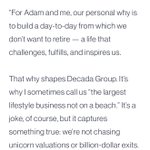
If I had a dollar for every time I’ve heard: “Oh, you want to run a lifestyle business?” … Let’s just say I’d be funding my next acquisition right now.
People often assume “lifestyle business” = small ambitions, lower hustle, meh growth. But that’s missing the point entirely.
3
288
Being ambitious and living on your terms? That’s a sweet spot.
I talked all about this on @AcquiringMinds_ recently. I had great fun talking to @whentheresawill, who has been an amazing resource for ETA entrepreneurs.
1
129
We dove into our unique HoldCo model, what it takes to close deals, what it means to be an operator, and many more.
Check it out: youtube.com/watch?v=mAGe68Xq…