PhD in Computer Science student. School of Engineering and Science. Tecnológico de Monterrey. Husband & Father. Son & brother.
Monterrey, N. L., Mexico
Joined June 2010
- Tweets23.7K
- Following1.9K
- Followers373
- Likes40.4K







<< In this episode, he explains:
■ The Reverse Password Trap: One unique old password leaked in a data breach lets #hackers trace every other email account you’ve ever tied to it.
■ The Invisible Footprint: Even people who have never used a computer are exposed, because ...
1
14
■ The Airplane Mode Myth: Airplane mode leaves Bluetooth switched on, so nearby attackers can still reach your phone unless you turn Bluetooth off in Settings.
■ The Smart Home Backdoor: Many cheap smart bulbs and plugs send your commands through overseas servers, ...
1
3
so keep them on a separate network from your phone and laptop. >>
youtu.be/Uj81Qo15wBc

8

Alí Aldo Gallardo D. retweeted

this is a f*cking must-read for anyone building agents
Andrej Karpathy joined Anthropic to lead a team pointing Claude at Anthropic's own pretraining research
a model helping to design its own successor
that part is confirmed
the line making the rounds - "two Anthropic seniors made his loop 1000x better with graph engineering" - has no source anywhere
I won't invent a quote to make the number bigger
what is real and public: Anthropic's own Claude cookbook on knowledge graph construction
> extract - pull entities and claims from raw text
> resolve - work out which mentions are the same thing
> assemble - link them with typed edges
> query - ask what no single document could answer
four published steps, free, sitting in the repo while the timeline quotes a rumor
learn them and you can build what that rumor was describing
read the cookbook first, then decide if the article below earned the click


Alí Aldo Gallardo D. retweeted

Esto lo cambia todo…
Anthropic ha revelado el truco para reducir hasta un 98% el uso de tokens en Claude
Sus ingenieros pasaron de 150.000 tokens a 2.000 con este método
Mismas herramientas. Misma tarea. Mismo modelo
La clave: el agente escribe código que llama a las herramientas y solo recibe la información necesaria
Así funciona el modo código:
1. Herramientas como archivos
Cada herramienta MCP se guarda como un archivo
Claude explora la carpeta y abre solo lo que necesita
2. Carga bajo demanda
En vez de leer las instrucciones de todas las herramientas antes de empezar, carga únicamente las que va a usar
Ahí está la reducción de 150.000 tokens a 2.000
3. Filtra antes de leer
Una hoja de cálculo con 10.000 filas?
El código la filtra y Claude recibe solo las 5 relevantes
4. Ejecuta los bucles en código
Hay que revisar Slack hasta que alguien confirme que ha terminado un despliegue?
Un bucle lo comprueba sin pasar por el modelo cada vez
5. Mantén los datos sensibles fuera del contexto
Los emails y teléfonos pueden sustituirse por etiquetas como [EMAIL_1] y [PHONE_1]
Los datos reales llegan a Salesforce sin que el modelo tenga que verlos
6. Guarda lo que funciona
El código útil se guarda en ./skills junto a un SKILL.md
El agente construye su propia caja de herramientas y la reutiliza en futuras tareas
Menos tokens para cargar herramientas. Más contexto disponible para trabajar.
He reunido las 6 partes en un solo prompt para que Claude Code te ayude a montar este sistema
Guarda esto y pásale el prompt a Claude Code
Te dejo el prompt y un artículo para optimizar tu uso de Claude abajo👇


Alí Aldo Gallardo D. retweeted

RAG vs. CAG, clearly explained!
RAG is great, but it has a major problem:
every query hits the vector DB. even for static information that hasn't changed in months.
this is expensive, slow, and unnecessary.
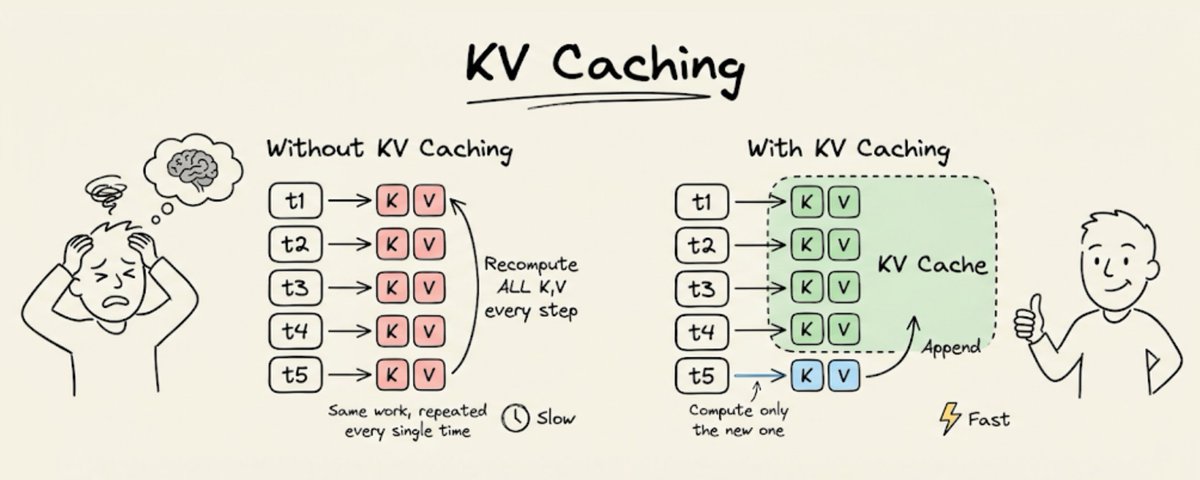
Cache-Augmented Generation (CAG) fixes this by letting the model keep static information in its key-value (KV) memory, which is what the model builds internally for every token it reads.
in fact, you can combine RAG and CAG for the best of both worlds.
here's how it works:
RAG + CAG splits your knowledge into two layers.
↳ static data (policies, documentation) gets cached once in the model's KV memory
↳ dynamic data (recent updates, live documents) gets fetched via retrieval
you get faster inference, lower costs, and less repeated work.
the trick is being selective about what you cache.
only cache static, high-value knowledge that rarely changes. cache everything and you'll hit context limits. separating "cold" (cacheable) and "hot" (retrievable) data keeps this system reliable.
you can start today. OpenAI and Anthropic already support prompt caching in their APIs.
one thing to know before you scale it.
prompt caching matches on an exact prefix, byte for byte. your cached layer only gets reused when it sits at the very front of the context in the same order every time.
↳ reorder two cached policy documents and both turn into a miss
↳ cache document A alone and document B alone, then query both, and the second one misses because the model computed its cached state without ever seeing the first
in production this looks like a small fraction of your cached blocks serving almost all the hits. the rest just sits there.
the way out comes from how attention behaves. tokens attend mostly to their own local neighborhood, and only a few reach across document boundaries. CacheBlend recomputes those few and reuses everything else from the separately cached documents.
multi-document queries run two to four times faster, quality holds, and order stops mattering.
it ships in LMCache, which is fully open source.
repo: github.com/LMCache/LMCache
(don't forget to star 🌟)
below, i have quoted my article on KV cache management. it covers where prefix caching stops working and how a proper caching layer fixes it.
give it a read.
cheers! :)




Alí Aldo Gallardo D. retweeted

Una empresa de pasta de dientes acaba de cargarse silenciosamente toda la industria de la investigación de mercados y nadie está hablando de ello.
Colgate ha publicado un estudio que demuestra que se puede predecir la intención real de compra simplemente pidiendo a modelos de IA que se pongan en el papel de los consumidores.
Y esto es una auténtica locura.
Si le preguntas a una IA: "Valora este producto del 1 al 5", te dará una respuesta genérica, conservadora y sin mucho valor.
Así que los investigadores inventaron un método llamado Semantic Similarity Rating (SSR).
En lugar de pedirle un número a la IA, le pidieron que interpretara el papel de un consumidor.
Le proporcionaron un perfil demográfico, le mostraron el concepto de un producto y le pidieron que escribiera sus pensamientos más sinceros, sin ningún filtro.
Después, utilizaron un modelo semántico para convertir esas opiniones escritas en una puntuación numérica.
Los resultados son impresionantes.
Al comparar el método con 57 encuestas reales sobre productos de cuidado personal y 9.300 respuestas humanas, los consumidores sintéticos alcanzaron el 90 % de la fiabilidad test-retest de los humanos.
Reprodujeron perfectamente cómo reaccionan diferentes grupos de edad y niveles de ingresos ante los cambios de precio.
Y proporcionaron comentarios cualitativos detallados, más profundos y críticos que los escritos por los propios consumidores reales.
Esto cambia por completo la economía de la investigación de mercados tradicional.
Ya no necesitas esperar un mes para saber si un producto se venderá.
Puedes simular 1.000 entrevistas con consumidores hipersegmentados en una sola noche.
Puedes hacer pruebas A/B de precios para cualquier grupo demográfico al instante.

Alí Aldo Gallardo D. retweeted

Two Anthropic senior AI engineers just made Karpathy's loop 1000x better with "Graph Engineering"
Then they dropped 11 page PDF.
Get it here (free):

Alí Aldo Gallardo D. retweeted

🚨 KARPATHY ACABA DE FIRMAR EL CERTIFICADO DE DEFUNCIÓN DE CLAUDE PRO, CHATGPT PRO Y GEMINI PRO
Y lo ha hecho con una sola frase:
"Todos están alquilando modelos de vanguardia para trabajos que un modelo local de 3B podría hacer. Los LLM locales pequeños son el futuro."
Este PDF de 18 páginas explica su idea: ejecutar la IA en tu propia máquina.
Sin suscripción.
Sin pagar por cada token.
La verdadera pregunta no es "¿el modelo local es igual de inteligente?"
Es "¿cuántas de mis 1000 llamadas necesitaban de verdad al inteligente?"
Te dejo el PDF abajo 👇


Alí Aldo Gallardo D. retweeted

User reports indicate problems with Microsoft Outlook since 6:21 AM EST.
How is it affecting you? #MicrosoftOutlookDown
downdetector.com/status/outl…

Alí Aldo Gallardo D. retweeted
User reports indicate problems with OpenAI since 3:13 PM EST.
How is it affecting you? #OpenaiDown
downdetector.com/status/open…

Alí Aldo Gallardo D. retweeted

Sentencia Google vs. SIC
🚨 Fallo histórico en Colombia sobre Protección de Datos y Big Tech.
El Tribunal de Cundinamarca ratifica las órdenes de la SIC contra Google LLC.
¿Tiene competencia la autoridad colombiana sobre empresas tecnológicas extranjeras sin domicilio físico en el país? La respuesta judicial es que si.
El Tribunal Administrativo de Cundinamarca resolvió la demanda de nulidad interpuesta por Google LLC contra la Superintendencia de Industria y Comercio, negando la totalidad de las pretensiones y confirmando la validez de las órdenes de adecuación para proteger los datos de menores en el país.
Puntos clave:
1️⃣ Extraterritorialidad y cookies: el lugar de la recolección define la ley aplicable
El Tribunal determinó que la Ley 1581 de 2012 aplica a cualquier tratamiento en territorio nacional. Dado que las cookies y tecnologías de rastreo se instalan y leen en los dispositivos de usuarios en Colombia, la operación de recolección ocurre en el país, con independencia de que el almacenamiento o análisis se ejecute en servidores en el extranjero.
2️⃣ Consentimiento de menores: la regla de los 18 años es inquebrantable:
Google argumentó la validez del consentimiento autónomo para adolescentes entre 14 y 18 años. El Tribunal rechazó esta tesis: bajo el ordenamiento colombiano y el principio constitucional del Interés Superior, el tratamiento de datos de cualquier menor de 18 años exige obligatoriamente la autorización previa y expresa de sus representantes legales.
3️⃣ Insuficiencia de herramientas técnicas unilaterales
Plataformas como Family Link o YouTube Kids resultaron insuficientes frente al estándar legal colombiano, entre otras razones porque
-Permiten que a partir de los 13 años los menores gestionen su cuenta sin supervisión parental.
-Se basan en declaraciones unilaterales de edad.
-No resuelven el rastreo de usuarios que navegan sin iniciar sesión.
4️⃣ Medidas preventivas vs. sanciones
Las órdenes de la SIC no constituyen sanciones administrativas, sino medidas de adecuación preventiva. Por tanto, la autoridad actuó legítimamente dentro de sus facultades legales de supervisión.
5️⃣ Principio de responsabilidad demostrada (Accountability)
No basta con afirmar que se protege la privacidad: el responsable del tratamiento tiene la carga probatoria de demostrar medidas apropiadas, efectivas y auditables que garanticen el consentimiento parental.

Alí Aldo Gallardo D. retweeted

Gemini 4 Neon: frontier-level intelligence with fast end-to-end task completion across complex software engineering, knowledge work, and science workflows.
Begins rolling out today in the Gemini API in @GoogleAIStudio, Gemini for business, for paid Google AI Pro and Ultra subscribers in Google @Antigravity, and for Google AI Pro and Ultra subscribers in the @GeminiApp.

Alí Aldo Gallardo D. retweeted

Big list of 125 free mathematics textbooks, written by mathematicians… ⤵️
abakcus.com/book-lists/free-…

Alí Aldo Gallardo D. retweeted

NVIDIA released a new looped transformer:
Instead of stacking more layers, it runs the same layers multiple times so a 4B model can think like a 9B one.
Here's how it works:
In a standard transformer, every token passes through a stack of decoder blocks once, and each block has its own weights.
So if you want a deeper model, you add more blocks, and the parameter count grows with the depth.
NVIDIA's Dory1.0-4B decouples the two by reusing a chunk of its layers.
The model is split into three parts:
> An input block of 8 blocks runs once and turns the tokens into a hidden state x.
> A recurrent block of 20 shared blocks runs k times, where k can be anywhere from 1 to 4.
> An output block of 8 blocks runs once on the final state, followed by the LM head.
Before every pass through the recurrent block, x is added back to the current state and the sum is L2-normalized.
This keeps the original token representation in view on every pass, instead of each pass only seeing what the previous one produced.
Both models in the diagram below store 36 blocks of weights.
The standard transformer applies each block once, while Dory applies 36 blocks at k=1, 56 at k=2, and 96 at k=4, i.e., 72, 112, and 192 physical layers from the same checkpoint.
The extra depth is actually helpful on reasoning and agentic tasks:
> SWE-bench Verified:
- at 1 loop → 50.3
- at 2 loops → 59.5
- at 4 loops → 61.8
> 12-benchmark average:
- at 1 loop → 35.17
- at 2 loops → 39.67
- at 4 loops → 40.60
- and with 2 or more loops, it beats Qwen3.5-9B, Gemma 4 12B, and Gemma 4 26B-A4B.
More loops implies more compute per token, but the 4-loop model also writes 1.3x to 2.5x fewer output tokens on agentic tasks.
So 2 loops end up costing only 1.03x to 1.25x the compute of 1 loop end to end, which is why NVIDIA recommends 2 as the default.
By default, Dory keeps a separate KV cache for every loop, so at 4 loops the recurrent layers store 4x the cache.
To avoid this, it can keep only the cache from the last loop, which uses the same KV memory as a normal model with only a small change in accuracy.
One thing to note here is that looping helps the model reason over what it already knows, but it does not add knowledge.
For instance, on tasks like AA-Omniscience, accuracy stays at 10.0 whether you run 1 loop or 4, and on knowledge-heavy tasks like GPQA, Dory still trails Qwen3.5-4B.
Here's the paper: arxiv.org/abs/2611.03998
That said, how much memory looping costs comes down to how the KV cache is handled, so I wrote a full breakdown of how KV caching works.
It covers what gets cached during prefill, how the cache grows during decoding, and why it becomes the main memory bottleneck at long context.
Read it below.