

Recent Masters degree in Archaeological Practice at Birkbeck @BirkbeckUoL Here to share my love of archaeology. No DMs
- Tweets29.3K
- Following2.8K
- Followers65.1K
- Likes72.1K





ALT My photo shows a front view of a clay flask with warm-yellow coloured slip with black hand painted decoration depicting an octopus. The octopus is swimming diagonally with eight writhing, sucker-lined arms covering the whole surface of the flask. It stares out at the viewer with wide, almost cartoon-like eyes. Additional black painted motifs include sea urchins, tritons, small rocks and seaweed. Minoan decoration depicting sea motifs is known by scholars as the 'Marine Style'. The flask measures 27 cm (about 10.5 inches) in height. It has a short spout at the top with a small loop handle at either side and a small base so that it can stand upright.

ALT My photo shows detail from an ancient Greek red-figure kylix (drinking cup) of a young man shown in profile seated on a stool facing right. He wears a knee length cloak (himation) over his left shoulder, which is shown in folds around his waist and upper legs. His right shoulder, chest, and arms are bare. His dark hair is short, and he wears a band around his head. He is looking down at an open rectangular wax writing tablet which he is supporting in his left hand above his lap. In his right hand he holds a metal stylus pen poised over the writing tablet. The wooden writing tablet is hinged like a book and, from this angle, resembles a modern laptop. The figure is part of a scene depicting school lessons in ancient Athens, painted by Douris around 480 BC. On display at the Altes Museum in Berlin.
ALT My photo shows detail from an ancient Greek red-figure kylix (drinking cup) of a young man shown in profile seated on a stool facing right. He wears a knee length cloak (himation) over his left shoulder, which is shown in folds around his waist and upper legs. His right shoulder, chest, and arms are bare. His dark hair is short, and he wears a band around his head. He is looking down at an open rectangular wax writing tablet which he is supporting in his left hand above his lap. In his right hand he holds a metal stylus pen poised over the writing tablet. The wooden writing tablet is hinged like a book and, from this angle, resembles a modern laptop. The figure is part of a scene depicting school lessons in ancient Athens, painted by Douris around 480 BC. On display at the Altes Museum in Berlin.


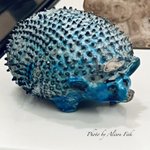
ALT My photo shows a small ancient Egyptian turquoise-coloured blue faience hedgehog figurine, shown in 3/4 profile facing right. It has a rounded body densely covered in small raised spines each of which are emphasised with a dot of black pigment. It has a small wide face with a short snout. The snout has a small chip at the end. The eyes are highlighted with black pigment. It has relatively long oval-shaped ears, set back either side of the face. It has short stubby front legs. Dimensions: Height x width x depth: 5 x 5.5 x 9.3 cm It sits on a pale display case surface at the Neues Museum in Berlin.

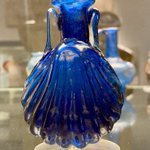
ALT My photo shows a small Roman scent bottle made of cobalt-blue mould-blown glass in the form of a scallop shell. At the top it has a cylindrical neck with an out-turned rim. There is a thin, curved, handle either side of the neck. The top of each handle is attached to the neck, and the bottom is attached to the top of the scallop shell. Bottle dimensions: height 8.5 cm, diameter 5.2 cm. Dated AD 25-100. It is displayed on a circular, clear perspex (?) stand in a British Museum display case. The bottle was bequeathed to the British Museum by Felix Slade in 1869.
ALT My photo shows a small Roman scent bottle made of cobalt-blue mould-blown glass in the form of a scallop shell. At the top it has a cylindrical neck with an out-turned rim. There is a thin, curved, handle either side of the neck. The top of each handle is attached to the neck, and the bottom is attached to the top of the scallop shell. Bottle dimensions: height 8.5 cm, diameter 5.2 cm. Dated AD 25-100. It is displayed on a circular, clear perspex (?) stand in a British Museum display case. The bottle was bequeathed to the British Museum by Felix Slade in 1869.

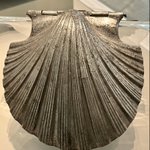
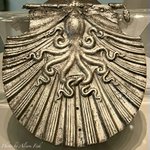
ALT My photo shows a silver shell-shaped container with an eight-armed octopus in relief at the centre of the lid. The arms of the octopus curl outwards across the ridges of the shell's surface. This ornate shell container has a hinged lid and may once have been a cosmetic container. It is displayed on a clear stand in a museum case. Dimensions: 13.3 × 13.2 × 3 cm. It is part of the Silver Treasure from Paternò, Sicily, a hoard discovered in 1909, consisting of tableware and toiletries. Dated 4th-3rd century BC.
ALT My photo shows a silver shell-shaped container with an eight-armed octopus in relief at the centre of the lid. The arms of the octopus curl outwards across the ridges of the shell's surface. This ornate shell container has a hinged lid and may once have been a cosmetic container. It is displayed on a clear stand in a museum case. Dimensions: 13.3 × 13.2 × 3 cm. It is part of the Silver Treasure from Paternò, Sicily, a hoard discovered in 1909, consisting of tableware and toiletries. Dated 4th-3rd century BC.


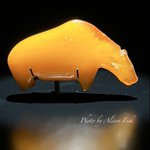
ALT My photo shows a small and ancient figurine of an amber bear carved some 10,000 years ago during the Danish Mesolithic period. The museum lighting makes the amber glow translucent orange against a dark display case background. The bear is displayed on a small metal stand viewed in profile facing right. The ears, muzzle, and mouth are defined. The neck has a polished groove suggesting it was once suspended on a cord. The characteristic shoulder hump of a brown bear is clearly defined. There are some finely incised horizontal lines along the belly. The legs are incomplete. Length 6.5cm. It was found in 1991 on a west coast beach of the Danish North Sea island of Fanø. It is one of a small number of amber animal figurines from the Baltic Sea region dated to the Mesolithic period.
ALT My photo shows a small and ancient figurine of an amber bear carved some 10,000 years ago during the Danish Mesolithic period. The museum lighting makes the amber glow translucent orange against a dark display case background. The bear is displayed on a small metal stand viewed in profile facing right. The ears, muzzle, and mouth are defined. The neck has a polished groove suggesting it was once suspended on a cord. The characteristic shoulder hump of a brown bear is clearly defined. There are some finely incised horizontal lines along the belly. The legs are incomplete. Length 6.5cm. It was found in 1991 on a west coast beach of the Danish North Sea island of Fanø. It is one of a small number of amber animal figurines from the Baltic Sea region dated to the Mesolithic period.

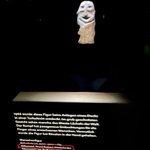
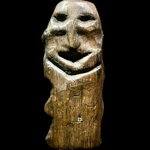
ALT My photo shows a human figure roughly carved from dark brown oak wood during the Mesolithic period about 5,400-5,300 BC. It is 12.5 cm tall with a long body with two finger-shaped indents on the right hand side, suggesting it was made to be held in the hand. The stylized head has deeply carved eyes, nose, and open mouth. The triangular shape of the mouth makes it look as if the figure is smiling, leading to its description as ‘The oldest smile in the world’. It is displayed against a black display case background at Landesmuseum Halle in Germany where the figure is currently on loan for the ‘Shamaness’ exhibition. It is part of the permanent collections of Rijksmuseum van Oudheden, Leiden, Netherlands. It was found in a layer of peat in 1966 during the construction of a dock at Willemstad, North Brabant, Netherlands.