

Alphaliner by Signal Ocean. The worldwide reference in liner shipping since 1999. Fleet deployment, services, ports and forecasts for the container market.
Joined February 2020
- Tweets1.6K
- Following20
- Followers3.3K
- Likes25






📢 Orderbook soars past 15 Mteu: LNG and conventionally powered ships in high demand, while methanol falls out of favour
📈 The global container vessel orderbook has recently breached the 15 Mteu mark. Before the end of the year, another 40 or so ‘megamax’ newbuilding contracts from Maersk, Yang Ming (both expected soon), CMA CGM, and MSC (both believed signed, but yet to be confirmed by Alphaliner) will push the global newbuilding pipeline very close to 16 Mteu in the last quarter of 2026.
🔍 While the number of vessels and the sheer size of the orderbook are impressive, it is also worth looking at carriers’ and owners’ most recent propulsion choices.
⛽ Alphaliner figures show that LNG dual-fuel tonnage accounted for the majority of orders in 2024, 2025 and 2026. Over the same period, conventional propulsion, often with scrubbers, has made a comeback, whereas ordering for methanolenabled tonnage has almost come to a standstill.
🚢 As of today, conventionally powered ships still account for 88% of fleet capacity in the water, but the orderbook share of such vessels has declined to just below 32%.
🌱 LNG dual-fuel tonnage now accounts for 56% of contracted newbuildings, while methanol dual-fuel orders reach 12%, again in terms of capacity, not units. This means that more than two thirds of the overall newbuilding pipeline is for dualfuel ships, designed to run on alternative fuel.
🔄 When it comes to the choice of alternative propulsion option, however, Alphaliner has observed a shift in carriers’ and ship owners’ technology preference: LNG appears to be the favoured alternative to conventional power, having logged 2.3 Mteu of new orders in 2026 so far. This compares to around 2.0 Mteu at the same point last year.
🔮 The aforementioned expected 40-ish ‘megamax’ orders that have yet to make it into the statistics will likely add another 1.0 Mteu to the overall LNG dual-fuel newbuilding pipeline before the year is over.
✅ Read the full story and subscribe for the latest news in Liner shipping at public.axsmarine.com/alphali…

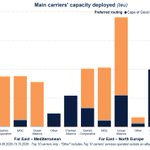
📢 Carriers return 63% of the Far East - Europe capacity to Suez!
⚠️ On 19 November 2023, Houthi rebels hijacked the car carrier GALAXY LEADER in the southern Red Sea, marking the start of their campaign against merchant shipping in response to the armed conflict in Gaza.
🔍 As the third anniversary of the event that set off the large-scale diversion of container shipping around the Cape of Good Hope approaches, Alphaliner has surveyed the routings used by the Top-10 carriers on the Far East - Europe trade from 15 September to 15 October 2026.
🚢 Over this period, containerships transiting the Red Sea were observed on 24 of the 46 direct services operated by these carriers between the Far East and Europe.
📊 In capacity terms, services with ships routed via the Red Sea now account for 70% of all tonnage deployment on the Far East - Mediterranean trade and 58% on Far East - North Europe.
🌍 Overall, 5.50 Mteu (63%) of the 8.70 Mteu deployed on Far East - Europe sits on loops whose vessels sail through the Red Sea.
🔄 It is worth emphasising, however, that most carriers are gradually reverting their networks. Typically, some loops sail through the Bab-el-Mandeb Strait westbound but still return to Asia via the Cape of Good Hope.
👀 Want to see how the top carriers like MSC, Maersk, CMA CGM, COSCO SHIPPING, Hapag-Lloyd, Evergreen, and ZIM performed individually against this backdrop?
✅ Read the full story and subscribe for the latest news in Liner shipping at public.axsmarine.com/alphali…

📢 TOC Americas 2026 is just around the corner - and we’ll be there!
🚢 Sofia Rodriguez will be representing us in Cartagena, Colombia from 20 - 22 October at one of the most important gatherings for the port and container supply chain community across the Americas.
💡 From port authorities and terminal operators to shipowners and logistics specialists: TOC Americas brings together every point along the supply chain for three days of conversations, connections and a window into the future of port and terminal operations.
🤝 We’re proud to be attending as Session Sponsors this year. If you’re heading to Cartagena, reach out to Sofia - she’d love to connect!

📢 Analysts raise Maersk price target as market cap tops $50 bn
📈 Share prices for the majority of the leading public container carriers hit 52-week highs in August and September after the publication of strong Q2 results. Of the 11 top- and mid-tier companies surveyed by Alphaliner, eight operators saw their stock price reach yearly peaks in the weeks following. Only HapagLloyd, HMM and Yang Ming missed out, having seen their stocks peak in March.
🌍 Since then, signs of robust demand, ongoing geopolitical disruption and persistent port congestion have raised expectations for a continuation of strong rates.
💰Following liner operating profits of $935 M and a 22% year-on-year increase in rates (far higher than the other carriers) in Q2, AP Moller-Maersk's (APMM) prospects have been quickly revised by banks. Six analysts, including HSBC, Morgan Stanley, Fearnley Securities, Citi, Goldman Sachs and Kepler Cheuvreux, raised their price targets on the group in September, with HSBC and Fearnleys both slapping a buy rating on the stock. HSBC raised its target price a second time last week to DKK 27,000.
🎯 In addition to upbeat expectations for the market over the rest of the year, it was recognised that APMM had been particularly effective in capturing the positive effects of higher rates. It follows an increase in its spot-exposed shipping capacity (now 56%), as well as the impact from unspecified digital investments.
✅ Read the full story and subscribe for the latest news in Liner shipping at public.axsmarine.com/alphali…

🚢 Hamburg delivered - and what a week it was.
🌍 Last month, SMM Hamburg 2026 once again confirmed its place as the leading event in the maritime industry calendar, welcoming around 50,000 trade visitors and 2,300 exhibitors from 66 countries, with participants spanning 134 nations.
🤝 Sinem Sen, Pelin Nişli, Jan Tiedemann, Hugo Rousse and Maximilian Kuhlmann were on the ground throughout the week, connecting with the industry across the fair and beyond.
🎙️ The week kicked off with the inaugural Mare Forum Hamburg, where the focus was on people, investing in talent and the human side of maritime, with around 160 attendees gathered for a panel on People Power.


📢 Samudera and Meratus lead Indonesia's carrier Top-5
🌏Indonesia is the world's largest archipelagic state, with about 17,000 islands stretched across roughly 5,000 km between the Indian and Pacific Oceans.
👥 With more than 280 million people, the world's fourth-largest population, Indonesia relies on the sea to move food, fuel and goods between densely populated islands such as Java and remote communities in the country's eastern provinces.
🔗 Domestic shipping is central to keeping the nation's economy connected, while international services link the country to key deep-sea hubs in the region. More recently, Indonesia has also attracted direct shipping links to China, India and the Middle East.
🗺️ Indonesia sits on some of the world's most important shipping chokepoints, including the Malacca, Sunda, Lombok and Makassar straits, which carry a large share of trade between Asia, the Middle East and Europe.
🏙️ Given the country's large population and archipelagic character, Indonesia's main ports are served by many of the world's major shipping lines. In addition to these, a number of Indonesian carriers play a vital role in the market. In this context, Alphaliner has taken a look at Indonesia's main container lines, a sector in which five domestic and regional carriers stand out.
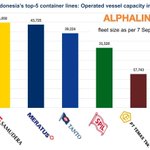
🥇 Samudera tops the league of Indonesian carriers with a fleet of about 45,000 teu. However, more than 90% of Samudera's operated capacity is deployed on international routes rather than in the Indonesian domestic trade.
🥈 Meratus follows in second place with just under 44,000 teu. Despite its slightly smaller capacity, Meratus operates the most vessels, at 66 units. In contrast to Samudera, this Surabaya-headquartered carrier currently deploys only about 16% of its capacity on international regional loops.
⚓ Among the Top-5 Indonesian carriers, only Samudera and Meratus deploy vessels on international liner services, while the other three, Tanto Intim Line (39,000+ teu), Salam Pacific Indonesia Lines (SPIL, 31,500+ teu) and Temas (almost 18,000 teu), remain focused on Indonesia's domestic inter-island trade.
✅ Read the full story and subscribe for the latest news in Liner shipping at public.axsmarine.com/alphali…

📢 Top-10 carriers cut chartered tonnage exposure!
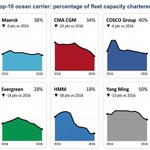
📅 Chartered container tonnage is losing the favour of the Top-10 container shipping lines. Since 2021-2022, the share of chartered capacity in most of the biggest carriers’ fleets has been falling, sometimes in a drastic way.
🚀 Thanks to the extraordinary profits shipping lines achieved in the post-Covid cargo boom, many started growing their fleets by investing in newbuilding container vessels and second-hand ships. The move allowed them to cut their dependence on chartered tonnage and increase control on their fleets.
📊 Whilst the operated capacities of the Top-10 carriers typically included 40-70% on charter ten years ago, this bracket is now down to 18-50%, with some shipping lines having cut their exposure in recent years more than others. The chartered fleets of the Top-5 carriers now stand between 30 and 40% of their deployed capacities.
ℹ️ Among the carriers who slashed their chartered exposure the most is South Korea’s HMM. Whilst the shipping company had 56% of its container fleet on charter, in capacity terms, in 2016, it is now less than 20%. After the collapse of Hanjin, the South Korean government propelled HMM to the position of Korean flagship carrier, supporting a massive fleet expansion that included the purchase of multiple newbuilding vessels, 59 so far.
🚢 CMA CGM saw the second largest drop, with the share of chartered tonnage falling from 67% of its operated fleet in 2016 to around 34% today. Most of the downfall started in the aftermath of the Covid pandemic, with huge profits allowing the carrier to invest massively in owned tonnage. The buying spree included 160 second-hand container vessels so far, while 100 newbuilding containerships, ordered for its own account, joined its network. The French carrier remains nonetheless a major user of non-operating owner (NOO) tonnage with an active presence in the charter market.
🕵️ MSC has seen its share of chartered fleet drop from 61% in 2016 to 36% today, a 41% fall. However, when looking at the share of the fleet on charter to MSC during Covid (around 75%), compared with the current 36%, the Geneva-based carrier has literally halved its charter exposure in the last five years.
✅ Read the full story and subscribe for the latest news in Liner shipping at public.axsmarine.com/alphali…

📢 Intra-Asia liner market: Maersk takes COSCO’s top spot!
📅 Alphaliner's mid-August review of the intra-Asia (excluding domestic) trade shows a modest 6.2% year-on-year increase in deployed capacity, to just below 2.6 M teu. This compares with over 5% growth in the global 34+ Mteu container fleet over the same period.
📊 The trade remains one of the most competitive in container shipping, with more than 80 active players surveyed in mid-August.
🚢 Most of them are small regional and feeder carriers that only held 37% of total deployed slots. Main Line Operators (MLOs) continue to dominate, controlling over 63% of capacity, despite deploying fewer vessels.
⚖️ The lead comes from larger ship size: MLOs average 2,699 teu per vessel, more than double the 1,338 teu average for regional carriers.
🌏 SITC, the leading regional carrier in intra-Asia, makes the point vividly: it runs 109 ships, but its considerably smaller average vessel size leaves its total capacity at 157,000 teu well behind Maersk and COSCO’s, putting SITC in sixth spot.
🎯 This is in line with SITC's focus on direct services to smaller and niche ports in Asia, rather than competing on scale.
🏆 SITC is the only carrier on the list besides Maersk (108 ships) and COSCO (122 ships) that operates a fleet of more than 100 vessels in the region.
✅ Read the full story and subscribe for the latest news in Liner shipping at public.axsmarine.com/alphali…

📢 The 27,500 teu ship: elusive vision or tomorrow’s reality?
ℹ️ For about a decade it looked as if the ‘megamax-24’ with its intake of around 24,000 teu would remain the largest container ship class ‘forever’.
💡 Alphaliner however believes that orders for vessels of an even larger type could be placed in the foreseeable future: Increased cost pressure might prompt some of the largest carriers to reconsider their fleet strategies and opt for a novel ship type that is slightly larger than the current capacity record holders.
📅 Even compared to a fairly recent point in time such as the beginning of 2020, a mere few weeks before the outbreak of the COVID-19 pandemic and its farreaching effects on global supply chains, the liner fleet has grown massively. Within this relatively short period, global boxship capacity has soared from 23.2 Mteu to 34.1 Mteu today, up 47%. On the back of this massive industry growth, most of the world’s top carriers could theoretically deploy at least one ‘full set’ of next-generation container ships on the East - West mainlines as of 2030. The sheer scale of the three main container line alliances would make this possible.
📊 A look at the top carriers’ fleet structures and orderbooks, as well as their alliance network setups, however suggests: One of the big shipping lines would likely profit more than others from being the first mover.
🚢 Why opt for ships bigger than the 24,000 teu ’megamax-24’?
💰 Especially on very long haul East - West mainlines, factors like the increasing price of fuel and the introduction of carbon emissions taxes will give bigger ships a competitive edge in the long run.
🕵🏻♂️ Five years ago, Alphaliner presented the hypothetical concept of a 425+ m long ‘gigamax’ container ship that would be one hold (or: two 40-foot bays) longer than today’s biggest ‘megamax’ ships.
✅ Read the full story and subscribe for the latest news in Liner shipping at public.axsmarine.com/alphali…

📢 Carriers enjoy profit rebound, but costs, trade mix prove key!
📈 The average operating margin for the leading container carriers rose to 11.2% in the second quarter of 2026, as route disruption, port congestion, and continued strong demand pushed freight rates sharply up.
📊 The results show the fortunes for the majority of container carriers have again turned after a difficult Q1. Unlike the previous two quarters, no lines reported operating deficits in the second quarter. However, Hapag-Lloyd remained in the red over the full six-month period.
🕵️ There were some surprises in the quarter, however, as Maersk’s margin overtook that of HMM, despite the usual dominance of Asian (spot-oriented) carriers over Europe’s (contract cover-oriented) lines when freight rates surge.
💪 Maersk logs highest rate increase!
🏆 Taiwan’s Wan Hai Lines again reported the highest operating margin for the quarter, at 26.0%. The mid-tier carrier has now topped the rankings for five consecutive quarters. Evergreen and COSCO Group, who have long dominated second and third position, traded places, with Evergreen rising to second with a margin of 18.4% to COSCO’s 14.2%, as East-West trades became a more important revenue driver than inter-Asia rates.
⚡ Most notably, Maersk climbed two places in the rankings after logging a margin of 8.9% on the back of a market-beating 22% year-on-year increase in rates. The world’s number two carrier benefited from good market exposure, with 56% of its product mix earning spot rates, as well as effective network redeployment, with rates rising 28% East-West and 21% North-South. CEO Vincent Clerc said digital investments also helped the line raise rates quicker than its rivals, without giving further details.
💰 As a result, Maersk’s group EBIT of USD 3 bn exceeded analysts’ expectations by almost USD 900 M. Its sixth place shipping margin ranking was its highest since 2023, and put the carrier above HMM.
✅ Read the full story and subscribe for the latest news in Liner shipping at public.axsmarine.com/alphali…

📢 Shake-up in port rankings at half-way stage!
ℹ️ A review of the top-30 ports at the half-year mark shows the widespread impact of geopolitical trends on the global container market, as carriers adjusted their networks in reaction to the Middle East conflict and shippers responded to the US tariff policy.
🗓️ The effect of renewed disruption in the Hormuz Strait, which resulted in a near shutdown of the waterway from March onwards and only a partial and unstable reopening in June, saw volumes plummet over 90% at Dubai’s Jebel Ali to just 374,000 teu in the second quarter of the year:
📉 Combined with a Q1 decline of 23%, Dubai’s flagship port handled a total 3.14 Mteu in the first six months of the year, less than half the 7.77 Mteu recorded a year earlier. As a result, the port fell out of the top-30, dropping from 10th place to 32nd.
📊 Abu Dhabi’s Khalifa Seaport also saw a major contraction. Operator AD Ports did not release official figures, but based on wider group results, it is thought volumes fell at least 50%, pushing Khalifa out of the top-50 from its previous position at 32nd.
📈 It contrasts with 2025, when the port registered year-on-year growth of 21.4%, challenging Lianyungang for a top-30 place.
✅ Read the full story and subscribe for the latest news in Liner shipping at public.axsmarine.com/alphali….

⚓ The future of shipping depends on the people who will shape it.
📍 At the 1st Mare Forum Germany 2026 in Hamburg, our Sinem Sen will join the panel discussion “People Power: Investing in People - The Future Maritime Workforce” to explore one of the industry's most pressing questions: how do we attract, develop and retain the talent shipping needs for the future?
💬 From recruitment and retention to diversity, automation, education, mental health and the industry's ability to make maritime careers compelling for the next generation, the discussion will challenge how well prepared the sector really is for the workforce of tomorrow.
🌊 We’re looking forward to hearing different perspectives on how the maritime industry can invest in its most important asset: its people.

📢 Far East - North Europe trade: Evergreen and HMM concentrate most capacity in a few North European ports!
⚠️ Congestion is and will remain a growing problem for the liner sector. Climate change resulting in extreme weather with typhoons, heavy rainfall, but also periods of excessive drought, is increasingly playing havoc with liner schedules.
⚓On the port side, a widespread comment made by terminal operators is that the pressure on their facilities is amplified by the fact that call sizes on ‘megamax’ ships have increased significantly over the past years.
🕵️Information on the exact call sizes is not publicly available as it is considered to be commercially sensitive. One can, however, get an idea of potential call sizes by dividing a service’s nominal capacity by the loop’s number of discharge ports.
🌐 Alphaliner has carried out this exercise for the Far East – North Europe westbound trade. The average vessel size per individual loop was divided by the number of westbound stops in Europe, with the Moroccan port of Tanger Med exceptionally considered as ‘European’ for the purposes of the survey as it can be the first port of discharge for vessels arriving from the Far East.
📊 There are huge differences in the potential call sizes between the different loops. MSC’s ‘Swan’ service with ships of 15,000 teu has on average six discharge ports in Europe, resulting in a theoretical volume of 2,500 teu per port.
ℹ️ At the other end we see Evergreen’s ‘CEM’ service with only three westbound calls for ships of an average size of 23,490 teu, resulting in 7,830 teu per port.
🔮 The Premier Alliance ‘FE3’ loop, operated by HMM tonnage of 22,200 teu on average, discharges in three ports, resulting in theoretical call sizes of 7,400 teu per port.
🗓️ When the Gemini Cooperation of Maersk and Hapag-Lloyd launched its hub and spoke concept in February 2025 with a very limited number of calls per mainline loop, this was considered to be a novelty.
🚢 The Danish and German carriers meanwhile added extra calls at Gothenburg, Aarhus and Antwerp on the Far East – North Europe loops.
✅ Read the full story and subscribe for the latest news in Liner shipping at public.axsmarine.com/alphali…

📢 Gulf conflict cuts Far East - ISC/ME/RS capacity by 14% y-o-y!
🔎 A review of the Far East - Indian Subcontinent/Middle East/Red Sea trade in late July shows deployed capacity fell by around 312,000 teu, or more than 14% year-on-year, to just under 1.9 Mteu.
🌍 Most of the reduction can be traced, directly or indirectly, to the widening Gulf conflict and carriers' response to security concerns surrounding the Strait of Hormuz and the wider Middle East.
📉 The largest individual capacity decline came from HMM, down around 115,000 teu, and SeaLead, which withdrew approximately 66,000 teu (see page 3).
ℹ️ Indeed, smaller players on the trade — those with a capacity share of less than 1%, including carriers like HMM and SeaLead that withdrew or ceased deploying tonnage on the route — accounted for almost 90% of the overall decline in capacity.
🔝 By contrast, the eighteen largest carriers on the trade (capacity share 1% or more) saw comparatively little aggregate change in capacity, despite substantial movements by individual operators.
📊 CMA CGM recorded the largest increase, adding almost 70,000 teu, or close to 40%, compared with July 2025. COSCO Group (including OOCL) recorded the largest reduction among the trade’s top-18, cutting capacity by around 60,000 teu.
🥇 MSC retained its lead with a 3% capacity bump, despite reducing its vessel count from 25 to 18 ships.
✅ Read the full story and subscribe for the latest news in Liner shipping at public.axsmarine.com/alphali….

📢 Majority of top-10 carriers on Transatlantic reduced capacity
📅 In July, Alphaliner counted 189 container ships trading in services connecting North and South Europe with Canada, the US (both coasts) and the US Gulf.
📊 Their combined capacity stood at 1,119,150 teu, which represents a small 0.4% year-on-year decline. Only three top-10 carriers increased their capacity compared to July 2025.
💸 Low ocean freight rates and high charter costs forced Hapag-Lloyd to close its North Europe – US East Coast – Central America ‘Caribbean Express Service’ (‘CES’). The loop was shut down in December.
ℹ️ Another major rationalization on the North Europe – US route was the closure of the North Europe – South Atlantic ‘AT2 / TAE2’ loop operated jointly by ONE and Evergreen, which was part of the offering of a Vessel Sharing Agreement between the partners of OCEAN Alliance (CMA CGM, COSCO SHIPPING Lines/ OOCL, Evergreen) and ONE.
📉 Six of the top-10 carriers in the Transatlantic (TA) trade have lowered their capacities over the last twelve months, while the Grimaldi-controlled Atlantic Container Line (ACL) kept its fleet of five conro ships unchanged.
🙌 There are no changes in the positions for the four largest carriers, with MSC further increasing market share from 41.8% last year to 44.2% in our last count. Total capacity of the 69 ships deployed by the Geneva-based carrier stands at 529,340 teu, compared to 176,000 teu for the number two (Hapag-Lloyd).
✅ Read the full story and subscribe for the latest news in Liner shipping at public.axsmarine.com/alphali….

📢 Maersk has achieved by far the highest growth in capacity and market share of the carriers in the intra-North European service segment over the past twelve months.
📈 Intra-North European service capacity grew by 6.8%, or close to 20,000 teu, compared to July 2025, as carriers deployed 243 ships against 235 a year earlier, of a marginally larger average size (1,294 teu versus 1,253 teu). Alphaliner has calculated the market share of each carrier offering regular intra-North Europe container services compared to a year ago.
🥈 Maersk again claims the second spot among the largest mainline operators (MLOs) in North Europe. The Danish line increased its capacity share to 16.2% (50,800 teu), up from 13.5% (39,800 teu) a year ago, a gain of 2.7%, the largest of any operator in the segment. The disproportionately high growth in capacity and market share again stems from the ‘hub and spoke’ concept that the carrier implemented last year with its ‘Gemini’ partner Hapag-Lloyd.
🥇 MSC remains firmly in pole position by deployed capacity. With a market share of 21.2% (21.3% a year ago), the Geneva-based carrier has gained 6.2% in capacity (versus 6.8% for the market as a whole), but still has the largest market share of all carriers in the intra-North European service segment.
🥉 DP World again claims the third spot in the league of intra-North Europe carriers, ahead of CMA CGM and X-Press Feeders. It recorded a market share of 11.0% compared to 12.2% a year ago. The UAE-based ports, shipping, and logistics giant in late 2025 dropped the well-known Unifeeder brand under the banner of which the group used to serve its intra-North Europe network.
📉 CMA CGM is the only main line operator in the intra-North European segment to record a decline in both capacity and market share. The French carrier reduced capacity by 14.4%, from 35,300 teu to 30,200 teu, while its market share slipped from 12.0% to 9.6%, leaving it in fourth spot.
ℹ️ The Asian main liners invested further in intra-North Europe trading, and added 4,700 teu of capacity in the past twelve months.
📊 Ocean Network Express (ONE) continued to build on last year's momentum, climbing from ninth to seventh place. COSCO Group cemented its ninth spot among North Europe’s largest operators with a market share of 2.9% (2.5% a year ago).
✅ Read the full story and subscribe for the latest news in Liner shipping at public.axsmarine.com/alphali…

📢 Accidents and sanctions lift demolition sales in first half of year!
📉 The containership demolition market continues to evolve at record lows with only eleven cellular vessels for a capacity of 36,700 teu reported sold for recycling in the first half of the year.
🗓️ On paper, this is, in capacity terms, a significant rise compared to 2025, when the whole year saw only twelve vessels for 8,172 teu commercially disposed of for recycling. In reality, nearly 32,000 teu of the capacity sold so far this year was the result of accidents or sanctions and was not commercially motivated.
🚢When considering commercial sales only, the first half saw only five ships for about 4,800 teu reported sold for recycling.
ℹ️ Once again, the healthy container shipping market, with a continuously high demand for tonnage and robust charter and freight rates in the last months, have explained in great part shipowners’ and carriers’ reluctance to dispose of their older tonnage, preferring instead to make the most of the lucrative trading environment.
📈 The H1 demolition sales figures were boosted by exceptional events such as vessel accidents and sanctions.
🕵️ Regarding accidents, Taiwanese carrier Wan Hai Lines (WHL) was forced to scrap in January its 4,333 teu WAN HAI 503, which was hit in June 2025 by a devastating fire while sailing off India. Meanwhile MSC had to resign itself to never getting back its 2,478 teu MSC BALTIC III which ran aground in Newfoundland, Canada, in February 2025 after losing power. The ship dismantling started on site in June and could take several months to complete.
✅ Read the full story and subscribe for the latest news in Liner shipping at public.axsmarine.com/alphali….

📢 Sale and purchase market bullish, despite fewer H1 sales!
🗓️ The second-hand sale and purchase containership market saw a significant drop in the number of transactions concluded in the first half of the year, compared to the similar period of 2025.
🚢 A total of 126 cellular container vessels for a capacity of 351,734 teu reportedly changed hands for further trading up to 30 June, compared to 199 sales for 513,000 teu in the first six months of 2025. The volume of transactions concluded so far this year was also less than the 144 vessels for 479,324 teu sold in the second half of 2025.
📉 The lower volume of transactions was the result of a reduced number of prompt ships available for sale, with tonnage owners often preferring to hold on to their vessels and continue to trade them profitably, rather than make one-off sale profits.
💰 Healthy freight and charter markets otherwise kept buying interest for ships of all sizes strong across the board, contributing to keeping prices at firm levels for all sizes and ages of vessels.
📊 MSC was again by far the biggest buyer, with 23 vessels (of which 21 NOO ships) acquired, including 4 x 4,300 teu newbuilding resales from Chinese owners.
✅ Read the full story and subscribe for the latest news in Liner shipping at public.axsmarine.com/alphali…

🏗️ Build the port delay into your supply chain model before it hits your shelf.
📉 Singapore's congestion ratio hit a record low of 29.7% in February 2026 - the result of nine years of steady improvement from a peak of 69% in 2017. For supply chain teams sourcing from Southeast Asia, that's a story of significantly improved transit reliability.
📈 Then in March 2026, the ratio jumped to 37.5% in a single month.
💡 Teams planning on the February baseline had no buffer. Those monitoring the ratio pulled forward production runs before the delay materialised. The difference between a stockout and a smooth quarter is often just a few weeks of lead time - and that lead time starts with the anchorage data, not the ETA update.
📊 The Alphaliner Congestion Rate API delivers daily congestion trends across major origin and destination ports, filterable by service and operator. With years of daily data, built to feed directly into safety stock and reorder point models.
🎯 Know before your shelf does. Book a demo at cdanalytics.axsmarine.com/ax…

📢 CMA CGM is the fastest growing carrier in H1 2026!
🗓️ After many years, MSC appears to be no longer the fastest growing top-10 carrier. In the first six months of 2026, the title of ‘growth champion’ went to CMA CGM, as the French carrier added 235,500 teu slots to its fleet (+5.7%), which is more than MSC (205,000 teu).
🏅 The Marseille-based operator is well on track to overtake Maersk as the number two in liner shipping next year. In an interview with French media, Rodolphe Saadé, chairman and chief executive of CMA CGM, confirmed his intention to become the second largest carrier before the end of 2027.
🔍 With a fleet capacity of 4.39 Mteu, CMA CGM has closed the gap with Maersk (4.73 Mteu). The French operator, however, has 1.8 Mteu on order, compared to 1.2 Mteu for its Danish competitor.
📈 The overall liner fleet grew by 2.0% in the first half of this year. Average growth for the top-10 carriers stood at 2.7%. MSC’s growth of 2.9% is slightly above that average. Last year, the Geneva-based carrier showed the strongest growth in the top-10 by adding 831,400 teu (+11.7%) in the twelve month period.
ℹ️ Compared to that figure, half-year growth of 205,000 teu is rather modest. It was mainly due to the delivery of eight newbuildings: the 16,169 teu MSC CLAIRE and seven smaller 10,300 – 11,480 teu vessels.
💡 CMA CGM welcomed twelve new units to its fleet, including the LNG-powered 24,212 teu CMA CGM NOTRE DAME, the new flagship of the French container fleet. Other deliveries included the LNG-powered 23,872 teu CMA CGM GRAND PALAIS and ten methanol-powered vessels of 13,130 – 16,180 teu.
✅ Read the full story and subscribe for the latest news in Liner shipping at public.axsmarine.com/alphali….
