AngelSpan (@AngelSpanInc) header
AngelSpan (@AngelSpanInc) profile picture

Investor relations for funded startups.

Austin, TX
Joined June 2014
Photo by AngelSpan (@AngelSpanInc)Photo by AngelSpan (@AngelSpanInc)Photo by AngelSpan (@AngelSpanInc)Photo by AngelSpan (@AngelSpanInc)Photo by AngelSpan (@AngelSpanInc)Photo by AngelSpan (@AngelSpanInc)Photo by AngelSpan (@AngelSpanInc)Photo by AngelSpan (@AngelSpanInc)Photo by AngelSpan (@AngelSpanInc)Photo by AngelSpan (@AngelSpanInc)
Replying to @lxbp
You may want to check out the newly launched Journal of Privat Markets Investing. The lastest journal launched by the original Institutional Investors Journals (now @PM_Research_), JPMI will quickly become THE resourse for best investment practices within the 'Alts' space. It's a spin-off from II/PMR's Journal of Portfolio Management, Edited since '86 by Frank Fabozzi, and will be Edited by Mr. Fabozzi's protege (my observation) - Prof. Michael Imerman.
1
5
352
Big Venture is bad for entrepreneurs & investors. Big Tech is bad for users of tech. Big Pharma is bad for your health. Are we seeing a pattern here? When will we learn?
I've said it before, and I'll say it again: Large venture-backed IPOs are structurally overpriced. Private markets reward fragile growth, public markets want quality and durability. The more venture capital a company raises, the harder that transition gets. Even if it's a company you believe in, like SpaceX*, you're likely to get a substantial discount in the 6–18 months post-IPO. In many cases even the round prior to the IPO ends up underwater by lockup expiry. This process wipes a huge amount of theoretical value off the company as they essentially need to rebuild around a better business with stronger economics. Often, they do not survive the process. Unfortunetely, this isn't likely to change until there's an end to the ridiculous inflation of venture funds. More money in private markets = good. More money in individual firms = bad. (*And SpaceX raised relatively little, relative to the scale and ambition of the company.)
1
18
And it was Gordon Bell that did the early work on the PDP-1, eventually credited with the 'inventor' of the mini-computer, 'Bell's Law', the first winner of the Von Neumann Medal (Nobel equivalent for technologists), and maybe his most important work - the Bell Mason Diagnostic
In 1957, ARD invested $70,000 in Digital Equipment Corporation — creators of the minicomputer. While IBM and others were building giant mainframes, DEC created more affordable computers (starting with the PDP-1 in 1960 and especially the PDP-8 in 1965). These machines made computing more accessible to scientists, engineers, universities, and businesses. Nine years after the ARD investment, DEC went public (with no other outside equity investors) and ARD’s stake was worth ~550x. The firm held for another six years, ultimately liquidating their position at a ~5700x return. Stories like this just don’t happen anymore. Venture capital has become a tool of wealth concentration and incumbent servicing, not prosperity. Today, DEC would have been kept private for 15 years, and ARD would be heavily diluted by subsequent funding rounds. Instead of going after the large pool of relatively small buyers, investors would have pushed the company to position as a direct competitor to IBM and threaten those huge contracts. The company would have sunk hundreds of thousands into R&D for mainframe technology, burning cash to compete against IBM’s marketing and infrastructure. Once public, grossly overcapitalised and overvalued, insiders would celebrate the giant outcome while quietly and urgently dumping their bags. The company would flounder as the share price sank — and ultimately it would get acquired by IBM at a heavy discount. In the process, private investors would have skimmed significant wealth and status — celebrating with champagne and caviar with their cronies. Instead of distributing compute across industry and academia at an accessible price, DEC would ultimately have just strengthened IBM’s dominance. Technological progress would slow as the market monopolised. No >10x returns for public market investors in those first six years, but rather a gradual slide toward a heartbreaking end— all of the value having been pulled forward and extracted well in advance. And those private investors, motivated by the lucrative fee income they collected along the way, would do it all exactly the same next time.
2
63
Minutes (approx) 25 to 55 are a MUST WATCH for those that want early stage venture investing to be better!
Legendary investor Tim Draper on late-stage megafunds: two and 20 on a $20 billion fund is $400 million a year “without doing anything.” For Draper, those firms are investment bankers, not venture capitalists. They write $100 million checks to companies that need $10 million. He says AI will replace them soon. But the seed investors who make the initial calls? They earn their fees, for doing a job AI can’t yet do. A brand new VC Roundtable is live now. @timdraper, @DFJvc, @davemcclure, @TradingVCs, @dawallach, @Jason 0:00 Tim started off in VC during a crash 8:20 Plaud: If your work depends on conversations - interviews, meetings, calls - you need a Plaud NotePin S. You can check it out at plaud.ai/twist and use code TWIST for 10% off! 9:29 Dave is reminded of the PayPal IPO 11:10 Vanta - Get $1000 off your SOC 2 at vanta.com/twist 15:01 The panel ranks the top chatbots 19:35 Stripe Startups - Stripe Startups offers early-stage, venture-backed startups access to Stripe fee credits and more. Apply today on stripe.com/startups. 24:35 Why AI empowers weirdos 25:58 What’s the post-overrated aspect of venture? 31:12 Sentry - New users can get $240 in free credits when they go to sentry.io/twist and use the code TWIST26 45:01 Rise and fall of “investment banker” VCs 56:18 Are Walmart and Costco the real bubble? 1:03:55 DFJ’s SpaceX-heavy fund and the LP swap 1:08:32 “It’s murky in all directions” 🎥 Watch the full episode here 👇
1
23
A principled person as Chief of Staff....what a concept. @DonaldTrump Deserves huge credit for this if nothing else! Deep State is gonna Deep State....we need warriors.
Just ask my kids. They will confirm.
41
Aside from building a generational company, how J.Huang is being treated could(?) finally cure powerful/high profile men from being susceptible to honeypots of various forms. The humiliation will just be too high. THAT...aside from NVDA, could be his legacy.
Jensen Huang spent decades building the technology that would eventually allow strangers to shitpost about him singing Careless Whisper. A true visionary Writer: Ian
1
43
Should we be concerned about a 'Venture Deep State'?
1
2
2
97
I would suggest we need natural leaders, courageous leaders, principled leaders. Not self-appointed ones. Those that lived their principles. First principles. Timeless principles.
America needs a natural aristocracy. Aristocracy just means “rule by the best” and Joe Lonsdale argues that it is an idea that is unduly demonized. Artificial, hereditary aristocracies are indeed a corrupting force, but to reject the idea that the most competent should rule is equally dangerous. By rejecting Aristocracy altogether, we don’t unleash democracy we get bureaucracy: a geriatric slop that will suffocate a civilization if not eradicated. This is what is plaguing America today. @JTLonsdale is the closest thing you’ll find to a Roman senator, someone who acts courageously in politics, commerce, and the military informed by a classical understanding of virtue. And this interview will tease out Lonsdale’s political philosophy that underlies all of his ventures: Palantir, UATX, Cicero and 8VC. Timestamps: 1:50 Change Requires a Demanding Philosophy 3:17 America’s Problem: No Aristocracy 8:34 In a World of Machiavellis, Be a Cyrus 10:51 The World Can’t Afford Our Absence 21:43 Democracy Dies in Bureaucracy 30:48 How Cicero Institute Writes Philosophy Into Bills 32:38 Measuring Who Gets Help First 44:04 When Buyers Become Too Powerful 50:04 The Philosophy Behind Palantir
2
186
This is really important, and why diversification and staging your investments over multiple rounds is so important not only to manage the downside, but to capture and lean into the upside.
Venture doesn't run on leverage. It's asymmetric: you can only lose 1x, but you can potentially make 1,000x. In the math, overwhelmingly the error that matters is the error of omission.
38
Who else besides @elonmusk is OUR Legacy Capitalist?
1
42
We chose to be better....or not. There is a way to get our innovation leadership back. But it requires applying some innovation to how we fund innovation. See joe-26467.medium.com/how-gov…
The biggest scandal is that top Silicon Valley VC firms went to China and “taught them how to do early stage investing.” Venture capital is American Dynamism. “It is the thing that allows America to be dominant in the global economy.” And we just gave it away. “VCs went over there and shared information, shared limited partners, shared all of the aspects and the functions of how you build an incredible legacy defining venture firm.” Twenty years later, China has a full-stack tech ecosystem aligned with the CCP. The real scandal is not just Apple but Silicon Valley itself. @KTmBoyle
1
167
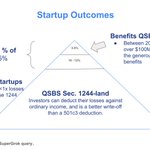
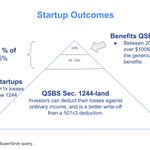
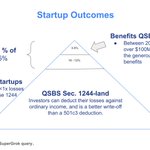
Everyone is now writing about QSBS Sec. 1202, which was made even MORE generous for those few investors that won the 'venture lottery'. However, only approx. 3 - 5% of investors in startups will actually benefit. Yet the original QSBS law - Sec. 1244 - impacts more startups' fundraising and early investors' opportunity to de-risk their investment. Yet QSBS Sec. 1244 hasn't been modernized since 1978. Is this just a lack of awareness from our Policy-makers, or is it the impact of lobbying by vcs?
37
More great work by @credistick.
"All models are wrong, but some are useful" The post quoted below has ruffled enough feathers to require further explanation: TL;DR for the lazy: The implication is simply that a trend towards larger portfolios is likely to lift the median to top quartile performance of venture capital. This is a general observation, not a recipe for success. Nobody is trying to make the case that diversification is always and strictly better, or vice-versa. Before going further, I think this quote (and the others below) from Daniel Kahneman summarises many of the responses: "What we told the directors of the firm was that, at least when it came to building portfolios, the firm was rewarding luck as if it were skill. [...] The illusion of skill is not only an individual aberration; it is deeply ingrained in the culture of the industry. Facts that challenge such basic assumptions — and thereby threaten people’s livelihood and self-esteem — are simply not absorbed. The mind does not digest them. This is particularly true of statistical studies of performance, which provide general facts that people will ignore if they conflict with their personal experience." (source: "Don't Blink! Hazards of Confidence") Unequivocally true: Portfolio construction is a poorly understood topic, and too many GPs (and LPs) blindly follow the common wisdom about concentration without giving it proper thought. There are factors the model cannot represent as a simple reflection of probabilities, and many of them are counter-intuitive or require deep analysis: For example: - Overconfidence is the most well-studied bias in investing, and is endemic to venture capital. It is a large part of what leads the majority of investors to believe they can pick well and concentrate. More here: xitter.gq/credistick/status/1940… - Overconcentration manifests as broadening the distribution of returns with a negative skew. That's exactly what we see in VC: it has the widest distribution of returns and the worst median. More here: xitter.gq/credistick/status/1939… - Diversification is shown to benefit fund performance by enabling investors to take more idiosyncratic risk per investment, which is fundamentally the source of outperformance. Concentration drives consensus. More here: xitter.gq/credistick/status/1934… A lot of the group-think around concentration versus diversification is based on the assumption that concentrated firms must be better at picking because they spend more time per investment. This is fundamentally untrue, as is described in Kahneman's article. When faced with difficult judgements on limited information, people will habitually change the question to something simpler. That is, if investors spend more time on decisions where that extra time doesn't actually yield access to more useful information, they're likely to construct a process that produces greater confidence rather than greater accuracy. "The confidence we experience as we make a judgment is not a reasoned evaluation of the probability that it is right. Confidence is a feeling, one determined mostly by the coherence of the story and by the ease with which it comes to mind, even when the evidence for the story is sparse and unreliable. The bias toward coherence favors overconfidence. An individual who expresses high confidence probably has a good story, which may or may not be true." In venture capital this typically manifests as overconfidence in founder-focused human capital, which produces predictably bad investments (and missed good ones). More here: xitter.gq/credistick/status/1844… The distribution of outcomes in venture capital, and the unpredictability of those outcomes, means it is fundamentally a portfolio discipline more than it is a picking discipline. The only point at which that changes is when an investor has enough genuine experience to consistently beat the odds — which is very rare. Just as every pitch to LPs somehow demonstrates top quartile performance, every investor believes they can beat the odds. ~90% of VCs lose that fight. Finally, there is another important element to this portfolio construction question: reserves. I don't have anything written on this topic (yet), but I know two people who have: First is @AngelSpanInc's brilliant paper on 'Process Alpha' in venture capital. Essentially, his proposition is that a diversified portfolio with a robust follow-on strategy can reap the benefits of both strategies: broad exposure to more potential outliers, and the ability to concentrate. It is represented in the diagram below. "Poker players and statisticians sorted this out years ago, and the economics of gambling and venture capital are similar: If you are wrong (particularly at the seed stage of investing), you lose all your money. A recognized optimization framework that is instructive as to how much investor capital to deploy at each stage of the startup life cycle (or funding round) is called the Kelly Criterion, also referred to as 'The Scientific Gambling Method'" (source: "Process Alpha: How to Construct and Manage Optimized Venture Portfolios") Another great read on this topic is from @LauraLPThompson of @SapphirePrtnrs. It covers multiple angles on reserve strategies, with some interesting math, but there's one particular quote that is relevant to this theme: "Reserve dollars have to be concentrated into winners to improve fund performance and there usually aren’t many of them. Early-stage venture remains a power-law business, and many portfolios come down to one or two winners." (source: "Dirty Secret: Venture Reserves are Not Always a Good Thing") To conclude a post that is already too long: "Diversification versus concentration" is a complex and multivariate question. There is no "right" answer, and certainly not one that can be reached by a simple model of distributed outcomes. However, the general understanding of this topic and the underlying factors is shockingly poor, which speaks to the institutional insecurity of venture capital and the unwillingness to engage in self-scrutiny. If you are a GP, you owe it to your LPs to be a student of venture capital. Read the research, familiarise yourself with the data. Build a well-informed and rational strategy. Do not engage in group-think. If you are an LP, you are paying GPs significant management fees to invest your money. Learn how to find competent investors, and then don't get in their way if they have a rational strategy. Beware anyone who blithely dismisses questions like these; they are charlatans. To finish with another great quote from Kahneman: "In general, however, you should not take assertive and confident people at their own evaluation unless you have independent reason to believe that they know what they are talking about. Unfortunately, this advice is difficult to follow: overconfident professionals sincerely believe they have expertise, act as experts and look like experts. You will have to struggle to remind yourself that they may be in the grip of an illusion."
1
4
124
Great quote.
the more ambitious you are, the harder it is to feel proud of anything you’ve done
1
44
You need to know WHAT the data is telling you, regardless of how it was collected/availed. This has been well settled in the public investing markets. More data doesn't improve outcomes. The right data, in the right hands, does. That last part will always be the most important component of decision-making. Not how easy it is to accumulate data.
Bob McGrew (Head of Research OpenAI) explains why proprietary data no longer provides companies with a competitive advantage in the AI era. Finance companies once believed their years of accumulated data would give them an edge. They planned to train specialized models on top of GPT or Llama using their exclusive information. The results shocked them. Their industry-specific models performed worse than the next generation of general purpose models. The ability to synthesize new information proved more valuable than memorizing old data. McGrew introduces the concept of "embodied labor" - the human work behind data collection. Companies spent years having employees call customers, analyze case studies, and gather information through manual processes. This accumulated knowledge required massive time and money to build. It represented thousands of hours of human effort that companies thought couldn't be replicated by competitors. But AI changes everything. Instead of years of customer calls, AI can conduct comprehensive surveys instantly. Rather than manual case analysis, AI processes thousands of examples in hours. The core insight is that value wasn't in the data itself but in the labor required to collect it. Since AI makes that labor essentially free, the advantage disappears. Companies can no longer rely on their proprietary data as a protective moat. Any competitor can use AI to replicate years of data gathering almost instantly.
1
70
But still no movement on indexing QSBS Sec. 1244 to inflation. This would impact FAR more startup and investors than tweaking Sec. 1202.
What you need to know about the proposed QSBS expansion (Senate draft ⚖️ June 2025) It's not a rewrite of QSBS, but it could reshape exit timing & fund economics in the following ways: 1️⃣ Tiered holding periods: • 3 yrs ➡️ 50% of gain excluded • 4 yrs ➡️ 75% • 5 yrs ➡️ 100%
1
68
I'm shocked...JUST SHOCKED...that echo chambers fail.
Welcome home to the true global town square!
43
Power corrupts, and absolute power corrupts absolutely. But I could be wrong...
"The thing that you want from your venture firm is power."
1
32
Show me the incentives, I'll show you the behavior. Simply change the incentives (rules) to change the game on the field. Better portfolio construction/risk management (QSBS, diversification, dollar cost averaging) eliminates Power Law pursuit incentives, attracts different capital, and supports more diverse entrepreneurial behaviors.
VC has become a massive big money, high stakes, high risk, high burn rate game. And you cannot opt out. It’s the game on the field.
44