

Writing for @TheEconomist | More at https://xitter.cf/t.co/qPYdNie0jd
London, DC and sometimes NY
Joined February 2011
- Tweets3.8K
- Following3.5K
- Followers10.7K
- Likes7K





Archie Hall retweeted

Quite a way to make a splash in a new job: The Economist's (relatively) newly appointed US business correspondent @saviyonah interviewed Sam Bankman Fried for an episode about effective altruism, down the phone from federal prison.
economist.com/podcasts/2026/…

Archie Hall retweeted

On our “Checks and Balance” podcast, @ArchieHall travels to Ohio to hear voters’ concerns about data centres economist.com/podcasts/2026/…

Archie Hall retweeted

Throwing a Works in Progress launch party that coincided with an air show over San Francisco Bay was really fun!
There is basically no hedonic adjustment to fighter jets soaring past your window.


Huge turnout for the @WorksInProgMag Issue 26 Launch Party last Sunday in San Francisco.
Thank you @cosmos_raj for the photos!


Archie Hall retweeted

New essay: To keep human judgment, we need AI courts.
AI-generated filings are starting to overwhelm courts around the world.
The most popular response I’ve heard is to fight AI with AI: If we can just give judges the right tools and training, AI will help them keep pace.
But this strikes me as the worst of both worlds.
Because we want human judges in the loop, we don’t get the speed and scale benefits of AI. Yet because we expect them to resolve a massive number of cases quickly, judges (or their clerks) may end up leaning on AI more than they mean to or should.
This essay offers another way: a parallel AI adjudication track.
An AI track — inspired by AI use in private arbitration but formally part of the court system like magistrate judges — would let courts be explicit about how human judgment is allocated.
Done right, this would allow courts to process large volumes of cases while ensuring human judges devote their full attention to the cases where their judgment is needed most.
Read more in @PaxMachinaMag: paxmachina.ai/to-keep-human-…

Archie Hall retweeted

on the latest podcast episode, Archie Hall, acting Economics editor, discussed how the magazine is approaching the rise of democratic socialism.
Archie Hall retweeted

**NEWS**
I have started a substack, as a vehicle to tell you about my new FT columns and podcasts, as well as the odd song.
You can sign up here: soumayakeynes.substack.com/p…
Archie Hall retweeted

New research: we hired 12 CPAs to complete four realistic accounting tasks, then had AI models from the past few years complete the same work.
As of May 2025, accountants outperformed AI. Now they lose out to today's frontier models, which are near perfect on these tasks. 🧵

Archie Hall retweeted

'Gingerbread men with chocolate trousers incur value-added tax (VAT) worth 20%, but no tax is charged on those with chocolate only for their eyes.'
Britain's taxes aren't unusually high - but they are freakishly complex, @TheEconomist says: economist.com/britain/2026/1…

Archie Hall retweeted

The Economist editor @ArchieHall says Britain may have built itself into one of AI’s easiest economic targets by relying on service exports while lagging at adopting technology:
"I'm pretty concerned about where Britain could end up, and I think that's evocative of where a lot of non-US rich world economies could end up in a world where AI is more economically disruptive."
"You have an economy that's very, very services exports dependent. Law, finance, insurance. And it's not a vastly dynamic economy. It's not been incredibly successful adopting technology over the past couple decades."
"More nimble AI-enabled competitors could very, very easily eat away at the export base of a lot of those services companies that really power the British economy."
"Britain does have a pretty strong AI sector, but it's not huge, and most of the British economy is things that are not AI and things that are pretty bad at adopting tech."
@TheEconomist

I am increasingly frustrated about the state of conversation about AI in the UK. It feels like we are in never ending cycles of deluded thinking. Under current trends, Britain will be defenceless against the transformative effects of AI and have no leverage over development at the frontier.
We are the most exposed economy to AI in the world. We have very little data centre capacity and few credible plans to expand – and our high energy costs mean we would struggle to even if we tried.
I am publishing a paper today on what the UK should do to build that leverage, let the economy capture value from AI and prepare the state to adapt, however AI develops.
The three strategies are as follows:
1. Build the infrastructure that gives us leverage. Fix the grid, fix planning, make Britain a place frontier AI can run.
2. Let the economy capture the value of AI. Reform the regulatory, labour and talent barriers that stop British firms adopting AI.
3. Build a state that can adapt to a changing world. Build a tax base that survives the labour market changing, public services that use AI to deliver better, and capacity to weather the upcoming geopolitical storms.
Two years ago, we published a similar report on AI - many recommendations of which ended up in the action plan. I remember feeling hopeful, but sadly the fundamental problems facing the country on AI have not shifted. I truly hope that this week of momentum culminates in action. There’s still a narrow path for the UK, but everyday that path is narrowing.


Archie Hall retweeted

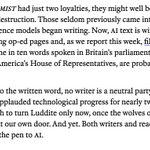
Would you push yourself to read all the way through an essay or book if you thought AI had written it?
@ArchieHall on how AI writing frays the contract between writer and reader.
(Archie, I read your piece to the end)

New @TheEconomist leader from me on the perils of AI writing—and why readers, not writers, are the victims to worry about. (Link ⬇️)

Archie Hall retweeted

Interesting that the U.S. senate seems mostly spared from AI speeches, something to do with larger offices, higher average staffers quality, or more media coverage of what’s said on the Senate floor?
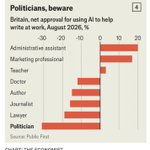
My latest for @TheEconomist: AI writing is taking over politics.
10% of what was is said in Parliament is now AI-drafted, per Pangram. Yet more in the House of Representatives, or in Australia and Canada.
Link: economist.com/britain/2026/0…
And a 🧵 below, w/ some main offenders


Archie Hall retweeted

the very very very short march through the institutions
My latest for @TheEconomist: AI writing is taking over politics.
10% of what was is said in Parliament is now AI-drafted, per Pangram. Yet more in the House of Representatives, or in Australia and Canada.
Link: economist.com/britain/2026/0…
And a 🧵 below, w/ some main offenders
Archie Hall retweeted
I understand this framing (and have probably written headlines along similar headlines in the past) but there is something wrong with it.
Low growth is only secondarily a problem for the PM - much more importantly, it is a problem for the people of Britain!!!

Archie Hall retweeted

Agree that this is an interesting & helpful analysis. I don't think however it's dispositive that fiscal & AI are *not* factors in recent rate rises. FOMC speeches & jobs data may instead be catalyzing volume events that force investors to "catch up" on lots of new information.

A TANTALIZING ANSWER TO THE BIGGEST MACRO QUESTION SINCE COVID
In today's newsletter, I argue that @timwillems85, Paolo Cavallino, and Paul Beaudry have published an important intervention in the ongoing debate about the post-Covid surge in interest rates.


Archie Hall retweeted

Remarkable how people will just make up things like, “Europe doesn’t have data centers because they can’t securitize them.”
Lots of American data center builders are active in Europe. Fluidstack pulled out of France and OAI out of Britain because permitting and time-to-power were too slow. In places where those problems don’t exist — i.e. Scandinavia — lots of stuff is getting built.
European data center builders will complain about “financing,” but what they mean is that, under the prevailing political, permitting, and energy environment, no one wants to buy the damn things!


Archie Hall retweeted
The problem with big money in British politics is that there isn't enough of it
@TheEconomist says this week that liberals who are outraged about Reform's cash bonanza should dig into their own pockets
Better funding is crucial to prepare opposition parties for power

Archie Hall retweeted

Just to update this chart:
1) AI salience has increased dramatically in the past week - increasing as much in the last week as the previous year combined
2) 80% of voters think it's either very or somewhat likely that AI will cause widespread job loss in the five to ten years
3) 64% of voters think it's either very or somewhat likely that AI could pose a threat to humanity's survival
4) Large bipartisan majorities back immediate government action on AI even when primed about risk from China


Archie Hall retweeted

Quite.
I'd presumed post-election claims that, having "opened the books", the PM and ChX suddenly discovered a fiscal "black hole" was purely cynical.
This report suggests something more worrying about our new leaders. How could anyone with even a passing interest not be aware?


RT @SonnyTLoughran: For this week’s cover package I wrote about Islamism in Britain - issue I do think is worth worrying about, not least b…